Languages
Friday, November 27, 2026



News and Views from the Global South
Food and Agriculture

Moving Towards a Food-Secure Ghana
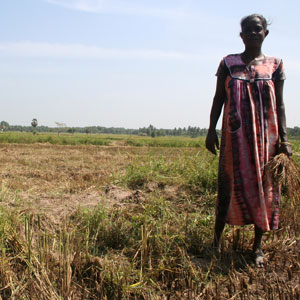
In Dundo village in Nyankpala district, Northern Ghana, 10 women are busy weeding a rice field on a piece of land donated to them by the village chief.
AGRICULTURE-BOLIVIA: Adapting to the Floods
Margarita Amabeja holds out her hands full of golden rice grains and rough brown manioc roots - the first results of a strategy to adjust the agricultural cycles to the seasonal floods and droughts in the vast plains of Beni, in northeastern Bolivia.
CLIMATE CHANGE: Waiting for the “Heavens to Weep”
Duduzile Sibanda takes a break from preparing her long stretch of land for her maize crop in rural Mberengwa, in Zimbabwe’s Midlands province. She wipes her brow under the scorching sun and looks upwards. The sparse clouds are a cause of concern as she studies the sky and wonders aloud when the "heavens will weep."Chinese Village Besieged After Protests
A standoff between villagers and police is continuing in southern China, where police have sealed off the village of Wukan in an attempt to quell an uprising, witnesses say.INDIA: More Suicides Than Reforms
Five years ago, Pulparambil Varghese began cultivating ginger on 1.37 acres of land he owned in Thrikkeppatta village near Kalpetta town in Wayanad district of the southern Indian state of Kerala. Over the years, he borrowed 300,000 rupees (5,700 dollars) from banks and private financial institutions.
CLIMATE CHANGE-BRAZIL: Contradictory Goals in Agriculture
Brazil aims to meet its climate change targets in agriculture by stimulating techniques that have been proven to reduce greenhouse gas emissions – but which may increase the use of toxic agrochemicals, activists say.
MEXICO: Saving Native Seeds to Protect Food Heritage
When Guadalupe Ortiz planted gardens in Mexico, she was struck by the importance of saving and preserving the seeds, and decided to do something about the problem of seed supply.Decent Work Key to Food Security
Basic income security and access to social services can improve food production and consumption in the developing world, which can be boosted by South-South cooperation.
ARGENTINA: Poison from the Sky
Argentina's soy boom has been a major source of foreign exchange. But the other side of the coin is the toxic effects among the rural population, from spraying agrochemicals.
KASHMIR: Saffron and Silk Wither in the Valley
The saffron and silk industries in Kashmir have been dying a silent death over the last decade, with production rates for both commodities witnessing up to 50 percent declines in some areas of the Kashmir Valley.
HONDURAS: Indigenous Cooperatives Cultivate Success
Thanks to the quality and freshness of their produce, indigenous Lenca farmers in western Honduras are regular suppliers of seven supermarket chains. This year they won the National Environmental Prize, in the community initiatives category.
Q&A: “Investing in the Fight against Hunger Brings Extraordinary Returns”
The man who played a key role in the design of Brazil's successful food security policies believes it is possible to eradicate hunger in the world, and intends to try by promoting "a simple idea."
At the Nexus of Agrofuels, Land Grabs and Hunger – Part 2
The forests in Africa absorb over 1.2 billion tonnes of carbon annually. With these diverse and natural forests, grasslands and prairie lands disappearing under investment schemes and the development of monoculture plantations for supposed "green" energy alternatives like agrofuels, not much else remains to absorb the shocks of hunger and climate change.
At the Nexus of Agrofuels, Land Grabs and Hunger – Part 1
While the United Nations climate talks in Durban enter their ninth day of political feet-dragging, researchers and peasants around the world are busy connecting the dots between so- called "green climate solutions", industrialised agriculture and chronic hunger.
CLIMATE CHANGE: Biofuels Are Not the Solution
Science tells us that we are heading for a climate crisis, yet it is within our means to change course.
Q&A: Time for a New Agricultural Revolution
Negotiators at the 17th Conference of Parties owe it to the world's more than seven billion people to deliver a deal with a work plan for agriculture, a sector that is expected to be the worst affected by climate change.
Climate Change Killing Womens’ Livelihoods
Talata Nsor, a 54-year-old woman from Bolgatanga community in Northern Ghana, has been weaving the cultural Bolga baskets, which are named after her community, her entire life.
A Recipe for Carbon Farming
Civil society has warned of the danger of turning Africa's food-producing lands into "carbon farms" so that rich countries can avoid making cuts in their carbon emissions.
No Agriculture, No Deal
Zambian dairy farmer, Effatah Jele, does not believe in farming luck but in pragmatism because of climate change.
OP-ED: Can Finance Provide the Crown Jewels of a Durban Climate Accord?
As climate talks get underway in Durban, South Africa this week, progress on a Green Climate Fund is one of the hottest, most contentious tickets in town. It is also one of the great prizes to be won.
EUROPE: Co-ops Off to a Promising Start
A small wave of consumer cooperatives is rising in Central and Eastern Europe, attempting to provide food that is locally produced and healthy, and to build conviviality.« Previous Page — Next Page »


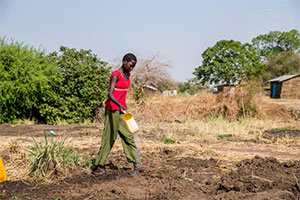 Farming on the Outskirts of Juba. Credit: UN Photo/JC McIlwaine
Promoting human and planetary health is a central focus of the United Nations, as laid out in the 2030 Sustainable Development Goals (SDGs). World hunger and unsustainable farming practices continue to be pressing concerns for the world. According to the 2025 State of Food Security and Nutrition in the World report by the Food and Agriculture Organization (FAO), 673 million people faced hunger in 2024. There are stark regional disparities, with the FAO projecting that 60% of the world population facing hunger will reside in Africa by 2030. Globally, the prevalence of food insecurity has remained consistently higher for women than men.
Sustainable and efficient national food systems are essential in preserving health, education, environmental well-being, peace, economy, and security. However, creating sustainable food systems can be a challenging endeavor, as food production takes a heavy toll on the environment. The agricultural sector accounts for a significant portion of greenhouse gases. Finding safe, sustainable, and ethical strategies to feed the world is crucial in ensuring planetary longevity. A recent initiative from 2023, the EU Regulation on Deforestation-free Products (EUDR), seeks to advocate for sustainable food systems. The main driver of deforestation is the expansion of agricultural land used to produce commodities like cattle, wood, cocoa, coffee, etc. The EUDR is part of the 2020 European Green New Deal and the EU Biodiversity Strategy for 2030 and aims to limit Europe’s consumption of products linked with deforestation by requiring that companies prove that their products are deforestation-free. Despite aiming to achieve major strides in sustainability, policies such as EUDR also raise socioeconomic concerns for targeted countries. Many emerging Latin American economies are impacted by the policy, and have raised the question of how developing countries can grapple with the tensions between economic development and advancing sustainability.
IPS has been at the forefront of providing compelling and insightful stories on communities facing hunger as well as the cost of food production. IPS uses statistics from FAO, the World Food Programme (WFP) and the International Fund for Agricultural Development (IFAD) to bring relevant and hard-hitting facts to readers. This gathering of information and data from such organizations helps bring the best stories from IPS journalists working in the different regions in consultation with experts on the ground.

The Week with IPS

NEXT STOP - SDGs
Tracking global progress towards a sustainable world