Languages
Saturday, November 21, 2026



News and Views from the Global South
Green Economy

Calls for an African Green Revolution, Only Smarter
To deal with looming food crises in the coming decades, Africa needs a Green Revolution on par with what took place in Asia during the 1960s and 1970s, according to experts in Washington.
Ahead of Rio+20, “The Economy is Already Turning Green”
While governments make a last desperate attempt to agree on a plan of action for next week's Rio+20 summit on sustainable development – including plans on the transition to a green economy and a set of sustainable development goals – the real economy is already turning green, according to Italy’s minister of environment, Corrado Clini.
RIO+20: A Stalemated U.N. in Do-or-Die Session on Action Plan
After weeklong negotiations, a meeting of the Preparatory Committee (PrepCom) to finalise a plan of action titled "The Future We Want" for next week's Rio+20 summit has failed to reach agreement - and deferred a decision to a final three-day session in Brazil.
24 Policies to End the Earth Emergency
Ecologically ignorant policies are largely responsible for the interlinked crises that are unraveling the planet's life support system.
Expo 2012 Shadows Rio+20 on Sustainable Oceans
When the U.N. Conference on Sustainable Development (UNCSD) takes place in Brazil next week, it will be closely shadowed by another event thousands of kilometres away in the South Korean coastal town of Yeosu: Expo 2012.
RIO+20: Earth Summit Negotiated the Size of the Zero
Amidst much political fanfare, the 1992 Earth Summit in Rio de Janeiro concluded with the adoption of the Rio Declaration on Environment and Development and the landmark Agenda 21 blueprint for a sustainable future in the 21st century.
Human Activity and Climate Change Threaten Tourism in Jamaica
Experts here fear that that the impact of climate change on Jamaica's fragile ecosystems will worsen the ravages of human activity and destroy the country's tourism industry.
When Energy Begins to Flow Long Distance
With rising energy prices and stringent requirements for producing a higher proportion of energy from renewable sources in the near future, long-distance electricity cables are increasingly thought of as a viable option for providing electricity.
“Land Is Our Ally, But Its Patience Is Not Eternal”
Land degradation poses a threat to all life on Earth including humanity. To stop the enormous loss of life-giving land, the United Nations Convention to Combat Desertification (UNCCD) is pushing for a sustainable development goal of Zero Net Land Degradation (ZNLD) to be adopted at the upcoming Conference on Sustainable Development, known as Rio+20, in Brazil.
For an Ailing Planet, the Cure Already Exists
The planet's climate recently reached a new milestone of 400 parts per million (ppm) of carbon dioxide in the Arctic.
Rio+20 – a Call to Responsibility, a Call to Action
We are all going through a period of great confusion and uncertainty.
Time for a More Sustainable Global Food System
It is vitally important that governments and civil society organisations start transitioning to a more sustainable global food system in order to achieve lasting development.
Cultivating Food Security in Their Own Backyards
Misradi, a 58-year-old farmer from the Jelok neighborhood in Pacitan, East Java, some 524 kilometres east of Jakarta, has found a way to reduce his monthly expenses by 30 percent: instead of buying produce from the local market, he and his family now harvest most of their vegetables from their own yard.
Biomass Plantations Can Power India
Valli, 50, and Sarasu, 60, have been working with Energy Plantation Projects India (EPPI) since inception in 2007, the income they earn forming an integral part of their household budgets. "We easily manage household work and a salary-paying job," they tell IPS.
A Future With Food, or No Future At All
The upcoming Rio+20 Conference on Sustainable Development will not succeed if the crises of hunger and malnutrition are not effectively addressed. The issues are so inextricably linked with sustainable development that they have to be part of the agenda, according to a report released Wednesday by the United Nations Food and Agricultural Organisation (FAO) for the upcoming Earth Summit that will take place in Rio de Janeiro from Jun. 20-22.
Climate Change and Family Planning – Twin Issues for LDCs
The reproductive rights agenda, from improving women’s access to education to systematic family planning to reducing birth rates and combating poverty, has become a cornerstone of most industrialised nations’ development policies toward the least developed countries (LDCs), comprised primarily of sub-Saharan African states.
Q&A: North-South Divide Looms Heavily Over Rio+20 Summit
The 1992 Earth Summit in Rio de Janeiro was to a large extent derailed by a North-South divide: a battle between a coalition of rich industrial nations versus the world's developing countries led by the Group of 77.
Rio+20 is Everyone’s Conference
The United Nations Conference on Sustainable Development, otherwise known as Rio+20, is a once-in-a-generation opportunity.
Rural Women in Peru Key to Adaptation of Seeds to Climate Change
For ages, rural women in the Peruvian highlands have been selecting and storing seeds, ensuring their preservation. But the authorities have failed to tap into this storehouse of knowledge and experience, despite the contributions it could make to the design of effective policies for adaptation to climate change, which poses a growing threat to the women’s livelihoods.
‘Green Economy’ – New Disguise for Old Tricks?
Though the current global economic and financial crises are undoubtedly devastating much of the world, they present the perfect opportunity for remodeling our economic system, according to participants at the ninth annual Terra Futura (Future Earth) exhibition of ‘good practices’ in social, economic and environmental sustainability held here from May 25-27.
Q&A: A Green Economy Without a Pricetag on Nature?
As thousands gear up for the 2012 Earth Summit, Rio+20, scheduled to kick off in Brazil on Jun. 20, questions on the viability and adequacy of a ‘green economy’ abound.« Previous Page — Next Page »


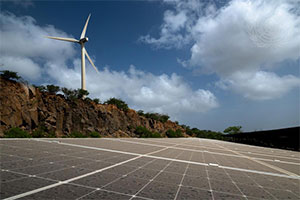 Renewable Energy in Cabo Verde. Credit: UN Photo/Mark Garten
A green economy is an economic model that aims to reduce environmental risks and build a sustainable future. Many of the UN SDGs seek to facilitate a green economy, such as ensuring access to affordable and reliable clean energy, building sustainable cities and communities, and implementing urgent action to combat climate change. Various key negotiations have strived to achieve a green economy, such as the Green New Deal and the Inflation Act of 2022. COP30, held in Belém, Brazil in 2025, agreed to mobilize $1.3 trillion annually for climate action and launched the Belém Mission to 1.5°C. However, the conference was not able to develop a fossil fuel reduction roadmap. Recent years have witnessed a sharp transformation in the geopolitical landscape of international sustainability cooperation. In March 2025, the United States stepped back from formal multilateral support for the SDGs, while China is on the rise as an international leader in renewable energy production. The actions of these global powers may shape shifting alliances on environmental governance. IPS is dedicated to sharing timely news on international developments in building a sustainable future.

The Week with IPS

NEXT STOP - SDGs
Tracking global progress towards a sustainable world
Tracking global progress towards a sustainable world
