Languages
Monday, November 9, 2026



News and Views from the Global South
Labour

Will Myanmar’s ‘Triple Transition’ Help Eradicate Crushing Poverty?
 Myanmar is never out of the news for long. This has been the case since a popular uprising challenged military rule in 1988. For over two decades, the country was featured in mainstream media primarily as one unable to cope with its own internal contradictions, a nation crippled by military rule.
Will Myanmar’s ‘Triple Transition’ Help Eradicate Crushing Poverty?
Myanmar is never out of the news for long. This has been the case since a popular uprising challenged military rule in 1988. For over two decades, the country was featured in mainstream media primarily as one unable to cope with its own internal contradictions, a nation crippled by violence.
Inequality in Mexico Is All About Wages
Sandra G. works Monday through Saturday in a beauty salon on the south side of Mexico City, where she earns slightly more than the minimum wage, which in this country is just five dollars a day.
True Gender Equality for Both Women and Men
Numerous international and national efforts have focused on gender equality and the empowerment of women. The United Nations, for example, has convened four world conferences on women - Beijing in 1995, Nairobi in 1985, Copenhagen in 1980 and Mexico City in 1975 - and Member States have adopted various international agreements, such as the Beijing Declaration and Platform for Action and the Convention on the Elimination of All Forms of Discrimination against Women (CEDAW).
Can China’s Silk Road Vision Coexist with a Eurasian Union?
There is a good chance that economic jockeying between China and Russia in Central Asia will intensify in the coming months. For Russia, Chinese economic expansion could put a crimp in President Vladimir Putin’s grand plan for the Eurasian Economic Union.
G20 Seeks to Streamline Private Investment in Infrastructure
Industrialised countries have agreed to collaborate on a new programme aimed at funnelling significant private-sector investment into global infrastructure projects, particularly in developing countries.
25 Years After Rights Convention, Children Still Need More Protection
Next week marks 25 years since the adoption of the Convention on the Rights of the Child, a historic commitment to children and the most widely accepted human rights treaty in history.
How a Small Tribe Turned Tragedy into Opportunity
When the Asian tsunami washed over several Indian Ocean Rim countries on Boxing Day 2004, it left a trail of destruction in its wake, including a death toll that touched 230,000.
Braving Dust storms, Women Plant Seeds of Hope
In the world’s largest refugee complex – the sprawling Dadaab settlement in Kenya’s North Eastern Province – women listen attentively during a business management workshop held at a hospital in one of its newest camps, Ifo 2.
As TPP Trade Talks Miss Third Deadline, Opponents Claim Momentum
For the third year in a row, government negotiators for 12 Pacific Rim countries have missed an internal deadline to reach agreement on a controversial U.S.-led trade deal.
More Economic Equality Brings Greater Political Polarisation in Brazil
“If I had to choose today I would stay back home, I wouldn’t come to look for work here,” said Josefa Gomes, who 30 years ago moved from Serra Redonda, a small town in Brazil’s semiarid northeast, to the city of Rio de Janeiro, 2,400 km away.
More Women Managers in Argentina, But They’re Still Doing the Chores
In Argentina there are more and more women in management-level positions in the public and private sectors, although they still have to forge their way amidst gender stereotypes, while shouldering the double burden of home and work responsibilities.
El Salvador Restores Biodiversity in the Face of Climate Change
Carlos Menjívar has been ferrying people in his boat for 20 years in this fishing village in western El Salvador surrounded by ocean, mangroves and wetlands, which is suffering the effects of environmental degradation.
Inside Pakistan’s Untapped Fishing Industry
If you want to know what ‘sea traffic’ looks like, just go down to the Karachi Harbour. Built in 1959, the dockyard houses close to 2,000 big and small boats anchored in the grey sludge at the edge of Pakistan’s southern port city, which opens into the Arabian Sea.
U.N. Favours Changeover from Landlocked to ‘Land-linked’
Some 440 million people are living in 32 countries that are among the world’s poorest, most of them least developed, and geographically isolated from world markets not only because they have very few commodities to export, but also because they have no direct territorial access to the sea.
Kyrgyzstan’s Teachers Quitting to Take Better Paying, Unskilled Jobs
Minovar Ruzieva, 38, was an English teacher in Osh until last summer. The mother of four now sells Chinese clothes at a local bazaar. Like many other teachers in Kyrgyzstan, she could not survive on her “scant salary,” so she took unskilled work to make ends meet.
Inside Pakistan’s Untapped Fishing Industry
If you want to know what ‘sea traffic’ looks like, just go down to the Karachi Harbour. Built in 1959, the dockyard houses close to 2,000 big and small boats anchored in the grey sludge at the edge of Pakistan’s southern port city, which opens into the Arabian Sea.

OPINION: One Mexico, or Many?
Mexico can charm, irritate, wound, inspire and confuse the casual visitor as well as the informed researcher. But no one is ever left indifferent by it. Mexico leaves an indelible mark.
Child Poverty in Spain Seen Through the Eyes of Encarni
“I would like to have a big house, and I wish my family didn’t have to go out and ask for food or clothes,” Encarni, who just turned 12, tells IPS in the small apartment she shares with five other family members in a poor neighbourhood in the southern Spanish city of Málaga.
Another Women’s Treaty? Implement Existing One, Say NGOs
Can violence against women be prevented or eliminated with a new international treaty signed and ratified by the 193 member states of the United Nations?Canada Accused of Failing to Prevent Overseas Mining Abuses
The Canadian government is failing either to investigate or to hold the country’s massive extractives sector accountable for rights abuses committed in Latin American countries, according to petitioners who testified here Tuesday before an international tribunal.« Previous Page — Next Page »





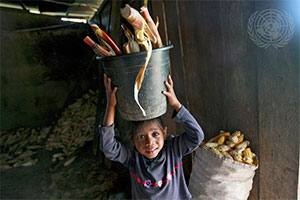 Timorese Girl with Fresh-Picked Corn. Credit: UN Photo/Martine Perret
A global common denominator is the need for a decent job. The economic realities of each country determine just how difficult it is to find one. Despite the labour movement's achievements, serious challenges persist: gender discrimination, child labour, worker migration, the digital divide and AI automation, evaporating pensions, unsafe workplaces, corporate pressure against union organising, negative impacts of trade agreements, and the precariousness of informal employment. The 2025 UN SDG Report identifies jobs and social protections as one of the six priority areas requiring urgent action, with progress either stalled or reversing in many developing nations.
In recent years, the fight to protect labour equality has taken on new dimensions with the rise of Environmental, Social and Governance standards. With the Social aspect aiming to promote equality and human rights, ESG principles have strengthened labour advocacy within corporate and governmental regulatory landscapes. In particular, ESG has become much more institutionalized in emerging economies such as Brazil and China. IPS follows the world’s workers as they confront these challenges - their setbacks and their successes.

The Week with IPS

NEXT STOP - SDGs
Tracking global progress towards a sustainable world
Tracking global progress towards a sustainable world
