Languages
Tuesday, November 10, 2026



News and Views from the Global South
Labour

Crisis Fuelled Resurgence of Horse-Drawn Carriages in Cuba
Up and down the streets of towns and cities in Cuba go horse-drawn carriages with black leather tops and large back wheels, alongside more simple carts, operating as public transportation.
OPINION: Towards an Inclusive and Sustainable Future for Industrial Development
As representatives of the United Nations Industrial Development Organization (UNIDO), we are sometimes asked whether industrial development is still relevant to a world which many observers have claimed over the past decades to have entered the “post-industrial age”. Our answer is always an emphatic “yes”, shaped both by the evidence of history and current events.
The Invisible Reality of Spain’s Homeless
“It’s easy to end up on the street. It’s not because you led a bad life; you lose your job and you can’t afford to pay rent,” says David Cerezo while he waits for lunch to be served by a humanitarian organisation in this city in southern Spain.
How Long Before Another Soma Mine Disaster?
Six days a week, Tahir Cetin spends seven and a half hours hundreds of feet underground on a narrow ledge, mining coal near Soma, Turkey. He breathes in dust that is destroying his lungs, and digs into walls that could collapse on top of him. With one false step, he could fall to his death.Central Asia Hurting as Russia’s Ruble Sinks
Pensioner Jyparkul Karaseyitova says she cannot afford meat anymore. At her local bazaar in Kyrgyzstan’s capital, Bishkek, the price for beef has jumped nine percent in the last six weeks. And she is not alone feeling the pain of rising inflation.
Añelo, from Forgotten Town to Capital of Argentina’s Shale Fuel Boom
This small town in southern Argentina is nearly a century old, but the unconventional fossil fuel boom is forcing it to basically start over, from scratch. The wave of outsiders drawn by the shale fuel fever has pushed the town to its limits, while the plan to turn it into a “sustainable city of the future” is still only on paper.
U.S. Revisiting “Broken” Workplace Chemicals Regulation Process
The U.S. government will soon begin receiving public suggestions on how federal regulators should update their oversight of toxic chemicals in the workplace.
OPINION: Innovation Needed to Help Family Farms Thrive
Family farms have been contributing to food security and nutrition for centuries, if not millennia. But with changing demand for food as well as increasingly scarce natural resources and growing demographic pressures, family farms will need to innovate rapidly to thrive.
OPINION: The Survivors
Oct. 18 is the EU’s Anti-Trafficking Day, as well as the United Kingdom’s Anti-Slavery Day. These events offer a good opportunity to talk about human trafficking within Europe’s borders, but we should not forget that there are victims and survivors all over the world.
Civil Society in Cuba Finds More Space Under the Reforms
Cafés, real estate agencies, taxis and other small privately-owned businesses and cooperatives in Cuba have brought new life to the depressed local economy and have given rise to pockets of prosperity in the country’s towns and cities.
Ahead of Myanmar Trip, Obama Urged to Demand Extractives Transparency
Lawmakers here are urging President Barack Obama to put transparency in the extractives sector at the centre of an upcoming trip to Myanmar.
Vanuatu Puts Indigenous Rights First in Land Reform
Stemming widespread corruption in the leasing of customary land to investors is the aim of bold land reform, introduced this year in the Southwest Pacific Island state of Vanuatu, which puts the rights of traditional landowners above the discretionary powers of politicians.
Curbing the Illegal Wildlife Trade Crucial to Preserving Biodiversity
For over five years, 33-year-old Maheshwar Basumatary, a member of the indigenous Bodo community, made a living by killing wild animals in the protected forests of the Manas National Park, a tiger reserve, elephant sanctuary and UNESCO World Heritage Site that lies on the India-Bhutan border.
New Trains, New Hopes, Old Anguish
The kids of Kodikaman, a dusty village straddling the newly laid railway line in Sri Lanka’s northern Jaffna District, enjoy a special treat these days.
Youth Employment Critical to Sustainable Development in Pacific Islands
The size of the youth population in the Pacific Islands is double the global average with 54 percent aged below 24 years, creating enormous challenges for slow-growing small island economies unable to create jobs fast enough.
Most Nations Reducing Worst Forms of Child Labour
Most of the world’s governments are taking measures to reduce the worst and most hazardous forms of child labour, according to a major report released here Tuesday by the U.S. Labour Department.
Thirsty Land, Hungry People
 Gazing out over the parched earth of Sri Lanka’s Northern Province, one might think these farmlands have not seen water in years. In fact, this is not too far from the truth.

Synthetic Biology Could Open a Whole New Can of Worms
Haiti, the poorest country in the Western Hemisphere, is the world’s leading producer of vetiver. In the southwest of the country, vetiver production is hard to ignore.
Latin America on a Dangerous Precipice
“We could be the last Latin American and Caribbean generation living together with hunger.”
Boosting Incomes and Empowering Rural Women in Cuba
Leonor Pedroso’s sewing machine has dressed children in the Cuban town of Florida for 30 years. But it was only a few months ago that the seamstress was able to become formally self-employed.
From Subsistence to Profit, Swazi Farmers Get a Helping Hand
Men in blue overalls are offloading vegetables from trucks while their female counterparts dress and pack the fresh produce before storing it in a cold room.« Previous Page — Next Page »





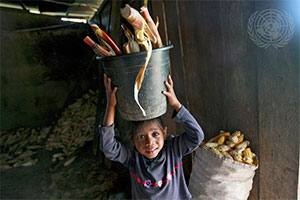 Timorese Girl with Fresh-Picked Corn. Credit: UN Photo/Martine Perret
A global common denominator is the need for a decent job. The economic realities of each country determine just how difficult it is to find one. Despite the labour movement's achievements, serious challenges persist: gender discrimination, child labour, worker migration, the digital divide and AI automation, evaporating pensions, unsafe workplaces, corporate pressure against union organising, negative impacts of trade agreements, and the precariousness of informal employment. The 2025 UN SDG Report identifies jobs and social protections as one of the six priority areas requiring urgent action, with progress either stalled or reversing in many developing nations.
In recent years, the fight to protect labour equality has taken on new dimensions with the rise of Environmental, Social and Governance standards. With the Social aspect aiming to promote equality and human rights, ESG principles have strengthened labour advocacy within corporate and governmental regulatory landscapes. In particular, ESG has become much more institutionalized in emerging economies such as Brazil and China. IPS follows the world’s workers as they confront these challenges - their setbacks and their successes.

The Week with IPS

NEXT STOP - SDGs
Tracking global progress towards a sustainable world
Tracking global progress towards a sustainable world
