Languages
Sunday, October 25, 2026



News and Views from the Global South
South-South
Investments Into, Out of Developing Countries at Record Levels
Foreign direct investment (FDI) both into and out of developing countries is at or nearing record levels, an arm of the World Bank reported on Thursday.Rural Co-ops in Central America Speak Out on Climate Change
Brenda Salazar has her sights set on two things: a good organic cacao harvest for the cooperative she belongs to in northern Nicaragua, and for the governments of Central America to heed the ideas of peasant farmers who have organised to fight climate change.
Wine to China
South Africa and China are partners within a club of leading emerging markets, and it would seem natural that exports of South African wine to the Chinese market should be surging.
The Big Fight in Doha Is Over Climate Finance
The new Green Climate Fund to help developing countries cope with climate change may one day have a bigger budget than the World Bank. At the moment, however, the Fund is empty.
Critics Slam ASEAN Rights Commission
At the age of 82, former Indonesian political detainee Mudjayin wonders if he will ever see justice served.
Chinese and Brazilian Firms Building the New Angola
"In Luanda there are no matches." This was the first line of a report written by Nobel Literature laureate Gabriel García Márquez in the Angolan capital in 1977.
Q&A: “Latin America Could Eradicate Hunger by 2025”
The hunger suffered by 49 million people in Latin America could be eradicated by 2025, according to Spanish agricultural engineer Ricardo Rapallo.
The Planet’s Thermostat Moves to Doha
The upcoming United Nations climate talks may have a renewed sense of urgency with a new World Bank report warning that the planet is on a dangerous path to four degrees Celsius of global warming by 2100.
Chile in the Vanguard of Monitoring AIDS Therapy
In Chile, not only do all people diagnosed with HIV/AIDS receive treatment, but the country also has advanced mechanisms for monitoring outcomes of the antiretroviral therapy.
Keeping African Roots Alive in Brazil
A Nigerian diviner dances and sings next to a Brazilian priest of the Candomblé religion, brought to this South American country by African slaves, that is now being rescued from oblivion in school texts on national history and culture.
Building BRICS
Will the BRICS expand into the BRICSIT?
Aluminium Industry Has Its Defenders in Brazil
Aluminium, opposed by environmentalists mainly because of the amount of energy needed to produce it, is one of the targets of the heated campaign against hydroelectric dams in Brazil’s Amazon jungle region.
Brazil Emerging as Key Player at U.N.
When a U.N. member state agrees to hold an international conference in its capital, the host country is not only offered the privilege of chairing the mega meeting but also given pride of place as the keynote opening speaker.
Narco-States Grope for New Strategy*
Mexico, Colombia and Guatemala face the need to modify their approach to the fight against drug trafficking and are urging the world to do the same. But Mexico and Colombia’s willingness to make the necessary changes is unclear.
Better Governance to Achieve Food Security
Despite a sudden increase in July this year, prices of cereals on world markets remained fairly stable. But there are no grounds for complacency, as cereals markets remain vulnerable to supply shocks and disruptive policy measures. In this context, the good harvests that are expected in the Southern Hemisphere are important.
Pan-American Rights Commission “Under Threat”
Representatives of nearly 40 civil society organisations from throughout the Americas gathered here on Wednesday to express concerns with proposed changes to the Inter-American Commission on Human Rights (IACHR).
Q&A: “Smallholder Agriculture Needs to Be Seen as a Business”
The countries of the developing South should remove the barriers still faced by small-scale farmers, because smallholders play a key role in economic growth, says Carlos Seré, the International Fund for Agricultural Development’s (IFAD) chief development strategist.
China Invests in Central America – But Isn’t Buying
From satellites to inter-oceanic canals, the most innovative or ambitious investments in Central America are coming from China - even though six of the seven countries in this sub-region do not have diplomatic ties with the Asian giant.
Q&A: Food Production Accounts for 29 Percent of Greenhouse Gases
Food production, including agriculture, represent 29 percent of the greenhouse gases that are causing global warming, say scientists with the Consultative Group on International Agricultural Research (CGIAR).
Caribbean Faces Increasing Fury of Storms
As the Caribbean reaches the end of October – the second-to-last month of the Atlantic hurricane season – Sandy has caused significant material losses and claimed the lives of 44 people in Haiti, 11 in Cuba, two in the Dominican Republic, one in Jamaica and one in the Bahamas.
OP-ED: Uruguay – Lessons from a Successful Rice Producer*
Uruguay is in the headlines of agricultural development news this week as it hosts the Second Global Conference on Agricultural Research for Development (GCARD 2) from Oct. 29 to Nov. 1 in the resort city of Punta del Este.« Previous Page — Next Page »





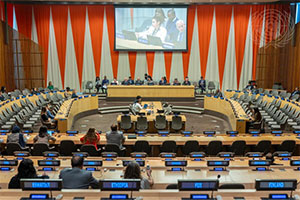 Panel Discussion on International Day for South-South Cooperation 2023. Credit: UN Photo/Cia Pak
South-South cooperation – collaboration between developing countries – is a growing and dynamic phenomenon, an important process that is vital in confronting shared challenges. Led by emerging giants, India, Brazil and South Africa (IBSA), the Global South is a tremendous source of tested solutions to development challenges, including the Millennium Development Goals (MDGs). China’s Belt and Road Initiative (BRI), launched in 2013, has further transformed South-South cooperation by enhancing infrastructure, trade, and investment linkages across Asia, Africa, and Latin America. Meanwhile, new platforms like the expansion of BRICS to include other countries such as Thailand, Nigeria, and Cuba are reshaping global economic governance and offering alternatives to traditional Western-led institutions. The Nairobi Outcome of the 2009 High-Level United Nations Conference on South-South Cooperation in Nairobi, Kenya highlights growing political and economic ties within the developing world, as countries from the Global South assume leading roles in decision-making on hot global issues ranging from economic recovery to food security, energy transitions, debt relief, and climate change. Today, the African Continental Free Trade Area and India’s “Voice of the Global South” summits have advanced frameworks for regional self-reliance, while G77 has reaffirmed commitments to resilient and inclusive economies ahead of the 16th UN Conference on Trade and Development.
Updated by Yilan Batista and Shuli Wong August 2026

The Week with IPS

NEXT STOP - SDGs
Tracking global progress towards a sustainable world
Tracking global progress towards a sustainable world
