Languages
Thursday, November 19, 2026



News and Views from the Global South
Trade & Investment

The Two Faces of International Commodity Trade
For decades, commodity trade has been understood from the point of view of “commodity dependent” exporting countries, those whose revenues are largely generated by commodities exports. The trend of decreasing agricultural commodity prices was the focus of attention. However, from the beginning of the 2000s, there was an upward trend in agricultural commodity prices culminating in the price peak of 2007-08.
Now Gaza’s Ark Prepares to Dare Israel
“An ark is literally a large floating vessel designed to keep its passengers and cargo safe,” say the group preparing ‘Gaza’s Ark’. But their ark, they say, is “a vessel that embodies hope that the Palestinians of the Gaza Strip can soon live in peace without the threat of the Israeli blockade.”
Group Warns of “Natural Resources Giveaway” in Latin America
Researchers have unveiled new data warning that governments in Latin America are infringing on the rights of their indigenous populations in a bid to fuel development through the extraction of natural resources.Concerns Mount as U.S. Plans Major Natural Gas Exports
Environmentalists and others here are reacting with concern to a surprise announcement on Monday of a major deal that would see U.S. natural gas exported to the United Kingdom, marking the first time that such sales have been permitted.
Tug-of-War Over Nuclear Future
Pushed and pulled in opposite directions, the future of Japan’s energy plans in the wake of the accident at the Fukushima Daiichi nuclear power plant two years ago is emerging as a fight between national economic advancement and what anti-nuke activists call “the lives of the people”.
OP-ED: The BRICS and the Rising South
On Tuesday, leaders of five large emerging economies – Brazil, Russia, India, China, and South Africa, known as the BRICS – will gather in Durban, South Africa to discuss harnessing their formidable resources on behalf of faster development progress in Africa and elsewhere.USAID Makes Steady but Slow Gains on Transparency
The United States’ main foreign assistance agency is getting widespread plaudits for new data on a series of internal reforms aimed at aid improvement, but some development experts are pointing to a persistent opaqueness from the agency.Civil Society Seeks to Influence Mexican Mining Law Reform
Two separate bills to reform Mexico’s mining laws, one from the government and the other from academics and NGOs, agree on the urgent need for major changes in the rules governing the industry.China Muscles into Kyrgyzstan’s Energy Market, Fueling Suspicion
China is financing the construction of Kyrgyzstan’s first major oil refinery, and excitement is building in Bishkek that the facility could enable the Central Asian nation to break Russia’s fuel-supply monopoly.Cyprus Government Holds Bailout Crisis Talks
Political leaders in Cyprus are working on an alternative proposal to stave off bankruptcy after parliament overwhelmingly rejected an international bailout plan.U.S. Urged to Reject New World Bank Focus on Large Infrastructure
A group of environmentalists, gender activists and international finance watchdogs are calling on the U.S. government to support calls for the World Bank to step back from a new programmatic focus on large-scale infrastructure, which critics say does little to help alleviate poverty.
Dependent on Venezuela’s Oil Diplomacy
Venezuela’s economic challenges, more than the uncertainty over who will succeed late president Hugo Chávez, could threaten the oil diplomacy he practiced in the region.
Russia to Get Venezuelan Oil for a Few Cents a Barrel
Russian state oil firm Rosneft and Venezuela's PDVSA (Petróleos de Venezuela S.A.) have agreed to form a partnership to exploit an oilfield with estimated reserves of 40 billion barrels, strengthening the alliance between the two countries.
How to Break the Stalemate on Global Sustainability
The current growth model is not sustainable. Neither the green economy nor alternative sources of energy can prevent global warming. Solutions will come from concerted actions at the local and national levels, from the adoption of instruments and practices borrowed from other disciplines like peacebuilding, and from the move to a “no-waste economy”, according to experts here.
China Outsells UK in World’s Lucrative Arms Bazaar
After ranking ahead of Japan as the world's second largest economy, China has reached another milestone: displacing the UK as the world's fifth largest arms supplier.
Dairy Farming Needs a Shot of Modernity
Mohammad Ali's routine has not changed in over three decades. A small dairy farmer in the village of Aliabad, in the Narowal district of Pakistan’s eastern Punjab province, he wakes at sunrise and walks to the barn to milk his three cows manually, stopping only for a breakfast of unleavened bread and tea heavily laced with milk before getting back to work.
Sugar Playing Catch-Up With Spice
Dotted with rice fields flanked by palm trees, Cambodia’s southeastern province of Kampong Speu is nothing short of picturesque. But behind the idyllic exterior is an on-going struggle to turn this region’s natural beauty into a global attraction and improve the lot of poor local farmers, as the neighbouring beachside Kampot province did just three years ago.
Q&A: Rise of South “Unprecedented in Speed and Scale”
The world's 132 developing nations, largely part of the global South, are ascending at a pace “unprecedented in its speed and scale", according to the latest Human Development Report (HDR) released Thursday by the U.N. Development Programme (UNDP).
Latin America and Caribbean Won’t Lose Oil Aid from Venezuela
Venezuela will keep in place the regional energy integration policies promoted by the late president Hugo Chávez if he is succeeded by acting president Nicolás Maduro, experts on regional relations told IPS.
Cameroonian Farmers Find Justice in Fair Fruit
The fruit farmers in Njombe, a small town in the coastal Littoral Region of Cameroon, learned a life lesson about “making lemonade out of lemons” - or rather “dried fruit out of fruit” when their land was taken from them by the government and leased to an international farming company.Drought Hits Policies
Drought has dramatically increased as a consequence of climate change. Most countries react to it only after it has occurred, but don’t have national policies to prevent it. The high-level meeting on national drought policies in Geneva this week is trying to match scientific knowledge with political awareness.« Previous Page — Next Page »


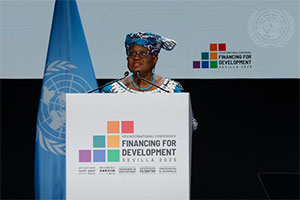 Opening of 4th International Conference on Financing for Development. Credit: UN Photo/Mariscal
International trade and investment are crucial elements of the world economy. While they can be powerful stimulators of development, they can also lead to global imbalances and dynamics of exploitation. In 2025, international trade entered a period of immense disruption, driven in part by a new wave of United States tariffs that reshaped global supply chains and investment flows. The increase in the US tariff rate, the highest since the 1930s, has forced bilateral renegotiations with global trading partners. Furthermore, the debt crisis in developing nations has accelerated while Official Development Assistance (ODA) has substantially dropped 7.3% in 2024.
In the 21st century, advancements in economic diversification in formerly colonized nations have propelled them into more central roles in the global economy. For example, both China and Mexico were able to develop their manufacturing sector and channel this development into booming export flows, thus advancing into the position of emerging economies. Foreign investment also plays an essential role in providing capital for developing countries, although they are oftentimes accompanied by social and environmental exploitation. For example, rising Chinese investments in natural resources in Latin America have often been met with tension as these investment projects fail to properly mitigate environmental risks and protect workers’ rights. In a more multifaceted vein, Sino-African relations have led to infrastructure development in Sub-Saharan Africa while also heightening the region’s economic dependency on China. IPS reports on global news in trade and investment, while shining a light on the nuanced nature of these endeavors.

The Week with IPS

NEXT STOP - SDGs
Tracking global progress towards a sustainable world
Tracking global progress towards a sustainable world
