Languages
Monday, September 21, 2026



News and Views from the Global South
South-South

Today’s Forecast Is for Climate-Proof Farming
Even as weather extremes bedevil Caribbean farmers, Ramgopaul Roop has turned his three-acre fruit farm into a showcase for how to beat climate change.
Storm Brews at U.N. Climate Talks
Hundreds of representatives from various NGOs walked out of the negotiating rooms at the United Nations climate talks in Poland on Thursday in protest against the reluctance by developed nations to commit towards achieving a global climate treaty.G77 Walk-out at COP19 as Rich Countries Use Delaying Tactics
The G77+China group of 133 developing countries negotiating a new international deal at COP19 in Warsaw to combat climate change walked out of the talks in the wee hours of Wednesday morning to protest developed countries’ reluctance to commit to loss and damage.
Driving Home the Link Between Gender and Climate Change
Tuesday was Gender Day at the COP19 climate summit in Warsaw, and many of the events that took place in the National Stadium focused on the topic of gender and its relation with climate change, and tried to shed a light on problems that require action from policy-makers.
Q&A: Indonesia Still at High Risk for Catastrophic Fires
In June, Singapore, Malaysia and Indonesia were enveloped in haze as hundreds of forest fires burned across the island of Sumatra, in the worst pollution crisis to hit Southeast Asia in more than a decade.
Uruguay Keen to Become Regional Logistics Hub
The small South American country of Uruguay could become a major logistics hub in the Southern Cone due to the deepwater port that the government is planning to build in a tourist area on the Atlantic ocean.
South America – From Granary to Megaprojects for the World
South America has gone from the world’s granary to the site of innumerable international infrastructure, energy and mining megaprojects. It is now facing a new dilemma: bolstering the economy with the promise of reducing inequality, in exchange for social and environmental costs that are taking their toll.
Energy Integration Runs into Short Circuits
Energy integration efforts in Latin America have been made in fits and starts, even though many clearly understand that the only way to solve the region’s energy shortages and high costs is by working together.
Domestics Join Forces to Put Their House in Order
“We have come together to join forces, to be heard, because we want to speak for ourselves,” said Ernestina Ochoa, a Peruvian domestic worker, at the close of the founding congress of the International Domestic Workers Federation in the Uruguayan capital.Ecuador-Colombia Settlement Won’t End Spraying
The secrecy surrounding a friendly settlement in a case that Ecuador brought against Colombia in the International Court of Justice for damage caused by anti-drug spraying along the border has further angered those affected by the fumigation.
Argentina Blindly Exploiting Groundwater, Scientists Warn
Half of Argentina is supplied with water by invisible underground aquifers, which are crucial in the country’s arid and semi-arid regions, experts say. But Tierramérica discovered that nobody – not even the government – has any accurate scientific data on these groundwater reserves.

Pacific Pact – a Minefield for Health Care
The Trans Pacific Partnership Agreement (TPP), the negotiation of which is set to conclude this year, could drive research into new drugs and improve access to medicines. Except – it won’t.
Small Island Economies Battered by Erratic Weather
Malcolm Wallace always knew on which side his bread would be buttered.FAO: Modernisation or Irrelevance
The current international situation is characterised by financial and economic challenges that in one way or another affect most countries around the world. In this context there is an increasing call to modernise state institutions, private sector companies, and civil organizations, whatever their remit may be.
Q&A: The Eleventh Hour for Climate Justice
Climate justice – the nexus between human rights and climate change – must be a pillar of the post-2015 development agenda, says former Irish president Mary Robinson.Less Hunger, But Not Good Enough
Every year, we take a snapshot of world progress in the fight against chronic hunger. This year, the picture is looking better, but it’s still not good enough.
Relief Brings Its Own Disasters
In Uttarakhand, the small Indian state in the Himalayan foothills that was a victim of flash floods that killed at least a thousand people in June this year and uprooted thousands of families, the story is told of a child who went every day to the helipad, believing his father will return when, in fact, the father died in the floods.
From Africa to Brazil in the Hold of a Ship
Ornela Mbenga Sebo, a young Congolese woman, escaped in 2011 from a rebel camp in an unidentified location in Africa where she was being held as a slave and stowed away in the garbage bay of a merchant ship, with no idea where it was headed.
Latin America Stirs the Marijuana Pot
In Latin America, where marijuana is the most widely consumed illegal drug, there is basically no home-grown research into its effects and properties. But possible legalisation in Uruguay and the Mexican capital could open the door to new studies.
Extremism Beckons Kenya’s Young
Ali Hassan Gitonga, 33, a recent convert to Islam from the Meru community in Kenya’s Eastern Province, is said to have travelled to Somalia for training with Al-Shabaab in 2011. He is under arrest for alleged involvement in the Sep. 21 Westgate Mall terror attack in Nairobi.
Cuban Athletes Score against Violence
It is unusual to see Cuban sports legends in public service announcements. However, a handful of champions and rising young stars are wearing messages or appearing in TV spots against violence among men or toward women.« Previous Page — Next Page »


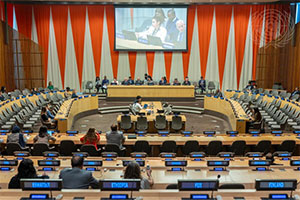 Panel Discussion on International Day for South-South Cooperation 2023. Credit: UN Photo/Cia Pak
South-South cooperation – collaboration between developing countries – is a growing and dynamic phenomenon, an important process that is vital in confronting shared challenges. Led by emerging giants, India, Brazil and South Africa (IBSA), the Global South is a tremendous source of tested solutions to development challenges, including the Millennium Development Goals (MDGs). China’s Belt and Road Initiative (BRI), launched in 2013, has further transformed South-South cooperation by enhancing infrastructure, trade, and investment linkages across Asia, Africa, and Latin America. Meanwhile, new platforms like the expansion of BRICS to include other countries such as Thailand, Nigeria, and Cuba are reshaping global economic governance and offering alternatives to traditional Western-led institutions. The Nairobi Outcome of the 2009 High-Level United Nations Conference on South-South Cooperation in Nairobi, Kenya highlights growing political and economic ties within the developing world, as countries from the Global South assume leading roles in decision-making on hot global issues ranging from economic recovery to food security, energy transitions, debt relief, and climate change. Today, the African Continental Free Trade Area and India’s “Voice of the Global South” summits have advanced frameworks for regional self-reliance, while G77 has reaffirmed commitments to resilient and inclusive economies ahead of the 16th UN Conference on Trade and Development.
Updated by Yilan Batista and Shuli Wong August 2026

The Week with IPS

NEXT STOP - SDGs
Tracking global progress towards a sustainable world
Tracking global progress towards a sustainable world
