Languages
Sunday, November 8, 2026



News and Views from the Global South
Africa
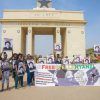
Free Stella Nyanzi, Demand Pan African Activists in Ghana
On Saturday 9th March, a small group of activists from Ghana, concerned by the continued incarceration of Ugandan feminist activist Dr Stella Nyanzi, rallied by the symbolic national independence Square to raise awareness on the dangers of remaining quiet to injustice.
Innovative Sustainable Business: A Three Trillion-Dollar Opportunity that UN Environment Wants People to Develop
In the East African region, communities around the continent’s largest water body, Lake Victoria, regard the water hyacinth as a great menace that clogs the lake and hampers their fishing activities. But in Lagos, Nigeria, some groups of women have learned how to convert the invasive weed into a resource, providing them with the raw material needed to make handicrafts.
UN Pays Homage to Staffers Who Died in Plane Crash
The United Nations headquarters is in mourning – and the UN flag is at half mast. The deaths of 21 UN staffers March 10, on board an Ethiopian Airlines flight in Addis Ababa, is one of the biggest tragedies in the extended UN family—with a flashback to the deaths of 22 people, mostly UN staffers, who lost their lives in the Canal Hotel bombing in the Iraqi capital of Baghdad in August 2003.
Nigeria Mourns the Loss of Leading African Academic Who Was in Ethiopian Airlines Crash
Nigeria is mourning along with the rest of the world after the downing of Ethiopian Airlines Flight, which claimed all of the 157 lives onboard. The fatalities included people from 35 countries, 19 United Nations officials and two Nigerians, one of whom was regarded as Africa's leading academic and labelled a genius by many.
Urgent Call for African Food Sovereignty Movements to Connect with Radical Feminist Movements on the Continent
Africa is facing dire times. Climate change is having major impacts on the region and on agriculture in particular, with smallholder farmers, and especially women, facing drought, general lack of water, shifting seasons, and floods in some areas.
International Women’s Day in Cameroon: A Day for All Women?
On March 8, women all over Cameroon will don custom-made dresses sewn of pagne, specially printed for International Women’s Day. They will parade through cities and towns, joining women around the world in celebration of the day.
Ethiopia’s Remote Afar: an Ancient Way of Life Continues in a Modernising Country

Once made infamous through explorers’ tales of old, Ethiopia’s remote northeast Afar region both conforms to and contradicts stereotypes.

Awareness Raising, a Deterrent to Educate Guineans About Irregular Migration
Every year, there thousands of young people, including women and children, who try to irregularly reach Europe and what, they hope, will be a better life.
Hope Springs Once Again for Nigeria’s Returnee Migrants
 Nigeria accounts for some of the largest number of irregular migrants trying to reach Europe from Africa.

Mauritius Scores Win over Britain in Diego Garcia Decolonisation
Mauritius has scored a victory over Britain at the International Court of Justice (ICJ) in a case involving the decolonisation of the strategically important island of Diego Garcia that is home to a United States military base.
Developing Agriprenuers to Save Nigeria’s Youth from Crime
When Lawrence Afere told his parents he was going into farming rather than getting a job in Nigeria’s lucrative oil and gas sector, they swore he was bewitched.
DRC’s First Peaceful Transition of Power Was At Expense of Women
When Felix Tshisekedi, the 55 year old son of the former opposition leader, won the recent presidential election in the Democratic Republic of Congo, it should have felt like a new dawn for many of us living here.
Reverse Engineering for SDGs
When young people from small towns and villages seek higher education they have to usually migrate to big cities leaving their local communities behind. On completion of their degree from the Universities, they generally prefer staying in cities, in search of a good job and a successful career. Though this is a standard practice, it is also a case of lost opportunities, especially for students who pursue higher education in agriculture. Here is why.
Agribusiness Is the Problem, Not the Solution
For two centuries, all too many discussions about hunger and resource scarcity has been haunted by the ghost of Parson Thomas Malthus. Malthus warned that rising populations would exhaust resources, especially those needed for food production. Exponential population growth would outstrip food output.
Sexual Violence Surging in South Sudan
Women and girls continue to face the brunt of violence in the northern region of South Sudan with persistently high and brutal levels of sexual violence, a new report found.
Kenya’s Marginalised Say Nothing For Us, Without Us
Julia Mutua is a resident of Kalawa ward in the semi-arid Makueni County in Eastern Kenya and a member of a women's farmers group that runs a poultry project.
The Hidden Economic Costs of Displacement
While the impacts of displacement on wellbeing are well-known, one group has pointed to the equally burdensome economic costs for those displaced as well as host communities.
Ghana Won’t Have Press Freedom Without Accountability
Three bullets, fired at close range by two assassins on a black and blue Boxer motorbike on January 16, 2019, killed investigative journalist Ahmed Hussein-Suale Divela, according to Sammy Darko, a lawyer working on Divela's case.
Farmers Secure Land and Food Thanks to ‘Eyes in the Skies’
Six years ago while wondering how best to use her engineering skills, Tanzanian ICT entrepreneur Rose Funja decided to enter an innovation competition. Years later she has turned a digital idea into a viable business that helps smallholder farmers across the East African nation access credit.
Blue Economy: The New Frontier for Africa’s Growth & How Japan Can Help
1. Why Blue Economy in Africa? What potentials does Africa have? The blue economy in Africa is neglected, ignored or underexploited, but it can offer a range of African solutions to African economic problems. More than one-quarter of Africa’s population lives within 100km of the coast and derive their livelihoods there. According to the International Energy Agency (IEA), by 2020, the annual economic value of energy activities related to maritime affairs will reach EUR 2.5bn.1 Out of the 54 African countries, 34 are coastal countries and over 90% of African exports and imports are transported by sea. The territorial waters under African jurisdiction cover a surface area of 13 million km², with a continental shelf of some 6.5 million km² comprising exclusive economic zones (EEZ). The continent covers 17% of the world’s surface water resources. The strategic dimension of the blue economy is an indisputable reality for African countries. It is for this reason that it has been included in the African Union’s Agenda 2063 and that a practical handbook on the blue economy was prepared by the United Nations Economic Commission for Africa in March 2016.
Ethiopia Juggles Refugees and Shoppers Coming from Eritrea Amid New Peace
The sudden peace between Ethiopia and Eritrea, and the opening of their previously closed and dangerous border, sent shockwaves of hope and optimism throughout the two countries. But a new issue has arisen: whether Eritreans coming into Ethiopia should still be classed as refugees.
« Previous Page — Next Page »





The Week with IPS

NEXT STOP - SDGs
Tracking global progress towards a sustainable world
Tracking global progress towards a sustainable world
