Languages
Monday, September 14, 2026



News and Views from the Global South
From Spanish Wire
Argentine Women Refused Legal Abortions in Cases of Rape
For over 90 years, a law in Argentina has allowed women who become pregnant as a result of rape to have an abortion. However, hospitals often refuse to carry out the procedure, instead referring the women to the justice system.
Q&A: Needed: Common Caribbean Strategies Against Climate Change
Subject to the double impact of the global economic crisis and climate change, the Caribbean island nations are in need of adaptation strategies in which international cooperation and citizen participation play key roles, says Cuban expert Ramón Pichs.
Brazil, Emerging South-South Donor
The Brazilian government is stepping up South-South aid, to strengthen the South American giant’s status as a donor country and its international clout. It now provides assistance to 65 countries, and its financial aid has grown threefold in the last seven years.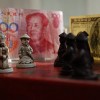
Latin America, Testing Ground for Chinese Yuan
China is looking to Latin America to experiment with the yuan, or renminbi, to replace the dollar, taking advantage of the growth in Chinese trade and investment in this region. But because the volume is still insignificant, it is not yet clear what impact the currency will have on economies in the region.
URUGUAY: Community Radios Have Innovative Law, But Are Off the Air
Uruguay took a giant step towards more democratic media when it passed a law on community radio broadcasting in 2007. But although regulations for the law were approved in late 2010, many broadcasters are now off the air and waiting to be assigned a frequency.Women Journalists in Cuba Revive Transgressive Group
More than 15 years after the "deactivation" in Cuba of the Association of Women Communicators (MAGIN), its members remain united in an informal network that transcends any specific political situation and has become a reference for the new generations.Argentina Losing Regional Leadership Position in Health
In Latin America, Argentina spends the most on healthcare. It has a vast infrastructure, highly qualified health professionals and the necessary material resources. But other countries in the region are achieving better and faster health outcomes with fewer resources.
Chile’s Earthquake Reconstruction Hindered by Delays and Profiteering
Two years after the earthquake and tsunami in south-central Chile, the worst natural disaster to hit the country in half a century, thousands of families who saw their homes destroyed are still waiting for a solution.
Airwaves Cut Distances in Rural Peru
The Onda Rural communication for development initiative in Peru has come up with a range of strategies to get information out to remote villages, to help them with decision-making on questions like climate change adaptation or disaster preparedness.PARAGUAY: Land Conflicts Threaten to Boil Over
A group of landless families occupying rural property claimed by large landowners in eastern Paraguay agreed to move to the Ñacunday National Park, defusing a tense situation.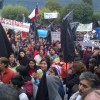
Social Unrest on the Rise in Southern Chile
The police have cracked down hard on demonstrators in the southern Chilean region of Aysén, who have been protesting the area's isolation and high local prices of fuel and food for the past two weeks.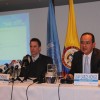
Illegal Wiretapping Continues in Colombia, U.N. Says
Illegal spying on human rights activists and journalists is still happening in Colombia, according to a new report by the Office of the United Nations High Commissioner for Human Rights.
Community Radio Stations Divided Over Law in Chile
Community radio stations in Chile continue to call for a legal framework that would allow them to operate without restrictions, because although a specific law was passed nearly two years ago, it has not yet entered into effect.Colombia Finds Swiss Hostage Mediator Innocent
The dismissal of charges in Colombia against Swiss mediator Jean-Pierre Gontard, who helped negotiate the release of numerous hostages held by guerrillas in this country between 1998 and 2008, is "magnificent news, for bilateral relations as well as at a purely human level," Colombia’s ambassador to Switzerland, Claudia Turbay, told IPS.ARGENTINA: Parana River Not What It Used to Be
Lower water levels and increasing pressure from overfishing in the Paraná river are causing an unprecedented decline in fish stocks in the river that is regarded as the second most biodiverse in South America after the Amazon river.CUBA: Oil Drilling Opens Up New Possibilities
The search for oil in Cuba’s Gulf of Mexico waters, launched by the Spanish firm Repsol, has triggered speculation about future prospects for Cuba and the possibility of this country one day making the transition from importer to exporter of crude.Trial Sheds Light on Trafficking of Women in Argentina
A high profile trial for trafficking of women is giving the public a clearer picture of how sex trafficking rings operate in Argentina, with victims who are even forced, eventually, to become victimisers.Spain to Reform, But Not Shut Down, Immigrant Detention Centres
The Spanish government has decided to reform the country’s Immigrant Detention Centres (CIEs) in response to a wave of criticism of the way they are run, following the death of two migrants. But the announcement has not toned down the campaign for closure of what many regard as prisons.Latin America Seeks to Spread Nuclear Free Zones
Latin America and the Caribbean are discussing ways to step up supervision of the use of nuclear materials in the region and contribute to the creation of more nuclear weapon free zones around the world, on the 45th anniversary of the treaty that banned nuclear arms in the region.Former Combatants in El Salvador Demand a Place in Society
Sporting an olive green combat jacket and a beret, civil war veteran Carlos Hernández prays at the tomb of slain Archbishop Oscar Arnulfo Romero at the Metropolitan Cathedral of El Salvador, which a score of former guerrillas have occupied to demand assistance to help them out of poverty.Drug Trade Will Weather Peruvian Rebel Chief’s Capture
The capture in Peru of the last major leader of the Maoist rebel group Sendero Luminoso is a mortal blow to the movement that managed to survive thanks to its connection with the production of coca and cocaine in the north of the country.« Previous Page — Next Page »


The Week with IPS

NEXT STOP - SDGs
Tracking global progress towards a sustainable world
Tracking global progress towards a sustainable world
