Languages
Monday, November 9, 2026



News and Views from the Global South
Active Citizens

Changing the Game to Achieve Nuclear Disarmament
Twenty-five years ago, on Dec. 8, presidents Mikhail Gorbachev and Ronald Reagan signed the Intermediate-Range Nuclear Forces (INF) Treaty. This historic agreement eliminated a modern class of land-based “theatre” weapons - the SS20s, cruise and Pershing missiles - that had been brought into Europe in the early 1980s.
Tunisia Gears Up to Host World Social Forum
Following in the wake of the wave of revolutions dubbed the ‘Arab Spring’, which originated here nearly two years ago, North Africa is gearing up to host the World Social Forum (WSF) for the first time.
Students Stuck With Shoddy Textbooks in Afghanistan
New textbooks, printed as part of an ambitious multi-million dollar exercise to reform the curriculum in Afghan public schools, have been found to contain glaring mistakes, adding yet another burden on a cash- and resource-strapped sector of this war-torn country.
Youth Call for ‘Change of Course’ to Solve Climate Crisis
While world leaders were wrapping up the United Nations conference on climate change (COP 18) in Doha, Qatar this past weekend with the annual vague promise to tackle the enormous crises brought on by extreme weather and global warming, a delegation of youth gathered far from the high-level conference halls to say “no” to advocacy without action.Off the Blacklist Doesn’t Imply Improvement in Human Rights in Colombia
Colombia will be removed from the Inter-American Commission on Human Rights “blacklist” next year. In exchange, the government of Juan Manuel Santos facilitated a visit to the country by a delegation from the Commission.
Haitian Community Radio Reopens After Protests
A community radio station silenced by Haitian authorities is open again thanks to the mobilisation of other stations as well as organisations and associations both inside and outside of Haiti.
Longer Lives, Lower Incomes for Japanese Women
When Hiroko Taguchi retired this past April, at the age of 64, from her job as an insurance sales agent, she joined the rapidly growing ranks of Japan’s aging women who now outnumber their male counterparts.
Doha Climate Summit Ends With No New CO2 Cuts or Funding
The United Nations climate talks in Doha went a full extra 24 hours and ended without increased cuts in fossil fuel emissions and without financial commitments between 2013 and 2015.
Farming in the Sky in Singapore
With a population of five million crammed on a landmass of just 715 square kilometres, the tiny republic of Singapore has been forced to expand upwards, building high-rise residential complexes to house the country’s many inhabitants.
Reaching Bolivia’s Native People on the Airwaves
Every morning from 6:00 to 8:00 AM, native people in this sprawling working-class suburb of La Paz, Bolivia listen to the programme broadcast by former education minister Donato Ayma in the Aymara language.Reforms Could Weaken Pan-American Rights Body
The pan-regional Organisation of American States (OAS) on Friday received a petition signed by more than 3,000 signatories from throughout the Americas, including four past presidents, expressing a host of concerns over current attempts to reform the Inter-American Commission on Human Rights (IACHR).
Drones Come Home, to U.S. Privacy Activists’ Dismay
Better known as drones, Unmanned Aerial Vehicles piloted by military in the U.S. hunt and kill suspected enemy combatants abroad. Now the drones are coming home to beef up local law enforcement.
Environmentalist Ends Hunger Strike Over Trinidad Highway
For 21 days Wayne Kublalsingh sat in the scorching sun outside the office of Prime Minister Kamla Persad Bissessar. He sat in support of his belief that constructing a highway in southern Trinidad would damage the environment and affect hundreds of lives in the surrounding area.
Germany Grapples with Diversity
With a persistent undercurrent of discrimination against foreigners, ‘Gastarbeiter’ (guest workers) and citizens of colour, despite the fact that 20 percent of its population - roughly 16 million residents - are from an immigrant background, Germany is faced with the urgent task of rethinking its ambivalence towards diversity.
An Empty Table at Doha Climate Talks
United Nations climate talks are on the edge of collapse Thursday, according to a coalition of civil society and representatives from half of the world's countries.
More Killings in Brazil Than in Some War-Torn Countries
Human rights activists in Brazil mobilised Wednesday to draw attention to the fact that half a million people have been murdered in this South American country in the past 10 years.Landfill in Argentine Capital “Kills Slowly”
"This isn’t like a tsunami, which appears all of a sudden, but a silent enemy that kills you slowly, as you breathe and drink the water,” says Hugo Ozores, who lives in González Catán, a working-class district in Greater Buenos Aires.
Peace in Colombia?
People in the streets and squares of the Colombian capital are breathing easier. The air is fresh with hope, in contrast to the former leaden and fearful atmosphere of eternal violence and interminable conflict.
Conflict Kills Culture in Kashmir
Nestled in a valley between the Great Himalayas and the Pir Panjal mountain range, Kashmir is an idyllic and culturally rich region, a cradle of Muslim, Hindu, and Buddhist religious relics and architectural sites.
Violence Against Afghan Women on the Rise
Afghan women are no strangers to gender-based violence. For decades now, violent crimes against women have been heading for epic proportions, as young girls are forced into marriage, wives and daughters are abused, and women are dealt harsh punishments for ‘moral crimes’.Deaf Ear Turned to Local Opposition to Mines in Guatemala
As the mining industry booms in Guatemala, local communities are increasingly opposed to the operations of the mainly foreign companies because of the potential negative effects on the environment and on their villages.« Previous Page — Next Page »





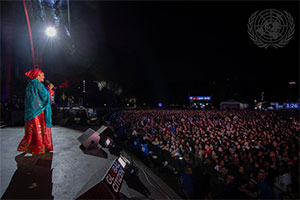 Global Citizen Festival in New York. Credit: UN Photo/Eskinder Debebe
Active citizens are committed to social change because they know that it is achievable. However, major political challenges face active citizens across the world. For example, in authoritarian regimes in Latin America where the hegemonic party has been in power for decades on end, protestors and human rights activists face enormous repression and struggle to materialize their advocacy into concrete results. The same can be said for Africans, where a shift towards elected government in recent decades has yet to translate into an effective voice in decision-making. Now, the Strengthening Citizen Demand for Good Governance, which uses evidence-based approaches – funded by DFID's Governance and Transparency Fund – seeks to raise their voices.
In 2025, the CIVICUS Monitor’s People Power Under Attack report revealed that civic freedoms are severely limited in 122 of 198 countries and territories, and only 7.2% of the global population now lives in countries where civic space is open. Through partnership with the Overseas Development Institute (ODI) and CIVICUS, IPS reporters across the continent will seek to define the extent and limits of state capability, government accountability and the responsiveness of leaders to the needs of citizens.

The Week with IPS

NEXT STOP - SDGs
Tracking global progress towards a sustainable world
Tracking global progress towards a sustainable world
