Languages
Monday, November 9, 2026



News and Views from the Global South
Active Citizens

Using the Airwaves to Empower Quechua Women in Bolivia
"Atispa mana atispa ñawpajman rinanchis tiyan" ("Power without power, we have to keep moving forward”) in the Quechua language, Ruth Rojas told her listeners at the end of a series of radio programmes on political culture, broadcast to indigenous women in Bolivia.New HIV Epidemic Looms over Romania
New HIV infections among Romanian drug users have grown exponentially over the past couple of years, from three to five cases annually between 2007 and 2009, to 98 just in the first half of 2012.
Local Opposition Rises Against Fracking Proposal
Efforts to promote the use of hydraulic fracturing, a controversial method of obtaining oil and natural gas, face stiff opposition from researchers and citizens who say that in its present form, the technology's risks far outweigh its worth.
Cooperatives as Business Models of the Future
When the International Year of Cooperatives (IYC) concluded last week, some of the overwhelming success stories highlighted at a two-day interactive session came both from developing and developed countries, including India, Brazil, China, Kenya, Rwanda, Ethiopia, Italy, France and the United States.
In Post-Fukushima Japan, Civil Society Turns up Heat on Officials
For the former industrial engineer Yastel Yamada, retirement does not mean he intends to sit back. Instead, the 73-year-old and about 700 other skilled seniors across Japan are eager to volunteer to tackle the most dangerous part of the Fukushima Dai-ichi nuclear plant cleanup and spare a younger generation from the effects of extreme radiation.
Development Targets Ride on Vitamins
One hundred and ninety million – that’s more than the populations of Germany, France and Poland combined. It is also the number of children affected by vitamin A deficiency around the world.Building More Democratic Families in Argentina
A wide-ranging reform of Argentina's civil code is looking to replace traditional concepts of parental authority and control with one of parental responsibility, while expressly prohibiting corporal punishment for children and adolescents.
The Planet’s Thermostat Moves to Doha
The upcoming United Nations climate talks may have a renewed sense of urgency with a new World Bank report warning that the planet is on a dangerous path to four degrees Celsius of global warming by 2100.
Deep Emissions Cuts Urged at Climate Summit
Extreme weather disasters, including floods and droughts intensified by climate change, have totalled many billions of dollars in damages this year.
Coastal Erosion Reaches Alarming Levels in Vietnam
For the last decade, many families in this southwestern Vietnamese province have been uprooted at least once every two years – but this is not due to economic or political upheaval.
Opposition to U.S. Bases Reaches Turning Point
Okinawa, the largest of a group of 60 sub-tropical islands forming Japan’s southernmost prefecture, has an equable climate and preferential treatment for United States servicemen under the Mutual Cooperation Security Treaty between the U.S. and Japan.
War Tourism Skips Reality
The tour guide’s voice echoes around the dark, musty room, three stories underground. Fifty visitors – among them mothers holding infants, youths snapping pictures on mobile phones and grandparents leaning against the walls – are crammed into the narrow stairwell that leads down into the chamber, listening attentively to his every word.
Briefly President, Now Pharaoh
When Mohamed Mursi was sworn in as president in June there were concerns that the first democratically elected president in Egyptian history would be subservient to the military council that had ruled the country since dictator Hosni Mubarak was toppled in early 2011.
Security Council Vow on Women Lives Mostly on Paper
When the U.N. Security Council (UNSC) adopted a landmark resolution numbered 1325 back in 2000, it was supposed to integrate gender into its core mandate: the establishment and maintenance of international peace and security.
Nepal Unprepared for Imminent Earthquakes
Nepal now ranks 11th on a list of the world’s most earthquake-prone countries, yet it remains one of the least disaster-prepared nations globally.India Reaffirms Death Penalty
One day after voting against a United Nations General Assembly draft resolution seeking to abolish the death penalty, India executed Pakistani national Mohammad Ajmal Kasab for the November 2008 terror rampage in Mumbai that left 166 people dead.
Keeping African Roots Alive in Brazil
A Nigerian diviner dances and sings next to a Brazilian priest of the Candomblé religion, brought to this South American country by African slaves, that is now being rescued from oblivion in school texts on national history and culture.
Ethiopia Throttles Rights Organisations
The world received contradictory signals about Ethiopia’s human rights record when in the same week it was elected to the United Nations Human Rights Council, a major German charity closed its Ethiopian office in protest against a restrictive political environment.
Sustainable Fashion Born in Brazil’s Favelas
A Brazilian designer has taken fashion from the exclusivity of the catwalk to the reality of the favela, to demonstrate that styles, trends and fads are also born in these poor neighborhoods of cities like Rio de Janeiro.
An Agreement For Peace Means a Promise of Tourism
International travellers may soon get to enjoy the scenic spots and rich cultural heritage of Muslim Mindanao, the Philippines’ southernmost island group, without the threat of being caught in the crossfire of the region’s conflict.
Q&A: “Solidarity and Mutual Aid” Key to Operation Sandy
Dee Knight experienced Hurricane Sandy in several different capacities. As a reporter and an organiser, not only did he report on the aftermath of the hurricane, but he was also a part of "Occupy Sandy", a response to the hurricane based on solidarity and charity.« Previous Page — Next Page »





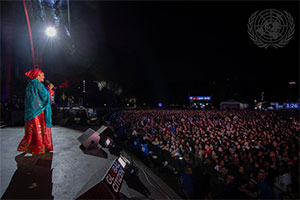 Global Citizen Festival in New York. Credit: UN Photo/Eskinder Debebe
Active citizens are committed to social change because they know that it is achievable. However, major political challenges face active citizens across the world. For example, in authoritarian regimes in Latin America where the hegemonic party has been in power for decades on end, protestors and human rights activists face enormous repression and struggle to materialize their advocacy into concrete results. The same can be said for Africans, where a shift towards elected government in recent decades has yet to translate into an effective voice in decision-making. Now, the Strengthening Citizen Demand for Good Governance, which uses evidence-based approaches – funded by DFID's Governance and Transparency Fund – seeks to raise their voices.
In 2025, the CIVICUS Monitor’s People Power Under Attack report revealed that civic freedoms are severely limited in 122 of 198 countries and territories, and only 7.2% of the global population now lives in countries where civic space is open. Through partnership with the Overseas Development Institute (ODI) and CIVICUS, IPS reporters across the continent will seek to define the extent and limits of state capability, government accountability and the responsiveness of leaders to the needs of citizens.

The Week with IPS

NEXT STOP - SDGs
Tracking global progress towards a sustainable world
Tracking global progress towards a sustainable world
