Languages
Monday, October 19, 2026



News and Views from the Global South
Conferences

Civil Society Condemns Immunity for Sitting African Leaders Accused of Serious Crimes
Mary Wacu lived in the Rift Valley region for 10 years prior to the 2007/08 post-election violence that rocked Kenya after a disputed general election.
Island States to Rally Donors at Samoa Meet
Amid accelerating climate change and other challenges, a major international conference in the South Pacific island nation of Samoa next month represents a key chance for Small Island Developing States (SIDS) in the Caribbean to turn the tide.
East Africa Breaks the Silence on Menstruation to Keep Girls in School
When Peninah Mamayi got her period last January, she was scared, confused and embarrassed. But like thousands of other girls in the developing world who experience menarche having no idea what menstruation is, Mamayi, who lives with her sister-in-law in a village in Tororo, eastern Uganda, kept quiet.
Oil Lubricates Equatorial Guinea’s Entry into Portuguese Language Community
Evidently, oil talked louder. By unanimous resolution, the Community of Portuguese Language Countries (CPLP) admitted Equatorial Guinea as a full member, in spite of the CPLP’s ban on dictatorial regimes and the death penalty.
AIDS Conference Mourns the Dead, Debates Setbacks
The 20th International AIDS Conference concluded today as the first in its history that remembered not just the 39 million people worldwide who have died of AIDS but also those who lost their lives in the crashed MH17 flight carrying six of its delegates, one of whom was the past president of the International AIDS Society (IAS).
‘Zero Tolerance’ the Call for Child Marriage and Female Genital Mutilation
Heightening their campaign to eradicate violence against women and girls, United Nations agencies and civil groups have called for increased action to end child marriage and female genital mutilation.
Indigenous Communities Say Education, Funding Key to Fighting HIV/AIDS
Marama Pala, hailing from Waikanae on the west coast of the North Island of New Zealand, was diagnosed with HIV at 22. The news of her diagnosis spread like wildfire in her tight-knit Maori community.Fragility of WTO’s Bali Package Exposed
The “fragility” of the World Trade Organization’s ‘Bali package’ was brought into the open at the weekend meeting in Sydney, Australia, of trade ministers from the world’s 20 major economies (G20).
Child Migrants – A “Torn Artery” in Central America
The migration crisis involving thousands of Central American children detained in the United States represents the loss of a generation of young people fleeing poverty, violence and insecurity in Honduras, Guatemala and El Salvador, the countries of the Northern Triangle of Central America where violence is rife.
International Reform Activists Dissatisfied by BRICS Bank
The creation of BRICS’ (Brazil, Russia, India, China and South Africa) own financial institutions was “a disappointment” for activists from the five countries, meeting in this northeastern Brazilian city after the group’s leaders concluded their sixth annual summit here.
If You Cut One, Plant Two
Olga Mugisa, 11-years-old, takes to the microphone in front of her peers, the Ugandan flag proudly draped behind her and green plants framing the stage. She has an important message to share with her fellow students: “If you cut one, plant two.”
OPINION: Why Asia-Europe Relations Matter in the 21st Century
Hopes are high that the 10th Asia-Europe Meeting – or ASEM summit – to be held in Milan on October 16-17 will confirm the credibility and relevance of Asia-Europe relations in the 21st century.
The Silent Power of Boycotts and Blockades
Peruse a few reports on global military expenditure and you will not be able to shake the image of the planet as one massive army camp, patrolled by heavily weaponised guards in a plethora of uniforms.
Rights Experts Urge Action on Gender Equality in Taiwan
Prominent international human rights experts are calling on the Taiwan government to quickly enact a comprehensive anti-discrimination act, revamp the law on citizenship and take a wide range of other actions to curb gender discrimination.
Inequality Blocks Path to “Gold” in Latin America
Inequality, poor infrastructure and declining trade are some of the problems that Latin America needs to overcome if the region truly wishes to achieve a “golden age”, according to Peru’s President Ollanta Humala.
Looking to Africa’s LDCs to Learn How to Save the Lives of Millions of Mothers and their Babies
Every year, three million newborn babies and almost 6.6 million children under five die globally, but if the rest of the world looked towards the examples of two of Africa's least-developed countries (LDCs), Rwanda and Ethiopia, they would perhaps be able to save these children.
Community Resilience Tops U.N.’s Disaster Relief Agenda
The Bangkok Declaration on Disaster Risk Reduction in Asia and the Pacific adopted at the close of the 6th Asian Ministerial Conference On Disaster Risk Reduction (AMCDRR) here today emphasised community-based solutions, and reflects a growing global desire to focus more on grassroots actions in the face of catastrophic climate change.
When Faith Meets Disaster Management
A consortium of faith-based organisations (FBOs) made a declaration at a side event Wednesday at the 6th Asian Ministerial Conference On Disaster Risk Reduction (AMCDRR), to let the United Nations know that they stand ready to commit themselves to building resilient communities across Asia in the aftermath of natural disasters.
U.S. Turns Attention to Ocean Conservation, Food Security
A first-time U.S.-hosted summit on protecting the oceans has resulted in pledges worth some 800 million dollars to be used for conservation efforts.
From Religious Conflict to an Interfaith Community
Holy men and their holy books have etched a trail of tears and blood in the annals of human history. From the depths of peaceful temples, mobs have been dispatched with flaming torches; from steeples and minarets messages of hatred have floated down upon pious heads bent in prayer. For too long religion has incited violence and fueled conflict.
Op-Ed: First Decolonisation, Now ‘Depatriarchilisation’
At the end of this week leaders of the Group of 77 and China will meet in Bolivia to commemorate the 50th anniversary of the group.« Previous Page — Next Page »





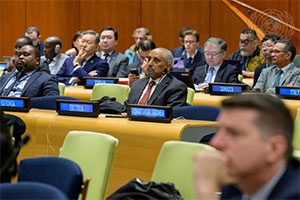 General Assembly Meets to Hear Briefing on UN80 Initiative. Credit: UN Photo/Manuel Elías
Global development conferences are continuing to produce critical frameworks for South-South cooperation and multilateral reform. In January of 2024, the 3rd Global South Nexus (GSN) International Conference was held in Odisha, India, with its theme being “Creating Responsible Professionals for Advancing SDGs: Inputs from Global North and South.” The 2025 UN SDG Report provided a midpoint assessment of the 2030 Agenda, with only 35% of targets on track and 18% having reversed. The 2025 UN Climate Change Conference (COP30) in Belém, Brazil, agreed to mobilize $1.3 trillion annually for climate action by 2035, operationalize the loss and damage fund, triple adaptation finance, and launched the Belém Mission to 1.5°C. In 2025, the Partnership for Economic Policy (PEP) convened its annual Policy Conference in Nairobi, Kenya, addressing the issue of “Financing and Inclusivity in Green Energy Transition in the Global South.” As the Global South advocates increasingly for a South-South framework alongside North-South cooperation, international conferences on sustainability aim to bridge economic and social divides between developed and developing countries in achieving the UN SDGs. Furthermore, to mark the UN’s 80th anniversary, the UN80 Initiative was launched to reshape how the UN system works so that every mandate, dollar, and decision creates greater impact for the global system.

The Week with IPS

NEXT STOP - SDGs
Tracking global progress towards a sustainable world
Tracking global progress towards a sustainable world
