Languages
Tuesday, October 20, 2026



News and Views from the Global South
Conferences

When Nature Gets a Price Tag
How much does a forest cost? What’s the true economic value of an ocean? Can you pay for an alpine forest or a glacial meadow? And – more importantly – will such calculus save the planet, or subordinate a rapidly collapsing natural world to market forces?
Nature Is Talking And Africa’s Legislators Are Listening
Africa's climate change legislative frameworks, though a step in the right direction, have come under fire for not being ambitious enough to meet the challenge of a changing climate.
Q&A: Developing World Leads in Advancement of Climate Change Laws
Developing countries in Africa, Asia and Latin America are increasingly leading the way in providing a legal framework for climate security and are being hailed for their continued advancement in formulating climate change laws and policies.
Indian Legislators Wake Up to Climate Change
Ramanjareyulu, a 55-year-old farmer from the southern India state of Andhra Pradesh, has been struggling to find his feet ever since inadequate rainfall dealt a blow to his harvest of groundnut and red gram (a pulse crop that grows primarily in India).
Mexico’s Biodiversity Under Siege
The Las Cruces hydroelectric project in the northwestern state of Nayarit is one of the threats to biodiversity in Mexico, according to activists.
Triple Summit in Singapore Puts Urban Planning on the Map
With over 20,000 international participants, a triple summit wrapping up today in Singapore is generating an abundance of ideas on sustainable cities.
Legislation Alone Will Not Address Africa’s Climate Challenges
Despite a raft of legislation dealing with the environment, African countries are still falling short when it comes to enforcing the legal instruments that respond to challenges posed by climate change, researchers say.
Wary of Climate Change, Indonesia Looks to Lawmakers for Solutions
Comprised of over 17,000 islands that are highly susceptible to rising seas, Indonesia is taking stock of its position as the world’s third leading emitter of greenhouse gases after the United States and China.
U.S. Pledges to Reduce Child Stunting by Two Million Globally
The U.S. government has pledged to reduce the number of chronically malnourished children around the world by at least two million over the next half decade, receiving an initial positive response from the development community.
Hawaii to Host 2016 IUCN World Conservation Congress
The International Union for the Conservation of Nature (IUCN) Council announced Wednesday that the 2016 World Conservation Congress (WCC) will meet in Hawaii - the first time in its 66-year history that the world’s largest conservation conference will be hosted by the United States.
Latin America’s LGBTI Movement Celebrates Triumphs, Sets New Goals
Although it might not seem to be, Latin America is the most active region in the world when it comes to the defence of the rights of lesbian, gay, bisexual, transgender and intersex (LGBTI) people.

Divisions over Gender Complicate Development Agenda
As the U.N. focuses on refining its Post-2015 Development Agenda, divisions surrounding issues of population and development continue to plague consensus on a universal way forward.Leadership Growing Young
Fidelis Molao was 33 when he ran in elections to become a member of parliament in Botswana for the first time in 2010. He was one of the youngest MPs in the country at the time, and still is. He has long championed youth rights.
Interfaith Leaders Jointly Call to Abolish Nuclear Arms
On the eve of next week’s meeting at the U.N. headquarters in New York on the Nuclear Non-Proliferation Treaty (NPT), more than 100 representatives of 11 faith groups from around the world have pledged to step up their efforts to seek the global abolition of nuclear weapons.
Brazil Assumes Leadership in Future of Internet Governance
Brazilian President Dilma Rousseff signed into law an Internet bill of rights just before her opening speech at an international conference on Internet reform in the southern city of São Paulo Wednesday.Reproductive Rights Have a Rocky Ride
For policy makers and activists working for sexual and reproductive health and rights, it’s been a long road since the landmark International Conference on Population and Development (ICPD) held in Cairo in 1994.
Civil Society Wants More Influence in New Development Agenda
Making international cooperation more effective requires a civil society with greater influence in the negotiations of the development agenda that the world’s governments are to adopt in 2015, civil society representatives said at an international meeting in Mexico.
Biofortified Beans to Fight ‘Hidden Hunger’ in Rwanda
Joane Nkuliye considers herself an activist. She is part of a select group of farmers producing biofortified crops on a commercial scale in Rwanda.
OP-ED: Europe’s Commitment to Africa’s Children is Still Needed
As African and European leaders meet in Brussels this week under the theme of “Investing in People, Prosperity and Peace", it is clear Africa’s greatest natural resource, its children, must be centre stage.
Women Seek Stand-Alone Goal for Gender in Post-2015 Agenda
The 45-member U.N. Commission on the Status of Women (CSW) concluded its annual 10-day session Saturday with several key pronouncements, including on reproductive health, women's rights, sexual violence, female genital mutilation (FGM) and the role of women in implementing the Millennium Development Goals (MDGs).
Abolitionists Want to Set a Deadline for Nuclear Ban
Countries in favour of nuclear disarmament have reached the point where they are ready to set a date for the start of formal negotiations to eliminate nuclear weapons, a decision that could be taken in Austria at the end of this year.« Previous Page — Next Page »





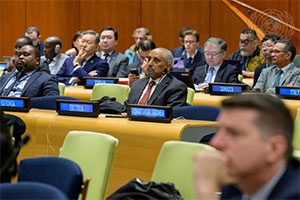 General Assembly Meets to Hear Briefing on UN80 Initiative. Credit: UN Photo/Manuel Elías
Global development conferences are continuing to produce critical frameworks for South-South cooperation and multilateral reform. In January of 2024, the 3rd Global South Nexus (GSN) International Conference was held in Odisha, India, with its theme being “Creating Responsible Professionals for Advancing SDGs: Inputs from Global North and South.” The 2025 UN SDG Report provided a midpoint assessment of the 2030 Agenda, with only 35% of targets on track and 18% having reversed. The 2025 UN Climate Change Conference (COP30) in Belém, Brazil, agreed to mobilize $1.3 trillion annually for climate action by 2035, operationalize the loss and damage fund, triple adaptation finance, and launched the Belém Mission to 1.5°C. In 2025, the Partnership for Economic Policy (PEP) convened its annual Policy Conference in Nairobi, Kenya, addressing the issue of “Financing and Inclusivity in Green Energy Transition in the Global South.” As the Global South advocates increasingly for a South-South framework alongside North-South cooperation, international conferences on sustainability aim to bridge economic and social divides between developed and developing countries in achieving the UN SDGs. Furthermore, to mark the UN’s 80th anniversary, the UN80 Initiative was launched to reshape how the UN system works so that every mandate, dollar, and decision creates greater impact for the global system.

The Week with IPS

NEXT STOP - SDGs
Tracking global progress towards a sustainable world
Tracking global progress towards a sustainable world
