Languages
Thursday, November 19, 2026



News and Views from the Global South
Food and Agriculture

Waste Not, Want Not – Providing for South Africa’s Food Security
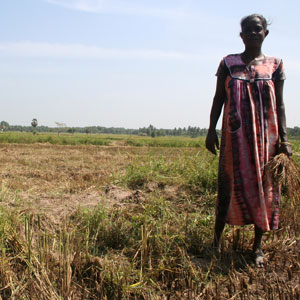
As South Africa grapples with reducing its sanitation backlog, scientists seem to have found a way to reduce the build up while simultaneously combatting the country’s food insecurity. The solution? Safely using human waste as fertiliser.
Q&A: Sustainable Development Key to Reducing Drug Use
"Drugs and crime threaten one of our most important goals - to ensure sustainable development around the world," United Nations Secretary-General Ban Ki-moon stated on Jun. 26, during a General Assembly debate on drugs and crime as a threat to development.Eco-Villages Breathe New Life Into Rural Senegal
Eighty-odd kilometres outside Dakar, the Senegalese capital, solar power and an irrigation scheme are transforming a traditional village into what the government hopes will be a model for the future of the countryside.
Mushroom farmers bloom in Cameroon
 In the NW region of Cameroon, mushrooms are a cherished delicacy, eaten by almost every household. Yet in the markets mushroom is scarce and farmer say successful cultivation is highly profitable.

Corporations See Green in Biodiversity
The gentle hills on the edge of this remote town are lush with tropical fruit trees that yield fine wines for the Broadchem Corporation and also give the agro company a green label.
Mapping out Climate Change Adaptation Plans on Kenya’s Airwaves
On a Wednesday morning in Mutitu-Andei township in Makueni County, one of Kenya’s driest areas, smallholder farmer Josephine Mutiso tunes into Radio Mang’elete 89.1 FM and listens as meteorological experts discuss the changes in rainfall patterns in the county.
Cuba Develops Crops Adapted to Climate Change
Cabbage, broccoli, carrots, onions and other resistant vegetables are being grown by researchers in Cuba, who for decades have been working to design plants adapted to the tropical conditions in the Caribbean region.
Cuba Seeks to Guarantee Food Supplies in Changing Climate*
In the face of the challenge of producing more food in a changing climate, farmers in Cuba are coming up with alternatives like planting drought-resistant crops and digging ponds to guarantee water supplies, in order to keep food on the table during times of drought, heavy rains or hurricanes.Microfinance Gets ‘Divine’ Intervention in India
In a country with a disastrous record for microfinancing, a religious organisation has done well enough to claim this year’s Ashden award for initiatives in providing loans to poor farmers.Biofuels and Hunger, Two Sides of the Same Coin
Despite growing evidence that biofuel production is causing food insecurity around the world, the new European Union policy blueprint on renewable energy ignores the social effects of biofuels. Last week, Guatemalan victims of the food crisis came to Brussels to make European policy makers aware of the problem.Food Safety Up Against Biotech Giants
As the 2012 Farm Bill continues to take shape in the halls of the United States Congress, the immense influence of corporate interests is on display.
Climate-Smart Agriculture to Reduce Vulnerability*
Agroforestry is gaining ground as a tool for climate change adaptation and mitigation in Central America, a region where global warming could generate losses equivalent to 19 percent of gross domestic product.
Increased Investment in Zambia’s Resources Means Displacement of Rural Poor
As social movements blasted the "new green economy" proposed at Rio+20 this week, environmental activists in Zambia worried about the role that poor people, especially those in rural areas, are going to play in it.
RIO+20: Promised Green Economy Was a Fake, Say Activists
When the Rio+20 summit on sustainable development ended Friday, there were winners and losers – mostly losers.
Mauritian Farmers Hooked on Fair Trade
In finding a way to survive a 36 percent cut in sugar prices, Mauritian farmers are not only exporting a variety of fruit and vegetables to the European Union, but they have also begun farming in a more environmentally sustainable way.Market Gardens Key to Autonomy for Niger Women
Four figures bend intently over their work in one corner of the large vegetable garden near the western Niger village of Dioga. Months after the village's main harvest has been brought in – and eaten up – the irrigated green of the garden is welcome relief in a part of the country where hunger never seems far away.
Agroecology Proves Cheap and Efficient on Brazilian Farm*
An agroecological farm outside of Rio de Janeiro is a testing ground for scientists and agronomists in Brazil, who have worked there for two decades to show that it is possible to produce a wide range of natural agricultural products in a cheap, efficient way that harms neither the environment nor human health.
Disasters Hold Climate Change Lessons for Thais
The Kiriwong community in southern Thailand is confident of handling climate change, thanks to lessons learned from a natural disaster that hit its village 25 years ago.Mauritanian Cooperative Contributes to Meeting Need for Vegetables
Fourteen years ago, unemployed and discouraged by a failed business venture, Mohamed Ould Abderrahmane turned to farming. Today the cooperative he set up to grow vegetables on the outskirts of the Mauritanian capital, Nouakchott, employs several dozen people and provides its members with a handsome income.
Refugees in South Sudan Facing “Full-blown Humanitarian Crisis”
Within the next nine days, drinking water at refugee camps in South Sudan's Upper Nile state will run dry, warned the aid agency Doctors Without Borders on Tuesday. Meanwhile, refugees continue to stream into the state, as the few camps set up to house to entrants are stretched even further beyond capacity.
Rio Outcome Bleak With No New Funding*
Amidst recrimination, anger and charges of “strong arm tactics”, negotiators eventually endorsed a global plan of action for sustainable development following marathon sessions lasting over six weary days.« Previous Page — Next Page »


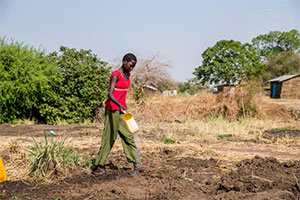 Farming on the Outskirts of Juba. Credit: UN Photo/JC McIlwaine
Promoting human and planetary health is a central focus of the United Nations, as laid out in the 2030 Sustainable Development Goals (SDGs). World hunger and unsustainable farming practices continue to be pressing concerns for the world. According to the 2025 State of Food Security and Nutrition in the World report by the Food and Agriculture Organization (FAO), 673 million people faced hunger in 2024. There are stark regional disparities, with the FAO projecting that 60% of the world population facing hunger will reside in Africa by 2030. Globally, the prevalence of food insecurity has remained consistently higher for women than men.
Sustainable and efficient national food systems are essential in preserving health, education, environmental well-being, peace, economy, and security. However, creating sustainable food systems can be a challenging endeavor, as food production takes a heavy toll on the environment. The agricultural sector accounts for a significant portion of greenhouse gases. Finding safe, sustainable, and ethical strategies to feed the world is crucial in ensuring planetary longevity. A recent initiative from 2023, the EU Regulation on Deforestation-free Products (EUDR), seeks to advocate for sustainable food systems. The main driver of deforestation is the expansion of agricultural land used to produce commodities like cattle, wood, cocoa, coffee, etc. The EUDR is part of the 2020 European Green New Deal and the EU Biodiversity Strategy for 2030 and aims to limit Europe’s consumption of products linked with deforestation by requiring that companies prove that their products are deforestation-free. Despite aiming to achieve major strides in sustainability, policies such as EUDR also raise socioeconomic concerns for targeted countries. Many emerging Latin American economies are impacted by the policy, and have raised the question of how developing countries can grapple with the tensions between economic development and advancing sustainability.
IPS has been at the forefront of providing compelling and insightful stories on communities facing hunger as well as the cost of food production. IPS uses statistics from FAO, the World Food Programme (WFP) and the International Fund for Agricultural Development (IFAD) to bring relevant and hard-hitting facts to readers. This gathering of information and data from such organizations helps bring the best stories from IPS journalists working in the different regions in consultation with experts on the ground.

The Week with IPS

NEXT STOP - SDGs
Tracking global progress towards a sustainable world
Tracking global progress towards a sustainable world