Languages
Wednesday, November 11, 2026



News and Views from the Global South
Labour

ICE Raids Leave Broken Homes in Their Wake
Saul Merlos is an undocumented migrant from El Salvador. About two years ago, he was living and working in the southern U.S. city of New Orleans.
Domestics Join Forces to Put Their House in Order
“We have come together to join forces, to be heard, because we want to speak for ourselves,” said Ernestina Ochoa, a Peruvian domestic worker, at the close of the founding congress of the International Domestic Workers Federation in the Uruguayan capital.
Swiss Knife Sharpened to Cut Bosses’ Pay
Swiss voters will decide Nov. 24 on introducing a salary cap that would limit the wage spread in companies to 1:12. The economic lobby is nervous - success for the proposal in the referendum is not as unrealistic as once expected.
Bangladesh Ailing After Aila
It has been four years since Cyclone Aila struck Bangladesh, triggering floods and widespread destruction. But the villagers of Koira subdistrict, among the worst affected of the 11 districts hit by the cyclone, are yet to recover from its impact.
Sometimes, Sex Work is the Least Bad
“We are not saying that all people become sex workers, but you make more money,” Virak Horn, a 32-year-old gay sex worker who works freelance in Cambodia’s capital Phnom Penh, tells IPS. He earns enough to support his family and pay for his college degree.
Private Initiative Finds Garbage Profitable in Cuba
As self-employment and cooperatives expand in socialist Cuba, they are making incursions into new areas, such as waste picking and recycling – for many a means of subsistence, but for others, a gold mine.
Walking an Economic Tightrope with No Safety Net
With the richest one percent of the population now owning 40 percent of global assets, and the bottom half sharing just one percent, inequality is fast being recognised as a stubborn underlying obstacle to development.
Climate Change a Mixed Blessing for Coconut Farmers
Climbing up the coconut industry has been anything but easy for Rosamund Benn, who has dedicated the past 32 years of her life working on a 50-acre coconut farm in The Pomeroon, a farming region of Guyana.
Behind Haiti’s Hunger
Haiti has been receiving food aid for half a century - over 1.5 million tonnes from the U.S. alone during the past two decades.
Treaty Poised to Cut Toxic Mercury Pollution
A new international convention opening for signatures this week will for the first time offer an agreed-upon roadmap by which to significantly decrease the global use of mercury while offering stronger safeguards for both human health and the environment.
Some Rice, Served With Rainwater
The quiet Cambodian village of Chouk, set in the beautiful forests of the Cardamom Mountains near the Thai border, seems peaceful. But things are difficult in this largely empty village of simple wooden houses, populated mainly by children and the elderly.The Dark Side of International Migration
The number of international migrants continues its inexorable climb even as reports of slave-like conditions continue to proliferate.
For the Disabled, Progress Unearths More Questions
When U.N. Secretary-General Ban Ki-moon opened a recent high-level meeting on disability and development that promised a place for the issue in the post-2015 agenda, he cited three examples of incapacity.
100-Dollar Dream Teases Bangladesh Workers
On the industrial outskirts of Dhaka, which is dotted with big and small clothes factories, thousands of workers took to the streets demanding a minimum wage rise.
U.S.-Africa Trade Mostly Benefits Oil, Textiles
With a key U.S.-Africa trade agreement up for renewal in 2015, advocates on all sides of the issue say current policies are rife with shortcomings that leave many African businesses out in the cold.
Disabled Make Do with Scraps from the Aid Table
Amidst the incomprehensible suffering that followed the 2010 earthquake in Haiti, international aid agencies rushed to provide services to the displaced and injured.People Pressure Piles up to Cleanse the Philippines
Under the reformist leadership of President Benigno Aquino III who has placed “good governance” initiatives at the heart of his administration’s agenda, the Philippines has enjoyed an unprecedented period of economic revival and political stability.
Egypt Paying a Price for ‘Cheap’ Labour
Egyptian workers who mobilised during the 2011 uprising that toppled the regime of Hosni Mubarak have used the past two and a half years to organise into unions, press for labour reforms, and strike for better wages and working conditions.BOOKS: Americana, a Filipino Story
One of the fastest-growing Asian immigrant groups in the United States, Filipinos are perceived as the most likely to assimilate with ease. That is, of course, if you’re looking from the outside in.
Mideast and Africa Still Holdouts on Women’s Rights
Gender equality around the world has increased dramatically over the past half-century even though the vast majority of countries continue to restrict women’s economic development in at least one way, the World Bank reports this week.
OP-ED: Sustainable Development Goals After 2015
Reducing the proportion of undernourished people by half until 2015 was one of the Millennium Development Goals that the international community set in 2000. It will not be reached: At least 870 million people worldwide – and one child in five – still go hungry; this in a world where we already produce enough food today to feed nine billion people in 2050.« Previous Page — Next Page »





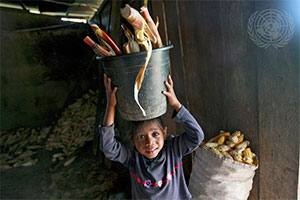 Timorese Girl with Fresh-Picked Corn. Credit: UN Photo/Martine Perret
A global common denominator is the need for a decent job. The economic realities of each country determine just how difficult it is to find one. Despite the labour movement's achievements, serious challenges persist: gender discrimination, child labour, worker migration, the digital divide and AI automation, evaporating pensions, unsafe workplaces, corporate pressure against union organising, negative impacts of trade agreements, and the precariousness of informal employment. The 2025 UN SDG Report identifies jobs and social protections as one of the six priority areas requiring urgent action, with progress either stalled or reversing in many developing nations.
In recent years, the fight to protect labour equality has taken on new dimensions with the rise of Environmental, Social and Governance standards. With the Social aspect aiming to promote equality and human rights, ESG principles have strengthened labour advocacy within corporate and governmental regulatory landscapes. In particular, ESG has become much more institutionalized in emerging economies such as Brazil and China. IPS follows the world’s workers as they confront these challenges - their setbacks and their successes.

The Week with IPS

NEXT STOP - SDGs
Tracking global progress towards a sustainable world
Tracking global progress towards a sustainable world
