Languages
Wednesday, November 11, 2026



News and Views from the Global South
Labour

Pakistani Workers Slaving Brick by Brick
One does not always need a time machine to travel into the past – a visit to a typical brick kiln in Pakistan’s Punjab province is enough to evoke a time when human beings were traded like animals and slavery was rampant.
For Development, Jobs May Outweigh Growth, World Bank Says
The World Bank warned Monday that over the next decade and a half, the world will need to create 600 million new jobs, particularly in Asia and Sub-Saharan Africa, just to maintain current employment rates.
Gaza Looks For Work, Not Aid
“The overwhelming majority of people we work with tell us, 'We don't want the aid, we want to have an opportunity to work and earn money’. Especially people who had a decent job but lost it in the last many years: before asking for any aid, they ask for a job.”
Smuggling Freely Across the Colombia-Venezuela Border
It's a straightforward calculation: a litre of gasoline costs 62 times more in Colombia than in Venezuela, a difference that fuels smuggling and crime along the border.
Stevia, a Flourishing Business in Spain
On a parcel of land a few kilometres outside the southern Spanish city of Málaga, unemployed activists are growing 2,000 seedlings of stevia, a plant used by the Guaraní indigenous people for centuries as a natural sweetener that is awakening ever greater interest in Spain.
For Palestinian Workers, the Enemy Is the Hope
Hassan Hader’s application for a permit to work in Israel has been rejected four times. Now waiting to hear back from the Israeli authorities on his latest attempt, the 52-year-old father of five said he has no choice but to keep applying.
Maldives Talks Condoms
For an orthodox Islamic country, the Maldives has made remarkable progress in halting the spread of HIV in the Indian Ocean archipelago through bold awareness programmes and the distribution of condoms.
Cuba’s Reforms Shift Focus to Training Skilled Workers
His carpenter’s certificate has made Antonio Tejero into a passionate champion of the trades, because, he says, he works “directly for society.” That attitude is in line with the government’s plan to train more technicians and skilled workers to give a boost to the economy.
Mexico, Also a Haven for Illegal Fishing
The authorities in Mexico seem to have thrown in the towel in the fight against illegal fishing, which is hurting fisheries, the environment, and incomes.South African Miners Begin Returning to Work
Miners at the Marikana platinum mine in South Africa have begun returning to work after agreeing a pay deal.*Women Redefine Japan’s Work Culture
Unhappy with her employer of five years, Chikako Harada, 34, quit three months ago and has just started on a new job with a large Internet sales company.
Occupy Celebrates Birthday, Forges Ahead
Led by a spirited brass band and waving placards decrying corporate greed, hundreds of occupiers took to San Francisco streets Monday to celebrate Occupy Wall Street’s first birthday, culminating in a ceremony where they symbolically ripped apart loan documents.
Occupy Marks Anniversary Amid Grim Economic Climate
Amid a heavy police presence, thousands of anti-capitalist activists in marked the one-year anniversary of the Occupy Wall Street movement against the U.S. political and economic system, which they say favours billionaires at the expense of the middle and working class.
Pakistan Factory Blaze Points to Poor Safety Standards, Corruption
The inferno that killed over 250 people at a garments factory in Karachi’s Baldia Town on Sept. 11 has raised questions over not just poor workplace safety standards in industry but massive corruption in government which leads to the flouting of building laws.
Ecotourism Helps Amazon Jungle Communities Survive
The Tsimane Mosetene people in Bolivia’s Amazon jungle region have found a tool to preserve their habitat and way of life: a community ecotourism project that won a United Nations-sponsored international award.
“Two Children May Have Died for You to Have Your Mobile Phone”
"It’s possible that two children died so that you could have that mobile phone,” says Jean-Bertin, a 34-year-old Congolese activist who wants to end the “absolute silence” around the crimes committed in his country to exploit strategic raw materials like coltan.
Justice a Long Way Off for Dead Miners
The South African Police Service members who were involved in a bloodbath with striking workers at the Marikana mine in North West Province could face murder charges, sources close to the investigation told IPS.
Informal Sector Work Survives Economic Boom in Argentina
Behind “yerba mate”, a caffeinated herbal brew that is popular in Argentina and neighbouring countries, lies a shameful reality: the dismal labour and living conditions of the workers who harvest the leaves of the bush used to make the infusion.
Cuban Women Face Challenges of Self-Employment
Beatriz Lemes took her time deciding, and finally agreed “apprehensively” to take the job of heading a state-run company that is making the transition to financial autonomy, a system that is spreading throughout Cuba and is testing women’s capacities, among other things.
Debate on Asbestos Safety Reaches Brazil’s Supreme Court
Brazil’s Supreme Court is assessing the level of risk posed by asbestos to human health, while industry defends its use under controlled conditions, and associations of people with asbestos-related diseases argue that it should not be used under any circumstances, even with regulations.
Women Spend 40 Billion Hours Collecting Water
As the weeklong international conference on water concluded Friday, it was left to one of the keynote speakers from the United Nations to focus on a much neglected perspective on water and food security: the role of women.« Previous Page — Next Page »





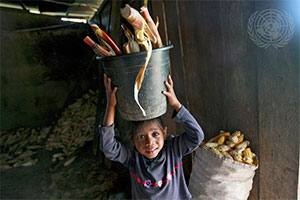 Timorese Girl with Fresh-Picked Corn. Credit: UN Photo/Martine Perret
A global common denominator is the need for a decent job. The economic realities of each country determine just how difficult it is to find one. Despite the labour movement's achievements, serious challenges persist: gender discrimination, child labour, worker migration, the digital divide and AI automation, evaporating pensions, unsafe workplaces, corporate pressure against union organising, negative impacts of trade agreements, and the precariousness of informal employment. The 2025 UN SDG Report identifies jobs and social protections as one of the six priority areas requiring urgent action, with progress either stalled or reversing in many developing nations.
In recent years, the fight to protect labour equality has taken on new dimensions with the rise of Environmental, Social and Governance standards. With the Social aspect aiming to promote equality and human rights, ESG principles have strengthened labour advocacy within corporate and governmental regulatory landscapes. In particular, ESG has become much more institutionalized in emerging economies such as Brazil and China. IPS follows the world’s workers as they confront these challenges - their setbacks and their successes.

The Week with IPS

NEXT STOP - SDGs
Tracking global progress towards a sustainable world
Tracking global progress towards a sustainable world
