Languages
Wednesday, November 18, 2026



News and Views from the Global South
Natural Resources

Draft Arctic Oil Spill Agreement “Inadequate”
Environmentalists are warning that a meeting of environment ministers that took place Monday in Sweden has agreed on a weak and inadequate response plan in case of an oil spill in the Arctic Ocean.
Hydroelectric Project Threatens Chile’s Lake Neltume
“This is paradise and they want to destroy it. This has had an enormous psychological impact on us,” says Guido Melinao, leader of the Mapuche indigenous community of Valeriano Cayicul, referring to the Neltume hydroelectric power plant project planned by the Spanish-Italian consortium Endesa-Enel.
Think Tank Urges “More Ambitious” U.S.-Mexican Agenda
The electoral and political stars are aligning in ways that offer the United States and Mexico major opportunities to substantially deepen their cooperation, particularly on trade, energy, and immigration, according to a report released here Wednesday by a special commission of the Inter-American Dialogue (IAD).
World Bank Unmoved on Auditor’s Criticism of Forest Policy
Officials at the World Bank are forcefully rejecting a new internal evaluation that is highly critical of the institution’s decade-long forest policy, expressing their “strong disagreement” with some assertions in the report.India Sails Into Troubled South China Sea
With territorial tensions in the South China Sea entering a new phase of confrontation, there are signs of growing Indian involvement in regional affairs.
New U.S. Biofuel Proposals Could Draw Heavily from Food Sources
New biofuel requirements proposed by the U.S. Environmental Protection Agency (EPA) are being met with concern by a spectrum of interest groups from environmentalists to the oil industry, with some warning that a gap between the proposal and existing law could force the government to draw on food-based alternative fuels.
Building Angolan-Brazilian Ties on Infrastructure
Brazil has turned to large infrastructure as a unique way to globally expand its economy and build up its political influence, with the added bonus of furthering the development of small nations. But this strategy is not without its risks.
OP-ED: Weird, and Getting Weirder
Weird is the only way to describe January temperatures whipsawing between record warm and arctic cold over a span of a few days. Experts say that is what climate change looks like: weird, record-shattering weather.
African Union Unable to Bring Peace to Warring Sudans
The African Union summit failed to provide a breakthrough in the ongoing negotiations between Sudan and South Sudan when it ended on Monday Jan. 28.Dubious Awards Presented at Davos
Only a stone's throw from the Davos World Economic Forum meeting, a group of non-governmental organisations presented the annual Public Eye Awards this week to Goldman Sachs and Royal Dutch Shell.
Expanding Coal Exports Test Obama’s Inaugural Climate Pledges
Following surprisingly forceful statements on the threat of global climate change by President Barack Obama during his second inaugural address on Monday, campaigners here are expressing cautious optimism that a second Obama administration will be able to see through some of the substantive actions on carbon reduction that largely eluded the president’s first term.
Dominica Sees Geothermal as Key to Carbon-Negative Economy
What a difference a trip makes. Before visiting the French island of Guadeloupe, Alfred Rolle had vocally expressed fears about the possible health effects of a decision to drill geothermal wells in the village of Laduat on the outskirts of Dominica's capital.
‘Green’ Approaches to Water Gaining Ground Around World
After Hurricane Sandy swept through the northeast of the United States late October 2012, millions of New Yorkers were left for days without electricity. But they still had access to drinking water, thanks to New York City's reliance on protected watershed areas for potable water.
Investments Go Green in Peru
Peru’s economic growth is largely dependent on its wealth of natural resources, which provide over 50 percent of the country’s gross domestic product (GDP) and 80 percent of exports. In view of this fact, the government is developing a project for the valuation and protection of this natural bounty.
Peering into the Energy Crystal Ball
Trying to predict the future of the energy sector is like trying to predict the weather in London in an era of global warming. But delegates had a go at it during the three-day World Future Energy Summit that ended in Abu Dhabi on Jan. 17.OP-ED: Organic Farming Movement Marginal but Growing Worldwide
Despite the growing worldwide demand for organic food, clothing and other products, the area of land certified as organic still makes up just 0.9 percent of global agricultural land, with 37 million hectares being farmed organically.
Digging for Water, But Striking Oil
The volatile politics of the Middle East have long been dominated by the fluctuating fortunes of a single commodity: oil.
Mideast Energy Crisis Looks For Light at the End of the Tunnel
When Jordan's Queen Rania Al Abdullah took the podium to address world political and business leaders at a back-to-back energy and water summit here, she said she was representing a country that relies on imports for over 90 percent of its energy needs.
OP-ED: Learning from Haiti’s Goudou Goudou
On a hillside overlooking Port-au-Prince, a muscular Haitian man in a green tank top raises a heavy steel pry bar over his head and brings it down into a hole, shattering a bit of Haiti’s limestone skeleton.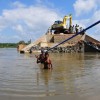
Experts Fear Collapse of Global Civilisation
Experts on the health of our planet are terrified of the future. They can clearly see the coming collapse of global civilisation from an array of interconnected environmental problems.
U.N. Aims at Sustainable Energy for All by 2024
When the General Assembly wound down its 67th session in late December, it underscored the key role for energy in the U.N.'s post-2015 economic agenda by declaring 2014-2024 the "Decade of Sustainable Energy for All".« Previous Page — Next Page »


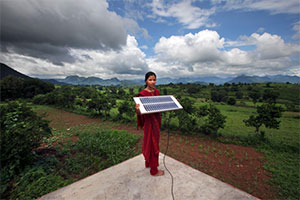 Bringing clean energy to rural India. Credit: Abbie Trayler-Smith / Panos Pictures / Department for International Development
Large reserves of oil, gas and minerals in developing countries generate opulent revenues. They could be used to stimulate economic growth and reduce poverty, but often result in environmental destruction and conflict, benefiting large companies and corrupt governments. Furthermore, competition over natural resources often manifests through geopolitical conflict. For example, before the US-Iraq war, Iraq’s domestic oil industry was nationalized. With US aggression came weakened Iraqi institutions and foreign intervention, thus eventually leading to the privatization of Iraqi oil, leaving the industry now largely dominated by Western companies. As another example, China’s rising investments within the lithium sector in South America are increasing the US-China rivalry across the Western Hemisphere. Notably, Bolivia has the largest reserves of lithium in the world, and the nation’s state-owned lithium extraction firm recently signed a contract with China’s CBC Consortium, while rejecting the entry of Western firms into the nation. In Bolivia’s case, rising Chinese investment in the nation’s lithium sector also raises concerns about environmental sustainability and the sociopolitical rights of Indigenous communities. More broadly, Sub-Saharan Africa holds nearly 30% of global reserves of critical minerals required for low-carbon technologies. Despite this, the region attracts less than 10% of global exploration investment, depicting a critical barrier to both the clean energy transitions and Sub-Saharan Africa’s economic development. Furthermore, resource wealth continues to fuel conflict like Sudan’s civil war, which has led to 9.1 million internally displaced people and is intensely connected to competition over gold, water, and agricultural land. IPS covers news about major oil, gas, and mining projects, their effects on the environment and local communities, and the ideas and actions of the interest groups involved.

The Week with IPS

NEXT STOP - SDGs
Tracking global progress towards a sustainable world
Tracking global progress towards a sustainable world
