Languages
Friday, November 27, 2026



News and Views from the Global South
Food and Agriculture
Fishing Communities in Brazil Fight for Survival
His father and other fishermen fought back with sickles, hoes and other work tools against the armed men sent by the purported owner of the land where they lived in order to evict them. But then the military police came and knocked down eight of their houses.
Swapping Trash for Fresh Produce in Mexico City
Isabel Becerril has come with some friends to the “barter market” in the Mexican capital, to exchange 40 kgs of recyclable refuse for fresh produce, sweets and plants. “This is the first time I have come here, and I like it,” the university student tells IPS, with her ecological bag in hand.DRC Farmers Reap Benefits of Soil Fertility
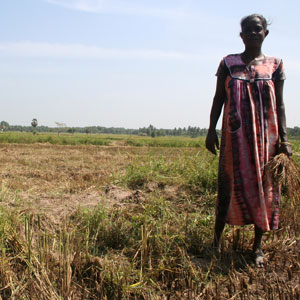
Just two years ago, rice farmers on the Ruzizi plain in the eastern part of the Democratic Republic of Congo were content to harvest 2.5 tonnes of rice per hectare. The adoption of new techniques has seen their output rise to between six and eight tonnes, with smallholder farmers also increasing their local market share.
Droughts Bring Climate Change Home to Nepali Farmers
Farmers in this fertile central district of south Nepal are convinced that an intense drought between May and early July that destroyed their maize crops is the result of climate change.
Climate-Battered South Asia Looks to Rio+20 Formula
Far-flung South Asian communities, from the high Himalayan slopes to the Indian Ocean coasts, united in the face of extreme and uncertain weather, continue to hold on to the hope that the Rio+20 focus on disaster risk reduction (DRR) will positively influence national policies.
Investigation Exposes Cruelty at Foie Gras Farms
Roasted foie gras fillet, with fresh chestnuts and soymilk skin. This dish from Mugaritz, considered the third-best restaurant in the world, sounds exotic. But how this "delicacy" - foie gras means "fat liver" - is produced and at what cost have been unmasked in an investigation led by Animal Equality.Local Producers Worried about Venezuela’s Admission to Mercosur
After a six-year delay, Venezuela finally became the fifth full member of South America’s main trade bloc, Mercosur, on Tuesday, bringing with it huge oil and natural gas reserves and a market hungry for the abundant agricultural production of its new partners to the south.
Profiting from Sustainable Forests on Communal Land in Mexico
Mario Guzmán plans to start cutting down trees again in August and September, the last months of the rainy season. “Now the roads are impassable, and the trucks can’t get in to haul out the timber,” the Mexican farmer, whose community is sustainably managing its forests, told IPS.
Pouring Edible Oil on Pakistan’s Troubled Areas
PESHAWAR, Jul 28 2012 (IPS) -Taking turns to lug a heavy can of edible oil, Mushtari and Sheema Gul, twin sisters aged nine, trip home happily from their school in Ghareebabad village in Pakistan’s troubled Bajaur Agency.
Africa Must Earn Its Climate Change Adaptation Finance
With the United Nations Climate Change Conference less than four months away, African countries need to present convincing arguments and successful adaptation projects to attract competitive funding for adjusting to changes in global weather patterns, climate finance experts say.
Cultivating Toxic Crops
At a time when spiraling input costs and perennial shortages of irrigation water are breaking countless farmers’ backs, a small village community on the outskirts of Lahore appears to have been spared.
Super Cereal For Mali’s Malnourished Children
Millet has become the basic ingredient for an enriched flour at the heart of an effort to establish a local, sustainable response to malnutrition in Mali.
Crops Failing as U.S. Simmers in Record Heat Wave
The United States is suffering one of its most severe droughts in decades, leading to both widespread crop failures and increased public concern about the impacts of climate change.
Pacific Coastal Fisheries in Dire Need of Protection
Coastal fisheries in Papua New Guinea, used primarily by local subsistence fisher folk, will face increasing pressure from climate change, compounding the twin problems of population growth and overfishing.
Teaching Madagascar’s Mothers to Combat Malnutrition
Every Friday, mothers and their children gather at the community nutrition centre in the little village of Rantolava, 450 kilometres north east of Antananarivo, the Malagasy capital, to learn more about a healthy diet.
Youth grow flowers to get money
 Farming flowers in slums is becoming an option for jobless youths in cities across Cameroon. Flowers and ornamental trees are planted to decorate compounds ,roadsides, lanes and tourism sites. Aaron Kaah reports.

Snails boost food, medicine production
Starting plantation farming in Cameroon in the 1980’s, and the spraying of pesticides, almost drove certain snail species to extinction. But farmers in the coastal regions of Cameroon are now cultivating the animals for food, traditional medicine and income. Iowa Firm Accused of Displacing Tanzanians for Profit
A major U.S. energy company, AgriSol Energy, is accused of engaging in land grabs in Tanzania that would displace more than 160,000 Burundian refugees who have lived there for decades, according to a report by the Oakland Institute, an organisation focused on environmental issues.
U.N. Showcases South-South Successes
Knowledge-sharing has become a cornerstone of successful cooperation among developing countries, in areas ranging from agriculture to health and renewable energies.
Cameroon farmers plant trees for bees
Honey producers in Cameroon are looking to restore bee habitats by planting trees in areas where deforestation have left the countryside bare.

Thai Farmers Fight ‘Global Warming Fines’
Small farmers in the Baan Pra village of Thailand's southern Trang province have been living in anxiety ever since they were slapped with stiff fines by the government in 2006 and ordered to vacate their ancestral lands for ‘contributing to global warming’.« Previous Page — Next Page »


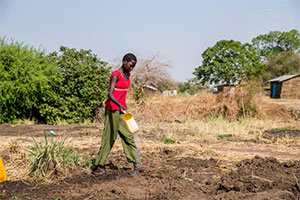 Farming on the Outskirts of Juba. Credit: UN Photo/JC McIlwaine
Promoting human and planetary health is a central focus of the United Nations, as laid out in the 2030 Sustainable Development Goals (SDGs). World hunger and unsustainable farming practices continue to be pressing concerns for the world. According to the 2025 State of Food Security and Nutrition in the World report by the Food and Agriculture Organization (FAO), 673 million people faced hunger in 2024. There are stark regional disparities, with the FAO projecting that 60% of the world population facing hunger will reside in Africa by 2030. Globally, the prevalence of food insecurity has remained consistently higher for women than men.
Sustainable and efficient national food systems are essential in preserving health, education, environmental well-being, peace, economy, and security. However, creating sustainable food systems can be a challenging endeavor, as food production takes a heavy toll on the environment. The agricultural sector accounts for a significant portion of greenhouse gases. Finding safe, sustainable, and ethical strategies to feed the world is crucial in ensuring planetary longevity. A recent initiative from 2023, the EU Regulation on Deforestation-free Products (EUDR), seeks to advocate for sustainable food systems. The main driver of deforestation is the expansion of agricultural land used to produce commodities like cattle, wood, cocoa, coffee, etc. The EUDR is part of the 2020 European Green New Deal and the EU Biodiversity Strategy for 2030 and aims to limit Europe’s consumption of products linked with deforestation by requiring that companies prove that their products are deforestation-free. Despite aiming to achieve major strides in sustainability, policies such as EUDR also raise socioeconomic concerns for targeted countries. Many emerging Latin American economies are impacted by the policy, and have raised the question of how developing countries can grapple with the tensions between economic development and advancing sustainability.
IPS has been at the forefront of providing compelling and insightful stories on communities facing hunger as well as the cost of food production. IPS uses statistics from FAO, the World Food Programme (WFP) and the International Fund for Agricultural Development (IFAD) to bring relevant and hard-hitting facts to readers. This gathering of information and data from such organizations helps bring the best stories from IPS journalists working in the different regions in consultation with experts on the ground.

The Week with IPS

NEXT STOP - SDGs
Tracking global progress towards a sustainable world