Languages
Sunday, October 25, 2026



News and Views from the Global South
Labour

Sri Lanka’s Development Goals Fall Short on Gender Equality
When Rosy Senanayake, Sri Lanka’s minister of state for child affairs, addressed the U.N. Commission on Population and Development (CPD) in New York last month, she articulated both the successes and shortcomings of gender equality in a country which prided itself electing the world’s first female head of government: Mrs. Sirimavo Bandaranaike in July 1960.
In India, a Broken System Leaves a ‘Broken’ People Powerless
As India paid glowing tributes to Bhimrao Ramji Ambedkar, the architect of its constitution and a champion of the downtrodden, on his 124nd birth anniversary last month, public attention also swivelled to the glaring social and economic discrimination that plagues the lives of lower-caste or ‘casteless’ communities – who comprise over 16 percent of the country's 1.2 billion people.
In India, a Broken Systems Leaves a Broken People Powerless
 As India paid glowing tributes to Bhimrao Ramji Ambedkar, the architect of its constitution and a champion of the downtrodden, on his 124nd birth anniversary last month, public attention also swivelled to the glaring social and economic discrimination that plagues the lives of lower-caste or ‘casteless’ communities – who comprise over 16 percent of the country’s 1.2 billion people.

Q&A: “People Need to Be at the Centre of Development”
In a populous archipelago nation like Indonesia, where 250 million live spread across some 17,500 islands, speaking over 300 languages, the question of development is a tricky one.
Watch What Happens When Tribal Women Manage India’s Forests
Kama Pradhan, a 35-year-old tribal woman, her eyes intent on the glowing screen of a hand-held GPS device, moves quickly between the trees. Ahead of her, a group of men hastens to clear away the brambles from stone pillars that stand at scattered intervals throughout this dense forest in the Nayagarh district of India’s eastern Odisha state.
Opinion: Progress of the World’s Women 2015-2016: Transforming Economies, Realising Rights
Our world is out of balance. It is both wealthier and more unequal today than at any time since the Second World War.Swelling Ethiopian Migration Casts Doubt on its Economic Miracle
The 28 Ethiopian migrants of Christian faith murdered by the Islamic State (IS) on Apr. 19 in Libya had planned to cross the Mediterranean Sea in search of work in Europe.
Opinion: The World Has Reached Peak Plutocracy
Parents in despair because they can’t pay the fees at the privatised neighbourhood school…
Rights Abuses Still Rampant in Bangladesh’s Garment Sector
Some say they were beaten with iron bars. Others confess their families have been threatened with death. One pregnant woman was assaulted with metal curtain rods.Backlash Follows South Africa’s Xenophobic Attacks on Africans
Shocking images of South Africans beating foreign-born residents residing in Durban, Johannesburg and other parts stunned the continent which had taken a message of brotherhood from former president Nelson Mandela.
From Slavery to Self Reliance: A Story of Dalit Women in South India
HuligeAmma, a Dalit woman in her mid-forties, bends over a sewing machine, carefully running the needle over the hem of a shirt. Sitting nearby is Roopa, her 22-year-old daughter, who reads an amusing message on her cell phone and laughs heartily.
Women Farmers Rewrite Their History in Chile’s Patagonia Region
More than 100 women small farmers from Chile’s southern Patagonia region have joined together in a new association aimed at achieving economic autonomy and empowerment, in an area where machismo and gender inequality are the norm.
781 Million People Can’t Read this Story
If you are reading this article, consider yourself one of the lucky ones; lucky enough to have received an education, or to be secure in the knowledge that your child will receive one. Lucky enough to be literate in a world where – more often than not – the ability to read and write can mean the difference between a decent life and abject poverty.
In Bangladesh, Gender Equality Comes on the Airwaves
Judging by how often they make headlines, one might be tempted to believe that women in Bangladesh don’t play a major role in this country’s affairs.
Women Still Struggling to Gain Equal Foothold in Nepal
Kali Sunar, 25, a resident of the Dumpada village in the remote Humla District in Far-West Nepal, lives a life that mirrors millions of her contemporaries.
Child Labour on U.S. Tobacco Farms: A Stubborn Problem in a Billion-Dollar Industry
For many young people, the summer is synonymous with free time, relaxation, or family vacations. For less fortunate kids the summer means labour, with scores of youths taking on part-time work to support their families.
Taking Child Workers Out of El Salvador’s Sugar Cane Fields
The participation of children and teenagers in the sugar cane harvest, a dangerous agricultural activity, will soon be a thing of the past in El Salvador, where the practice drew international attention 10 years ago.
No Rest for the Elderly in India
As more and more people in India enter the ‘senior citizen’ category, ugly cracks are beginning to appear in a social structure that claims to value the institution of family but in reality expresses disdain for the bonds of blood.
There’s No Such Thing as Equality in India’s Labour Force
It calls itself the ‘world’s largest democracy’ but the 380 million working-aged women in India might disagree with that assessment.
Opinion: A Major Push Forward for Gender and Environment
Experts from around the world gathered in New York recently to launch work on the Global Gender Environment Outlook (GGEO), the first comprehensive, integrated and global assessment of gender issues in relation to the environment and sustainability.
Afghanistan’s Economic Recovery: A New Horizon for South-South Partnerships?
First the centre of the silk route, then the epicenter of bloody conflicts, Afghanistan’s history can be charted through many diverse chapters, the most recent of which opened with the election of President Ashraf Ghani in September 2014.« Previous Page — Next Page »





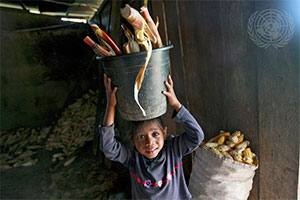 Timorese Girl with Fresh-Picked Corn. Credit: UN Photo/Martine Perret
A global common denominator is the need for a decent job. The economic realities of each country determine just how difficult it is to find one. Despite the labour movement's achievements, serious challenges persist: gender discrimination, child labour, worker migration, the digital divide and AI automation, evaporating pensions, unsafe workplaces, corporate pressure against union organising, negative impacts of trade agreements, and the precariousness of informal employment. The 2025 UN SDG Report identifies jobs and social protections as one of the six priority areas requiring urgent action, with progress either stalled or reversing in many developing nations.
In recent years, the fight to protect labour equality has taken on new dimensions with the rise of Environmental, Social and Governance standards. With the Social aspect aiming to promote equality and human rights, ESG principles have strengthened labour advocacy within corporate and governmental regulatory landscapes. In particular, ESG has become much more institutionalized in emerging economies such as Brazil and China. IPS follows the world’s workers as they confront these challenges - their setbacks and their successes.

The Week with IPS

NEXT STOP - SDGs
Tracking global progress towards a sustainable world
Tracking global progress towards a sustainable world
