Languages
Wednesday, November 11, 2026



News and Views from the Global South
Labour
Five Years of Protests in Nicaragua for a Partial Pension
Luisa Gutiérrez, 65, dances a frenzied mambo on an unusual dance floor: a street in the Nicaraguan capital. Dozens of cars line up behind her, honking their horns impatiently, while she, surrounded by elderly people with canes, walkers and protest signs, dances to demand a government pension.
Spain Hit by Epidemic of Despair
Rising rates of depression and suicide are among the most obvious signs of the increase in mental illness resulting from the economic crisis in Spain.Irregular Migrants Face the Boot in Greece
A crackdown on irregular migration has entered its fourth week in Greece. The government is shutting the Greek-Turkish northeastern border across river Evros, and removing massive numbers of undocumented migrants from big urban centres into makeshift detention camps.Millions of Jobless Desperate in Spain
The sun is shining in Spain as it does every summer. But millions of people in this crisis-stricken country are living in the shadow cast by Europe’s highest unemployment rate.
Cuban Higher Education Changing in Times of Reform
Enrolment in Cuban universities fell by 25.8 percent during the past school year, as young people are being oriented toward fields with more employment opportunities, such as agriculture, in the context of sweeping economic reforms that are also affecting public education.
Fishing Communities in Brazil Fight for Survival
His father and other fishermen fought back with sickles, hoes and other work tools against the armed men sent by the purported owner of the land where they lived in order to evict them. But then the military police came and knocked down eight of their houses.
Rescuing an Art to Save a People
Sitting on the floor, deep in concentration, Marta Llampa interlaces red and black threads that converge in sinuous shapes, gradually forming khurus or mythical creatures through a unique, age-old technique rescued from extinction by the Jalq'a people.
Pakistan Faces a ‘Youth Bomb’
“This is just a trailer of the horror that awaits us,” says noted demographer Farid Midhet, referring to Pakistan’s bulging population and the possibly corresponding link to rising crime, including murders, robberies, rioting and extremist activity.Many Chilean Women Keep Mum About Unequal Wages
"I know that my male colleagues earn more than I do and work the same amount or even less. And my employers keep me in a non-managerial post, even though I do tasks at that level,” said Pamela, a Chilean professional who holds a doctorate in economics.Assault on Colombian Trade Unions Continues Unabated
Two months after a free-trade agreement between the United States and Colombia went into effect, workers and activists are warning that U.S.-stipulated labour reforms have not been fully implemented and have yet to result in promised improvements in the lives of workers.
Caribbean Moves to Protect Rights of HIV-Positive Workers
Thirty years into the HIV and AIDS epidemic, Caribbean countries are slowly putting necessary legislation in place to ensure the rights of workers despite their HIV/AIDS and chronic disease status.
Poverty Drives Child Labour
In an informal settlement of 10,000 people on the outskirts of Papua New Guinea’s capital, Port Moresby, Tembari Children’s Care – a new grassroots initiative – is providing protection, food and education to orphans and abandoned children who would otherwise join the high numbers of child labourers in this Melanesian country.
Archaic Laws Stymie HIV/AIDS Work in Sri Lanka
Sri Lanka has long enjoyed a low 0.1 percent HIV prevalence but, as the number of fresh infections rises steadily, experts are calling for a change in the country's archaic laws that make sex work illegal and criminalises homosexual activity.Canada Targets Traffickers, With a Close Eye on Sex Work
The arrests last week of the three remaining perpetrators of the alleged Opapa human trafficking ring, which forced 19 people recruited from Hungary to endure long work days, poor living conditions and no pay in the Canadian construction industry, has cast a light on Ottawa’s new measures to combat the crime.Chile Debates Control over Lithium Production
The Chilean government's decision to invite companies to tender offers for mine lithium resources has been widely rejected by mining trade unions and legislators of the opposition.
Egypt’s New Unions Face Uncertain Future
The independent trade unions that have sprung up across Egypt over the last 17 months face an uncertain future, caught between Islamists and the military and operating under labour laws that have not changed since Hosni Mubarak was in power.
Mozambique’s “People from Germany” Wait Decades for Salaries
Every Wednesday at 11.00am José Alfredo Cossa unfurls his East German flag and leads a march of around 150 men and women down the main streets of Maputo, Mozambique’s capital. In a struggle for justice that has been going on for more than 20 years this group, known as the “Magermans”, represent the 16,000 to 20,000 Mozambicans who were sent to the former East Germany in the early 1980s to work and serve their country.
RFK Award Spotlights Struggle for Farmworkers’ Rights
New York State legislators up in Albany are likely to be seeing a lot of Librada Paz in the near future.
Growing ‘Entertainment’ Industry Traps Nepali Girls
Almost unnoticed, Nepal’s burgeoning adult entertainment industry has been drawing young girls away from being trafficked across the border to the fleshpots of India’s big cities.‘Reforms’ Legacy Rocks Romania Again
Romanian President Traian Basescu is close to being impeached after the Parliament suspended him Friday. The political crisis, however, distracts from citizens’ calls for a more responsive political class and a halt to declining standards of living.
Aquaculture Boosts Papua New Guinea’s Food Security
The vast Sirinumu Reservoir in Central Province which supplies water and electricity to Papua New Guinea (PNG)’s capital, is home to a co-operative of 60 fish farmers who are successfully employing aquaculture to improve local incomes and food security.« Previous Page — Next Page »





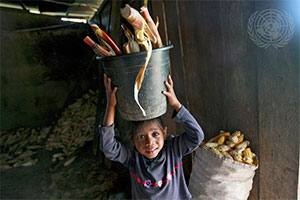 Timorese Girl with Fresh-Picked Corn. Credit: UN Photo/Martine Perret
A global common denominator is the need for a decent job. The economic realities of each country determine just how difficult it is to find one. Despite the labour movement's achievements, serious challenges persist: gender discrimination, child labour, worker migration, the digital divide and AI automation, evaporating pensions, unsafe workplaces, corporate pressure against union organising, negative impacts of trade agreements, and the precariousness of informal employment. The 2025 UN SDG Report identifies jobs and social protections as one of the six priority areas requiring urgent action, with progress either stalled or reversing in many developing nations.
In recent years, the fight to protect labour equality has taken on new dimensions with the rise of Environmental, Social and Governance standards. With the Social aspect aiming to promote equality and human rights, ESG principles have strengthened labour advocacy within corporate and governmental regulatory landscapes. In particular, ESG has become much more institutionalized in emerging economies such as Brazil and China. IPS follows the world’s workers as they confront these challenges - their setbacks and their successes.

The Week with IPS

NEXT STOP - SDGs
Tracking global progress towards a sustainable world
Tracking global progress towards a sustainable world
