Languages
Wednesday, November 11, 2026



News and Views from the Global South
Labour

Green Bricks Pave Future for Female Workers
At first glance the smart young women in white overcoats, black rubber boots and protective face masks seem out of place in impoverished Bangladesh’s dirtiest industry – brick making.
Corporations See Green in Biodiversity
The gentle hills on the edge of this remote town are lush with tropical fruit trees that yield fine wines for the Broadchem Corporation and also give the agro company a green label.
Depleted Chilean Fish Need “A Real Chance of Recovery”
The model of exploiting fisheries that has prevailed in the last decade has driven fish stocks to critically low levels in Chile, which has a 6,435 km Pacific coastline and a wide diversity of marine resources.
Bangladesh on the Green Brick Road
Bangladesh, a country highly vulnerable to climate change, is doing its bit to reduce greenhouse gas (GhG) emissions and glacier-melting soot by switching to ‘smokeless’ brick-making technology.
‘It Should be Named Planet Ocean, Not Planet Earth’
Oceans, seas and coasts provide over 200 million jobs globally, while 4.3 billion people get 15 percent of their intake of animal protein from the seas. Travel and tourism, ports and energy production use oceans and seas to create jobs and economic and social benefits for millions of people.
Disasters Hold Climate Change Lessons for Thais
The Kiriwong community in southern Thailand is confident of handling climate change, thanks to lessons learned from a natural disaster that hit its village 25 years ago.
Brazil Takes Steps to Confiscate Property of Landowners Using Slave Labour
Today, in the 21st century, there are still tens of thousands of Brazilians subjected to slave-like working conditions. Last year alone, 2,501 workers were freed from this situation by Ministry of Labour inspectors.
Nepal’s Female Farmers Fear Climate Change
When Arati Chaudhary’s husband left for India to find work as a migrant labourer, the job of managing farm and family fell on her slender shoulders.
Q&A: “Today’s Food System Is Failing Small Farmers”
With heads of state from more than 120 nations and tens of thousands of civil society and international development experts gathering for the U.N. Summit on Sustainable Development next week, it is accepted wisdom that rethinking agriculture is one of most critical issues facing this and future generations.
Samoan Breadfruit Makes a Splash in the Caribbean
Can a single species of tree significantly reduce hunger, unemployment and deforestation in the tropics? Researchers and scientists behind a surge in breadfruit activity think so.Trade Unionists Denounce Persecution in El Salvador
Persecution of trade unionists remains a problem in El Salvador, in spite of the fact that the country is governed by a left-wing party that advocates labour rights, union leaders say.Climate Change Drives Exodus to Jakarta
Another month of plying his ‘becak’ (trishaw) in the capital city and Sarjo will be coming back to this West Java district to harvest the rice ripening on his 1,400 sq m paddy.Singapore Still Hostile to Immigrants
The crash of a million-dollar Ferrari driven at high speed by a wealthy Chinese expatriate in the early hours of a weekend morning earlier this month has reignited the stormy immigration debate here, highlighting many Singaporeans’ resentment towards foreigners living and working in this small island nation.
A Future With Food, or No Future At All
The upcoming Rio+20 Conference on Sustainable Development will not succeed if the crises of hunger and malnutrition are not effectively addressed. The issues are so inextricably linked with sustainable development that they have to be part of the agenda, according to a report released Wednesday by the United Nations Food and Agricultural Organisation (FAO) for the upcoming Earth Summit that will take place in Rio de Janeiro from Jun. 20-22.Indonesian Immigrants Suffer in Silence
Foreign workers, mostly from Indonesia, now make up just over 10 percent of Malaysia’s workforce of 14 million people, both in the formal and informal sectors, according to the latest government statistics.
Outsourced Chilean Copper Workers “21st Century Slave Labour”
"Temporary and subcontracted workers in the copper industry are the slave labour of the 21st century. Lacking rights and social protection, they are vulnerable and defenceless," complained Cristián Cuevas, the leader of a union for outsourced Chilean copper workers.Efforts to Build Caregiving Industry ‘Inadequate’
To meet the demands of a rapidly ageing population, Japan has loosened its notoriously strict immigration and nursing regulations to accept foreign caregivers. But new evidence indicates deep cracks in those piecemeal gestures.TAJIKISTAN: Divorce Spurs Female Labour Migration
Four years ago, Farida Hajimova's husband left Tajikistan to work in Russia. After a time, he stopped calling. Ultimately, he never returned. She was left at home in Dushanbe with two daughters and not a lot of options.Manila and Moscow Inch Closer to Labour Agreement
As the number of migrant Filipino workers in Russia inches closer to 5000, Moscow and Manila are busy negotiating a bilateral labour agreement that could allow thousands more overseas workers into various sectors of the Russian economy.
Spain’s “Indignados” Take to the Streets Again
A filthy vacant lot is now sprouting strawberries, tomatoes and carrots. This small community garden in the centre of the southern Spanish city of Málaga was created by the "Indignados" protest movement, which is celebrating its first anniversary Saturday by taking to the streets across the country.War Widows Turn to Sex Work in Sri Lanka
On May 18, some 800 women in Sri Lanka’s northern region will hold Hindu religious ceremonies for the welfare of thier husbands who disappeared or surrendered to the military as it moved in to mop up nearly three decades of armed Tamil separatism.« Previous Page — Next Page »





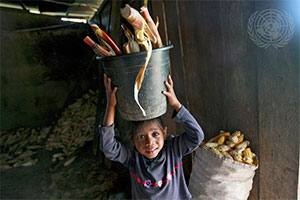 Timorese Girl with Fresh-Picked Corn. Credit: UN Photo/Martine Perret
A global common denominator is the need for a decent job. The economic realities of each country determine just how difficult it is to find one. Despite the labour movement's achievements, serious challenges persist: gender discrimination, child labour, worker migration, the digital divide and AI automation, evaporating pensions, unsafe workplaces, corporate pressure against union organising, negative impacts of trade agreements, and the precariousness of informal employment. The 2025 UN SDG Report identifies jobs and social protections as one of the six priority areas requiring urgent action, with progress either stalled or reversing in many developing nations.
In recent years, the fight to protect labour equality has taken on new dimensions with the rise of Environmental, Social and Governance standards. With the Social aspect aiming to promote equality and human rights, ESG principles have strengthened labour advocacy within corporate and governmental regulatory landscapes. In particular, ESG has become much more institutionalized in emerging economies such as Brazil and China. IPS follows the world’s workers as they confront these challenges - their setbacks and their successes.

The Week with IPS

NEXT STOP - SDGs
Tracking global progress towards a sustainable world
Tracking global progress towards a sustainable world
