Languages
Friday, November 13, 2026



News and Views from the Global South
Natural Resources

GM Crop Could Migrate Dangerously
Food security activists who secured a moratorium on introducing genetically modified brinjal (aubergine) into India fear that their efforts are being undermined by the release of GM brinjal in neighbouring Bangladesh.
U.S. Unveils Military Strategy for Arctic
The United States is calling for greater cooperation in the Arctic, even as it warns that it will defend its sovereignty in the face of strengthening international interest in newly opening shipping lanes and natural resource extraction opportunities as the region’s ice disappears.
Jobless Growth, the 21st Century Condition
The world’s poorest countries are rethinking economic policies that - even during periods of breakneck growth - have failed to provide quality employment capable of matching a demographic boom.
For Better or For Worse – Fracking in the Rustic Karoo
To the casual passer-by, Petrus Kabaliso and his wife Cynthia present a disarmingly rustic sight, seated as they are under the shade of a date palm at a truck stop in the scorching Karoo desert, in South Africa's Northern Cape province, a battered umbrella held jauntily over their heads.
Multinationals’ Interest Grows in Sustainable Bioplastics
Eight major multinational consumer products companies have come together to investigate whether it is possible to produce a sustainable form of “bioplastic”, made from plants rather than petroleum products.
Legal Battles Against Opening Up Mexico’s Oil Industry
As Mexico moves towards a controversial reform that would be the largest opening of the oil industry to foreign investors in decades, local communities and non-governmental organisations are fighting in court against earlier contracts with foreign companies, which have been possible since 2008.
Trinidadian Fishers Choose Jail over “Seismic Bombing”
The demonstration took place on land and sea simultaneously. In the end, police had arrested three people, including Gary Aboud, president of the Trinidadian NGO Fishermen and Friends of the Sea (FFOS), but protesters were undaunted. They would be back.
Oil Palm Changes Rural Culture in Brazilian Amazon
Thousands of small farming families in Pará, in the Amazon jungle in northeast Brazil, have turned to the African oil palm as a new source of income, through contracts with biofuel companies. Strange bedfellows, which poses cultural and economic challenges.
Carbon Emissions on Tragic Trajectory
Burning of fossil fuels added a record 36 billion tonnes of CO2 to the atmosphere in 2013, locking in even more heating of the planet.
Demarcation of Native Territories Essential for Venezuela’s Amazon Region
“All of the countries of the Amazon basin say they want to protect the environment, but they all have agreements with transnational corporations for the construction of roads or for mining and exploitation of forests,” Curripaco indigenous leader Gregorio Díaz Mirabal, from the south of Venezuela, told Tierramérica.*At Kyrgyzstan’s Kumtor Mine, “No Light at the End of the Tunnel”
The Kumtor gold mine is Kyrgyzstan's lone economic gem. Yet, despite the mine’s vital importance to the Kyrgyz economy, officials appear to be mulling a doomsday option for the Canadian-run project.
New Hope for Haiti’s Decimated Forests
Small farmers could play an important part in making Haiti – where just two percent of trees are still standing – green again.
Coal Tries to Clean Up Its Image
An International Coal and Climate summit organised by the Polish Ministry of Economy and the World Coal Association kicked off Monday in the Polish capital Warsaw in parallel to the United Nations Climate Change Conference COP19, amid outcry from environmentalists who accused COP host Poland of bias in favor of the coal industry.
“World Toilet Day” No Joke for Billions Without Sanitation
The United Nations has a longstanding tradition of commemorating political milestones - like the abolition of the slave trade - or sustaining day-long vigils on controversial issues such as a ban on nuclear tests.
Indonesia’s Forest Communities Victims of ‘Legal Land Grabs’
Indonesia’s rainforests are facing “legal land grabs”, allege NGOs. Its ancient communities are finding that their ancestral lands are slipping into the hands of foreign companies for oil palm cultivation, as demand for the product grows in Europe, India and China.
Fishing Communities Will Face Warmer, Acid Oceans
Eating fish has been an integral part of the Caribbean's cultural traditions for centuries. Fish is also a major source of food and essential nutrients, especially in rural areas where there are scores of small coastal communities.
Brazil Headed Towards an Energy Revolution
Energy consumption and production are undergoing fundamental shifts but the world is still on course to a 3.6 degree C hotter climate according a report released during the U.N. climate talks in Warsaw.
Las Pavas Extracts a Miracle from God
The rural community of Las Pavas in northern Colombia received this year’s National Peace Prize Wednesday in recognition of its peaceful struggle for land that is claimed by an oil palm company, in a case that became an international symbol of the conflict over land in this country.
Q&A: Indonesia Still at High Risk for Catastrophic Fires
In June, Singapore, Malaysia and Indonesia were enveloped in haze as hundreds of forest fires burned across the island of Sumatra, in the worst pollution crisis to hit Southeast Asia in more than a decade.
Oil Palm Expands on Deforested Land in Brazil’s Rainforest
The green of the oil palm plantations is unbroken along kilometre after kilometre of red soil, devastated in the past by loggers and ranchers. The oil palm, a sign of alarm for some and of hope for others, is here to stay in the Amazon rainforest state of Pará in the extreme north of this country.
St. Vincent’s Volcano Holds More Promise Than Peril
Weary of sky-high electricity prices, St. Vincent is following in the footsteps of another, decidedly un-tropical island nearly 4,000 miles away in its quest to harness clean geothermal power.« Previous Page — Next Page »


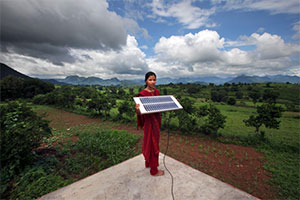 Bringing clean energy to rural India. Credit: Abbie Trayler-Smith / Panos Pictures / Department for International Development
Large reserves of oil, gas and minerals in developing countries generate opulent revenues. They could be used to stimulate economic growth and reduce poverty, but often result in environmental destruction and conflict, benefiting large companies and corrupt governments. Furthermore, competition over natural resources often manifests through geopolitical conflict. For example, before the US-Iraq war, Iraq’s domestic oil industry was nationalized. With US aggression came weakened Iraqi institutions and foreign intervention, thus eventually leading to the privatization of Iraqi oil, leaving the industry now largely dominated by Western companies. As another example, China’s rising investments within the lithium sector in South America are increasing the US-China rivalry across the Western Hemisphere. Notably, Bolivia has the largest reserves of lithium in the world, and the nation’s state-owned lithium extraction firm recently signed a contract with China’s CBC Consortium, while rejecting the entry of Western firms into the nation. In Bolivia’s case, rising Chinese investment in the nation’s lithium sector also raises concerns about environmental sustainability and the sociopolitical rights of Indigenous communities. More broadly, Sub-Saharan Africa holds nearly 30% of global reserves of critical minerals required for low-carbon technologies. Despite this, the region attracts less than 10% of global exploration investment, depicting a critical barrier to both the clean energy transitions and Sub-Saharan Africa’s economic development. Furthermore, resource wealth continues to fuel conflict like Sudan’s civil war, which has led to 9.1 million internally displaced people and is intensely connected to competition over gold, water, and agricultural land. IPS covers news about major oil, gas, and mining projects, their effects on the environment and local communities, and the ideas and actions of the interest groups involved.

The Week with IPS

NEXT STOP - SDGs
Tracking global progress towards a sustainable world
Tracking global progress towards a sustainable world
