Languages
Thursday, August 27, 2026



News and Views from the Global South
Trade & Investment

Why ACP Countries Matter for the EU Post-2015 Development Agenda
We are witnessing a shift in the original rationale behind the unique relationship between the European Union and the African, Caribbean and Pacific countries of the ACP group, which goes beyond the logic of “unilateral aid transfer”, “donor-recipient approach” and “North-South dialogue”.
Opinion: G20 Turkish Presidency Keen to Benefit the Global Community
Turkey assumed the Presidency of the Group of 20 (G20) on Dec. 1, 2014. It will culminate in the Antalya Summit on Nov. 15-16. Our priorities build upon the G20 multi-year agenda, but also reflect particular themes we see as important for 2015.
G7’s Coal Addiction Behind Hunger
As heads of state and government of the G7 states prepare for their Jun. 7-8 summit in Germany, Oxfam has released a new report titled Let Them Eat Coal which they may find hard to digest.
‘Ethical Fashion’ Champions Marginalised Artisans from South
“Work is dignity,” says Simone Cipriani. “People want employment, not charity.”
Pacific Civil Society Swings Out Against Free Trade Agreement
Fourteen Pacific Island Forum countries are currently locked in negotiations with their two largest economic neighbours, Australia and New Zealand, to forge a new regional free trade agreement called ‘PACER Plus’, which supporters believe will boost economic growth in the region.
Zimbabwean Women Weave Their Own, Beautiful Future
 Seventy-seven-year-old Grace Ngwenya has an eye for detail. You will never catch her squinting as she effortlessly weaves ilala palm fronds into beautiful baskets.

Native Communities in Mexico Demand to be Consulted on Wind Farms
“It hurts us that our land is affected, and the environmental impacts are not even measured. Wind farm projects affect streams and hurt the flora,” said Zapotec Indian Isabel Jiménez, who is taking part in the struggle against the installation of a wind park in southern Mexico.
Jamaican Gov’t Sees IMF Successes but No Benefits for the Poor
For Jamaicans like Roxan Brown, the Caribbean nation's International Monetary Fund (IMF) successes don’t mean a thing. Seven consecutive tests have been passed but still, the mother of two can’t find work and relies instead on the kindness of friends and family.
Opinion: Why the US-Iran Nuclear Deal May Still Fail
The euphoria that spread though the world after the Iran nuclear agreement reached in Lausanne in April this year with the United States, Russia, China, France, United Kingdom and Germany, plus the European Union, is proving short-lived.Corporate Tax Dodging Cheats Africa Out of 6 Billion Dollars, Says Oxfam
G7-based companies and investors cheated Africa out of an estimated six billion dollars in a year through just one form of tax dodging, according to a new Oxfam report ‘Money talks: Africa at the G7’, released Jun. 2.
Opinion: The Bumpy Road to an Asian Century
It has been apparent for some time that we are in the midst of a historic shift of the centre of gravity of the global economy from the trans-Atlantic to what is now becoming known as the Indo-Pacific.
Opinion: Internet Should be Common Heritage of Humankind – Part II
The Internet – and the applications that it has spawned – is the single most important technological innovation that has brought together and interlinked humankind in a real, tangible and interactive way.
ACP Aims to Make Voice of the Moral Majority Count in the Global Arena
“Four decades of existence is a milestone for the ACP as an international alliance of developing countries,” Dr Patrick I. Gomes of Guyana, newly appointed Secretary-General of the African, Caribbean and Pacific group of countries, said at the opening of the 101st Session of the group’s Council of Ministers.
Opinion: Finance Like a Cancer Grows
It is astonishing that every week we see action being taken in various part of the world against the financial sector, without any noticeable reaction of public opinion.
Q&A: Papua New Guinea Reckons With Unmet Development Goals
As Papua New Guinea celebrates 40 years of independence, 2015 marks a defining year for the largest Pacific Island nation, set to record 15 percent GDP growth this year.
Bougainville: Former War-Torn Territory Still Wary of Mining
From Arawa, once the capital city of Bougainville, an autonomous region in eastern Papua New Guinea in the southwest Pacific Ocean, a long, winding road leads high up into the Crown Prince Ranges in the centre of the island through impenetrable rainforest.
A Chimera in Growing Cooperation Between China and Brazil
A total of 35 agreements and contracts were signed during Chinese Prime Minister Li Keqiang’s visit to Brazil, as part of the growing ties between the two countries. But there is one project that drew all the attention: the Transcontinental Railway.
“Megaprojects” Can Destroy Reputations in Brazil
Megaprojects are high-risk bets. They can shore up the government that brought them to fruition, but they can also ruin its image and undermine its power – and in the case of Brazil the balance is leaning dangerously towards the latter.
Opinion: Clean Energy Access, a Major Sustainable Development Goal
The Sustainable Energy for All (SE4ALL) Forum will take place May 18-21 in New York. Success in achieving sustainable development and tackling climate change challenges requires investment in clean energy solutions.
U.S. Hosts Arms Bazaar at White House Arab Summit
When the United States sells billions of dollars in sophisticated arms to Arab nations, they are conditioned on two key factors: no weapons with a qualitative military edge over Israel will ever be sold to the Arabs, nor will they receive any weapons that are not an integral part of the U.S. arsenal.
The Asia-Pacific Region Is ‘Growing’, but Millions Are Living in Poverty
Home to an estimated 3.74 billion people, the Asia-Pacific region holds over half the global population, determining to a great extent the level of economic stability, or chaos, in the world.« Previous Page — Next Page »


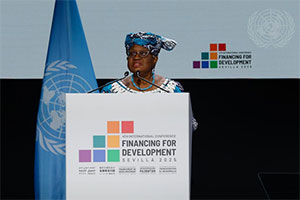 Opening of 4th International Conference on Financing for Development. Credit: UN Photo/Mariscal
International trade and investment are crucial elements of the world economy. While they can be powerful stimulators of development, they can also lead to global imbalances and dynamics of exploitation. In 2025, international trade entered a period of immense disruption, driven in part by a new wave of United States tariffs that reshaped global supply chains and investment flows. The increase in the US tariff rate, the highest since the 1930s, has forced bilateral renegotiations with global trading partners. Furthermore, the debt crisis in developing nations has accelerated while Official Development Assistance (ODA) has substantially dropped 7.3% in 2024.
In the 21st century, advancements in economic diversification in formerly colonized nations have propelled them into more central roles in the global economy. For example, both China and Mexico were able to develop their manufacturing sector and channel this development into booming export flows, thus advancing into the position of emerging economies. Foreign investment also plays an essential role in providing capital for developing countries, although they are oftentimes accompanied by social and environmental exploitation. For example, rising Chinese investments in natural resources in Latin America have often been met with tension as these investment projects fail to properly mitigate environmental risks and protect workers’ rights. In a more multifaceted vein, Sino-African relations have led to infrastructure development in Sub-Saharan Africa while also heightening the region’s economic dependency on China. IPS reports on global news in trade and investment, while shining a light on the nuanced nature of these endeavors.

The Week with IPS

NEXT STOP - SDGs
Tracking global progress towards a sustainable world
Tracking global progress towards a sustainable world
