Languages
Wednesday, November 18, 2026



News and Views from the Global South
Trade & Investment
Turkey’s Excessive Neo-liberalism Threatens ‘Peace at Home’
"Peace at home, peace in the world" is the official motto of the Turkish Republic. Coined in 1931 by the republic's founder, Mustafa Kemal Ataturk, it implies a causal relationship, but the events this week in Istanbul and dozens of other cities of Turkey suggest that causality can work in reverse order, too.
Quantitative Easing: Impact on Emerging and Developing Economies
The global economy is awash with successive waves of liquidity generated over the past few years by the four most advanced economies, viz., the United States, the European Union, (EU), Japan and the United Kingdom, known as the G4. This liquidity has taken the form of “quantitative easing” (QE).
Africa Leading the New Patterns of Growth
The old theories governing the way that countries produce and trade are being replaced. The pattern of trade is being transformed by increasingly sophisticated technology and innovations in transportation; and the topography of actors is shifting to reflect new poles of growth.
Japan Seeks to Remake Asia-Africa Relationship
Acutely aware of China’s strong presence in resource-rich Africa, Japan, the world’s third largest economy, is beefing up its relations with the continent. Participants at a high-level donor conference hosted by Japan this week stressed the need for closer engagement, not through the traditional grants and assistance loans that have hitherto defined the relationship, but rather through trade and investment led by the Japanese private sector.
Southern Africa Must Unite to Boost Tourism
Competing players in the tourism industry in southern Africa are putting aside their rivalry in pursuit of a common goal – a big boost in tourist numbers to the region.
U.S., China Seek Common Ground on North Korea
U.S. President Barack Obama is set to host his Chinese counterpart Xi Jinping on Jun. 7-8 for their first bilateral meeting as heads of state. Figuring on their agenda is how to address a precarious North Korea, which is armed with a small nuclear arsenal and vying for a bigger one.
Local Communities Invest Money – and Hope – in Ecotourism
Forty-five-year-old Serah Kei began building her artificial island and eco-lodge resort 26 years ago in Langa Langa Lagoon, located on the Solomon Island’s Malaita Province, about four hours by boat from the nation’s capital, Honiara. Kei, a single mother, paid for the construction by undertaking the laborious task of making and selling ‘shell money’ and finally opened Serah’s Lagoon Hideaway, which accommodates up to twelve visitors, in 2006.
Walmart, Gap Seek Separate Safety Standards for Bangladesh Factories
Top U.S. companies are now in negotiations to agree on new safety standards for their clothing-producing contractors in Bangladesh, a month after a garment factory’s collapse in Dhaka killed more than 1,100 workers.
India’s Maoists Are Far From Spent
They chopped down trees and used them to barricade the road, then retreated into the dense forests of the remote Sukma district, located in the central Indian state of Chhattisgarh, to await their quarry.Kazakhstan’s Green Zone on Slippery Slope
A group of flashmobbers took to the slopes in southeastern Kazakhstan on a crisp March morning this year to spell out a heartfelt SOS with their bodies.
U.S., China Woo Caribbean “Friends” Just Days Apart
First it was U.S. Vice President Joe Biden, who travelled to Trinidad and Tobago Tuesday to speak with "our friends” in the Caribbean.
Brazil Floors Gas Pedal on Bus Rapid Transit
Brazil, and especially the city of Rio de Janeiro, is experiencing a boom in bus rapid transit (BRT), a public transport system that now has an internationally-recognised quality standard.
Youth Say Coca-Cola Is Easier to Find Than Condoms
“If I am thirsty and want a bottle of Coca-Cola I can get it, no matter where in the world I am. Why can’t I get contraceptives or sexual heathcare?” asked Carlos Jimmy Macazana Quispe, a youth representative from Peru currently in Kuala Lumpur for the third edition of the Women Deliver global conference on the "health and well-being of women and girls."
Africa “Net Creditor” to Rest of World, New Data Shows
Over the past three decades, Africa has functioned as a “net creditor” to the rest of the world, the result of a cumulative outflow of nearly a trillion and a half dollars from the continent.
Weather Forecasts Go Mobile in Thailand
It was another Monday afternoon in the remote Thai village of Baan Dong when an incoming text message lit up the black, dust-covered Nokia phone belonging to Eiem Sompeng.Activists Claim Win as Herakles Halts Cameroon Operation
After coming under fire from environmental and social justice organisations for violations of land protection laws, Herakles Farms, a New York-based agricultural company, has suspended a large, controversial palm oil project in Cameroon.
Australian Retailers Feel Heat of Bangladesh Tragedy
Australia’s largest textile workers’ union and activist groups are up in arms that the country’s leading retail chains, who source most of their fashion labels from Bangladesh, are refusing to sign a legally binding accord that will help to improve labour and safety standards in Bangladeshi garment factories.
Heroin Dulls Hardships for Afghan Women
Located on a narrow street in a quiet neighbourhood in Kabul, the Sanga Amaj Women’s Treatment Centre is the only one of its kind in Afghanistan: named after the 22-year-old journalist who was assassinated in 2007, the facility caters exclusively to Kabul’s massive population of female drug addicts.
Advocates Cheer Tightening of Extractives Transparency Standards
Development groups and corruption watchdogs are applauding landmark new standards adopted Wednesday by an international initiative focused on ensuring greater transparency among oil and mining companies operating particularly in developing countries.
Indian Gov’t on Collision Course With Civil Society
For years India’s pro-liberalisation, Congress party-led coalition government chafed at civil society groups getting in the way of grand plans to boost growth through the setting up of mega nuclear power parks, opening up the vast mineral-rich tribal lands to foreign investment and selling off public assets.
Groaning Under Power Cuts, Scorching Temps in Pakistan
Raheel Tauseef is feeling quite powerless this summer. Frequent power outages in the industrial city of Faisalabad in the Punjab province of eastern Pakistan, where the 29-year-old and his family run three hosiery factories, are taking a heavy toll on their business.« Previous Page — Next Page »


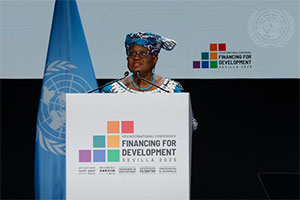 Opening of 4th International Conference on Financing for Development. Credit: UN Photo/Mariscal
International trade and investment are crucial elements of the world economy. While they can be powerful stimulators of development, they can also lead to global imbalances and dynamics of exploitation. In 2025, international trade entered a period of immense disruption, driven in part by a new wave of United States tariffs that reshaped global supply chains and investment flows. The increase in the US tariff rate, the highest since the 1930s, has forced bilateral renegotiations with global trading partners. Furthermore, the debt crisis in developing nations has accelerated while Official Development Assistance (ODA) has substantially dropped 7.3% in 2024.
In the 21st century, advancements in economic diversification in formerly colonized nations have propelled them into more central roles in the global economy. For example, both China and Mexico were able to develop their manufacturing sector and channel this development into booming export flows, thus advancing into the position of emerging economies. Foreign investment also plays an essential role in providing capital for developing countries, although they are oftentimes accompanied by social and environmental exploitation. For example, rising Chinese investments in natural resources in Latin America have often been met with tension as these investment projects fail to properly mitigate environmental risks and protect workers’ rights. In a more multifaceted vein, Sino-African relations have led to infrastructure development in Sub-Saharan Africa while also heightening the region’s economic dependency on China. IPS reports on global news in trade and investment, while shining a light on the nuanced nature of these endeavors.

The Week with IPS

NEXT STOP - SDGs
Tracking global progress towards a sustainable world
Tracking global progress towards a sustainable world
