Languages
Monday, November 9, 2026



News and Views from the Global South
Active Citizens
RIO+20: Promised Green Economy Was a Fake, Say Activists
When the Rio+20 summit on sustainable development ended Friday, there were winners and losers – mostly losers.Ethical Banks Weather Crisis in Spain
Where do banks invest their depositors' money? Whose interests do they serve, and what criteria do they apply? Increasing numbers of dissatisfied customers want to know what happens to their money, and are opting for alternative financial services which are growing in spite of the economic crisis choking Spain.
Biodiesel Brings Cleaner Air
For the past three months, a transport group in the Philippines has been making use of biodiesel processed from used cooking oil for their jeepneys.
‘It Should be Named Planet Ocean, Not Planet Earth’
Oceans, seas and coasts provide over 200 million jobs globally, while 4.3 billion people get 15 percent of their intake of animal protein from the seas. Travel and tourism, ports and energy production use oceans and seas to create jobs and economic and social benefits for millions of people.
Mexican and U.S. Activists Join Forces Against Arms Smuggling
Another Caravan for Peace is being organised in Mexico, but this time it will travel through the United States and call for action against weapons smuggling, as part of a bi-national initiative aimed at attracting the attention of President Barack Obama.
Q&A: Involvement of Local Communities Key to Climate Change Adaptation
To preserve the environment and adapt to climate change, alliances must be made with communities of local people with a view to educating, rather than dictating to them. This is the maxim upheld by Ángel Quirós, a marine biologist and head of Los Caimanes National Park, a protected area that is economically and environmentally important for Cuba and the Caribbean.
Earth Summits Fail Biodiversity in India
Heads of state and governments are meeting in Rio de Janeiro this week to decide how to renew their pledges made during the first Earth Summit held in Rio in 1992.
Notorious Immigrant Detention Centre Closed in Spain
The closure of one of Spain’s eight immigration detention centres on Wednesday was celebrated by human rights groups, which for years have denounced the prison-like conditions in the centres.
No Rest for Cyber Activists
One and a half years since the beginning of the Arab Spring, activists who guided their fellow citizens through the relatively unchartered terrain of social media activism feel their fight for human rights, democracy and transparency is only just beginning.
What is Stopping the Algerian Spring?
The on-going hunger strike of nine Algerian court clerks, coupled with the government’s indifference to their demands for an independent labour union, have stirred debate about Algeria’s role in the Arab Spring, which many see as an incomplete attempt to overturn a deeply flawed political and economic system.
RIO+20: Reforestation Pledges Reach Only 12 Percent of Target
The world's countries have committed themselves so far to restoring just 18 million hectares of forests by 2020, barely 12 percent of the goal of 150 million hectares agreed by the Bonn Challenge in 2011.
RIO+20 Doubts over Impact of Sustainable Development Dialogues
Announced as an innovative way to encourage the participation of Internet users and the public in general in the debates at Rio+20, the proposal for Sustainable Development Dialogues also raised doubts about the impact its recommendations would have.After the Curtain Call, a Crackdown Begins
As the attention of the world faded away from Azerbaijan after the recent Eurovision song contest, police began targeting some young activists and a journalist involved in protests here last month.‘Armed Youth’ to Rock Rio
Environmental and community activists from Taiwan will enliven the United Nations Sustainable Development Conference, dubbed Rio+20, and the parallel People’s Summit, with one of the island’s most prominent social protest music groups, the Village Armed Youth Band.
EUROPE: Rights Groups Call for Effective Investigations of Crimes Against Roma
Rights groups have called on governments in Central and Eastern Europe to publicly condemn violence against Roma, as a family was gunned down in Slovakia in the latest example of what monitors say is a rising tide of violence against Europe’s largest ethnic minority. [caption id="attachment_110111" align="alignright" width="375"]Where Journalism Is a Battlefront
“It does not matter if we ever find out who killed Saleem; whoever it was has destroyed my family,” says Anita Shahzad, Saleem Shahzad’s 36-year-old widow and mother of three. “It won’t bring him back,” she tells IPS.
RIO+20: The Two Faces of BRICS Development Aid
The BRICS countries (Brazil, Russia, India, China and South Africa) face a key choice: to opt for "good" development aid, based on sustainable development, or for the "bad" old traditional model, which they criticised when they were its recipients.
UN, People’s Summit Clash over Green Economy
U.N. Environment Programme Executive Director Achim Steiner believes that he and the Rio+20 People’s Summit agree that the global economic model has caused the current environmental destruction. But the discussion on what to replace it with turned into an acrid debate.
New Set of Sustainable Development Goals Looks Beyond 2015*
When world leaders from over 100 countries wind up their three-day Rio+20 summit in Brazil next week, they will leave behind the shattered remains of a slew of proposals that never got off the ground.
RIO+20: Developing Countries Accept Green Economy*
It’s not true that developing countries conditioned the inclusion of the green economy in the final document at Rio+20 on clearly defined provisions for financing, the head of the Venezuelan delegation, Claudia Salerno, told TerraViva.Resolution on Arms Trade ‘Bold but Not Bulletproof’
The European Parliament sent a bold message to the world last week with its comprehensive and ambitious resolution to put an end to the illicit global arms trade. But analysts regret the new resolution ignores several key factors, such as the impact of the arms trade on the socio-economic development of recipient countries, and the involvement of civil society in future negotiations.« Previous Page — Next Page »





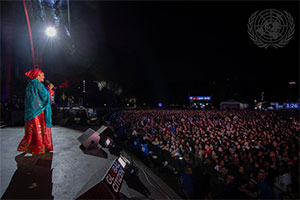 Global Citizen Festival in New York. Credit: UN Photo/Eskinder Debebe
Active citizens are committed to social change because they know that it is achievable. However, major political challenges face active citizens across the world. For example, in authoritarian regimes in Latin America where the hegemonic party has been in power for decades on end, protestors and human rights activists face enormous repression and struggle to materialize their advocacy into concrete results. The same can be said for Africans, where a shift towards elected government in recent decades has yet to translate into an effective voice in decision-making. Now, the Strengthening Citizen Demand for Good Governance, which uses evidence-based approaches – funded by DFID's Governance and Transparency Fund – seeks to raise their voices.
In 2025, the CIVICUS Monitor’s People Power Under Attack report revealed that civic freedoms are severely limited in 122 of 198 countries and territories, and only 7.2% of the global population now lives in countries where civic space is open. Through partnership with the Overseas Development Institute (ODI) and CIVICUS, IPS reporters across the continent will seek to define the extent and limits of state capability, government accountability and the responsiveness of leaders to the needs of citizens.

The Week with IPS

NEXT STOP - SDGs
Tracking global progress towards a sustainable world
Tracking global progress towards a sustainable world
