Languages
Friday, October 9, 2026



News and Views from the Global South
Active Citizens

From Bullets to Ballots: The Face of Sri Lanka’s Former War Zone
In four months’ time, Sri Lanka will mark the sixth anniversary of the end of its bloody civil conflict. Ever since government armed forces declared victory over the Liberation Tigers of Tamil Eelam (LTTE) on May 19, 2009, the country has savored peace after a generation of war.
Caribbean Youth Ready to Lead on Climate Issues
At 24 years old, Stefan Knights has never been on the side of those who are sceptical about the reality and severity of climate change.
CORRECTION/Sustainable Energy Starts With the Sun
It began with an experiment to install photovoltaic cells over an irrigation canal that forms part of the Sardar Sarovar canal network – a massive hydel power project across the River Narmada that irrigates some 1.8 million hectares of arable land in the western Indian state of Gujarat.
Pacific Islands Call for New Thinking to Implement Post-2015 Development Goals
As the Millennium Development Goals (MDGs), a set of poverty-alleviation targets set by the United Nations, come to a close this year, countries around the world are taking stock of their successes and failures in tackling key developmental issues.
Battle Heats Up Over Legalisation of Sex Work in India
Thirty-six-year-old Chameli Devi, a sex worker operating out of New Delhi's G.B. Road - Asia's largest red-light district, housing an estimated 12,000 of India’s three million sex workers – is an unhappy woman these days.
U.N. Helpless as Saudi Flogging Flouts Torture Convention
Flogging a dead horse, as the old idiom goes, is far removed from flogging a live Saudi blogger.
Papal Visit Rekindles Hopes in Former War Zone
Jessi Jogeswaran, a 20-year-old woman from Sri Lanka’s northern Jaffna district, waited over six hours with 18 friends in the sweltering heat just to get a glimpse of Pope Francis on Jan. 14.
Electioneering Undermines Fight Against Crime in El Salvador
The upcoming municipal and legislative elections in March and the hiring of former New York mayor Rudolph Giuliani as a kind of anti-crime tzar are not the best equation for bringing down El Salvador’s high murder rate, analysts say.
Boko Haram Insurgents Threaten Cameroon’s Educational Goals
“I’d quit my job before going to work in a place like that.” That is how a primary school teacher responded when IPS asked him why he had not accepted a job in Cameroon’s Far North region.
OPINION: Islamic Reformation, the Antidote to Terrorism
The horrific terrorist attack on the French satirical publication Charlie Hebdo has once again raised the question about violence and Islam. Why is it, some ask, that so much terrorism has been committed in the name of Islam, and why do violent jihadists seek justification of their actions in their religion?
In Sri Lanka Cartoonists Aren’t Killed – They’re Disappeared
Scenes from the brutal shooting of 12 journalists with the French satirical weekly ‘Charlie Hebdo’ have monopolised headlines worldwide ever since two men opened fire in the magazine’s Paris office on Jan. 7.
Haitians Worry World Bank-Assisted Mining Law Could Result in “Looting”
With Haiti’s Parliament having dissolved on Tuesday, civil society groups are worried that the Haitian president may move to unilaterally put in place a contentious revision to the country’s decades-old mining law.
European Citizens Call for Increased Aid to Developing World
An overwhelming majority of citizens in the 28-member European Union (EU) - which has been hamstrung by a spreading economic recession, a fall in oil prices and a decline of its common currency, the Euro - has expressed strong support for development cooperation and increased aid to developing nations.
Oil, An Invasive Water Species in the Carnival Capital
"We ran down to the beach and found a black tide, whose waves didn’t make the sound of water, but the slurp of a thick paste,” said Alexandre Anderson, describing the oil spill in Guanabara bay in the Brazilian state of Rio de Janeiro which turned him into an activist and leader among the local small-scale fishing community.
Women ‘Sewing’ a Bright Future in Northern Pakistan
At 46, Naseema Nashad is starting her life over, not out of choice but out of necessity. The Afghan woman was just 25 years old when Taliban militants stormed Kabul and her family was forced to flee to neighbouring Pakistan to escape what they knew would be a brutal regime.
Bhopal Cloud Hovers Over Industrial Safety in India
Three decades after 40 tons of deadly methyl isocyanate gas leaked from the Union Carbide India Limited plant in the central Indian city of Bhopal on Dec. 3, 1984 – killing an estimated 4,000 almost instantly and maiming and blinding hundreds of thousands of others – the world's worst industrial disaster remains a sharp lesson on the need for greater safety regulations in Asia’s third-largest economy.
Video Games, Poverty and Conflict in Bab Al-Tabbaneh
“People get used to war. During the last battle, children were still coming to play. Can you imagine, a seven-year-old boy running through the bullets just to play video games,” says Mohammad Darwish, a calm man with a curled beard framing his face.
OPINION: Global Citizenship, A Result of Emerging Global Consciousness
Globalisation is an integral feature of modernity. It already has significantly advanced to transform local experiences into global ones, to unify the disparate villages of the world into a global community, and to integrate national economies into an international economy.
Sri Lanka’s Minorities Choose “Unknown Angel” Over “Known Devil”
When the initial results started trickling in a little after midnight on Jan. 9, it still wasn’t clear exactly which way the country would swing: had Sri Lanka’s 15 million eligible voters thrown in their lot with incumbent President Mahinda Rajapaksa for a third term? Or would the desire for change put common opposition candidate Maithripala Sirisena at the helm?U.N. Chief Leads the Way on the ‘Road to Dignity’
Addressing the 193 member states of the General Assembly on Thursday, United Nations Secretary-General Ban Ki-moon called for sweeping changes that would set the world on the path of sustainable development.
Family Farming Eases Food Shortages in Eastern Cuba
Meat and vegetables are never missing from the dinner table of Damaris González and Omar Navarro, since they get almost all of their food from their farm, La Revelación, on the outskirts of the city of Santiago de Cuba, 765 km east of the Cuban capital.« Previous Page — Next Page »





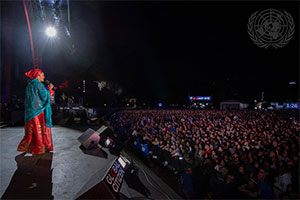 Global Citizen Festival in New York. Credit: UN Photo/Eskinder Debebe
Active citizens are committed to social change because they know that it is achievable. However, major political challenges face active citizens across the world. For example, in authoritarian regimes in Latin America where the hegemonic party has been in power for decades on end, protestors and human rights activists face enormous repression and struggle to materialize their advocacy into concrete results. The same can be said for Africans, where a shift towards elected government in recent decades has yet to translate into an effective voice in decision-making. Now, the Strengthening Citizen Demand for Good Governance, which uses evidence-based approaches – funded by DFID's Governance and Transparency Fund – seeks to raise their voices.
In 2025, the CIVICUS Monitor’s People Power Under Attack report revealed that civic freedoms are severely limited in 122 of 198 countries and territories, and only 7.2% of the global population now lives in countries where civic space is open. Through partnership with the Overseas Development Institute (ODI) and CIVICUS, IPS reporters across the continent will seek to define the extent and limits of state capability, government accountability and the responsiveness of leaders to the needs of citizens.

The Week with IPS

NEXT STOP - SDGs
Tracking global progress towards a sustainable world
Tracking global progress towards a sustainable world
