Languages
Thursday, October 8, 2026



News and Views from the Global South
Active Citizens

No Hope in Sight for Latin America’s Prison Crisis
In Latin America’s prisons, notorious for extreme overcrowding and violence, inmates live in constant danger of being killed – a contradiction in a region where virtually every country has abolished the death penalty.
OPINION: The Plight of Women and Girls in Zambezi’s Floods
The flooding of the Zambezi River has had devastating consequences for three countries in Southern Africa. The three worst affected countries are Malawi, Mozambique and Zimbabwe.
India Still Struggling to Combat Child Labour
Eleven-year-old Chottu* works 12 hours daily at a roadside tea joint near New Delhi's bustling interstate bus terminus.
People’s Tribunal Hopes Verdict on Mining Abuses Gains Traction
A recent case study on Canadian mining abuses in Latin America has woven one more thread of justice into the tapestry of international law.
Glimmer of Hope for Assange
There is a window of hope, thanks to a U.N. human rights body, for a solution to the diplomatic asylum of Wikileaks founder Julian Assange, holed up in the embassy of Ecuador in London for the past two and a half years.
Dumped, Abandoned, Abused: Women in India’s Mental Health Institutions
Following the birth of her third child, Delhi-based entrepreneur Smita* found herself feeling “disconnected and depressed”, often for days at a stretch. “Much later I was told it was severe post-partum depression but at the time it wasn’t properly diagnosed,” she told IPS.
Missing Students Case Also Highlights Racism in Mexico
The mother tongue of Celso García, a 51-year-old indigenous Mexican, is Mixteca. As a boy, García, the father of one of the 43 students forcibly disappeared four months ago, had to learn Spanish to make his way in mainstream society in this country where most people are of mixed-race heritage.
Marine Resources in High Seas Should be Shared Equitably
After almost 10 years of often frustrating negotiations, the U.N. ad hoc committee on BBNJ decided, by consensus, to set in motion a process that will result in work commencing on a legally binding international instrument on the conservation and sustainable use, including benefit sharing, of Biological Diversity Beyond Areas of National Jurisdiction.
Teenage Girls in Argentina – Invisible Victims of Femicide
The murder of a young Argentine girl on a beach in neighbouring Uruguay shook both countries and drew attention to a kind of violence that goes almost unnoticed as a cause of death among Argentine adolescents: femicide.OPINION: Russia’s Friendship University, Educating the Developing World for 55 Years
People’s Friendship University of Russia (PFUR), which celebrates its 55th anniversary on Feb. 5, is known worldwide as a major academic and research centre. During the last five decades, PFUR has educated 80,000 students from 145 countries.
Young People in Latin America Face Stigma and Inequality
Young people in Latin America now enjoy greater access to education. But in many cases their future is dim due to the lack of opportunities and the siren call of crime in a region where 167 million people are poor, and 71 million live in extreme poverty.
Developing Nations Write Hopeful New Chapters in a Toxic Legacy
The village of Dong Mai in Vietnam's agricultural heartland had a serious problem.
Cuba and U.S. Skirt Obstacles to Normalisation of Ties
The biggest discrepancies in the first meeting to normalise relations between Cuba and the United States, after more than half a century, were over the issue of human rights. But what stood out in the talks was a keen interest in forging ahead, in a process led by two women.
Not Without Our Daughters: Lambada Women Fight Infanticide and Child Trafficking
At 11 years of age, Banawat Gangotri already has four years of work experience as a farm labourer. The child, a member of the nomadic Lambada community from the village of Bugga Thanda in India’s southern Telangana state, plucked cotton and chillies from nine a.m. until 5 p.m. for about a dollar daily.
Aboriginal Businesses Stimulate Positive Change in Australia
Roy Roger Gibson, an indigenous Kuku Yalanji elder, would watch thousands of tourists and vehicles trampling his pristine land while working on the sugarcane fields in Far North Queensland. His people were suffering and their culture was being eroded. The native wildlife was disappearing. He dreamt of turning this around.
After Nine Years of Foot-Dragging, U.N. Ready for Talks on High Seas Treaty
After four days of intense negotiations - preceded by nine years of dilly-dallying - the United Nations has agreed to convene an intergovernmental conference aimed at drafting a legally binding treaty to conserve marine life and govern the mostly lawless high seas beyond national jurisdiction.
OPINION: Greece Gives EU the Chance to Rediscover Its Social Responsibility
The European Union should not be afraid of the leftist opposition party Syriza winning the Greek election, but see it as a chance to rediscover its founding principle - the social dimension that created it and without which it cannot survive.
U.S. May Soon Stand Alone Opposing Children’s Treaty
When the East African nation of Somalia, once described as a "lawless state", ratified the Convention on the Rights of the Child (CRC) early this week, it left two countries in splendid isolation from the rest of the world: South Sudan and the United States.
Three Minutes Away from Doomsday
Unchecked climate change and the nuclear arms race have propelled the minute hand of the Doomsday Clock forward two minutes closer to midnight, from its 2012 placement of five minutes to midnight.
Fighting Extremism with Schools, Not Guns
As a wave of outrage, crossing Pakistan’s national borders, continues a month after the Dec. 16 attack on a school in the northern Khyber Pakhtunkhwa province, some citizens are turning away from collective expressions of anger, and beginning the hard work of building grassroots alternatives to terrorism and militancy.
Final Push to Launch U.N. Negotiations on High Seas Treaty
The United Nations will make its third - and perhaps final - attempt at reaching an agreement to launch negotiations for an international biodiversity treaty governing the high seas.« Previous Page — Next Page »





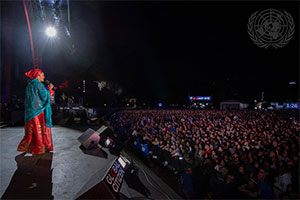 Global Citizen Festival in New York. Credit: UN Photo/Eskinder Debebe
Active citizens are committed to social change because they know that it is achievable. However, major political challenges face active citizens across the world. For example, in authoritarian regimes in Latin America where the hegemonic party has been in power for decades on end, protestors and human rights activists face enormous repression and struggle to materialize their advocacy into concrete results. The same can be said for Africans, where a shift towards elected government in recent decades has yet to translate into an effective voice in decision-making. Now, the Strengthening Citizen Demand for Good Governance, which uses evidence-based approaches – funded by DFID's Governance and Transparency Fund – seeks to raise their voices.
In 2025, the CIVICUS Monitor’s People Power Under Attack report revealed that civic freedoms are severely limited in 122 of 198 countries and territories, and only 7.2% of the global population now lives in countries where civic space is open. Through partnership with the Overseas Development Institute (ODI) and CIVICUS, IPS reporters across the continent will seek to define the extent and limits of state capability, government accountability and the responsiveness of leaders to the needs of citizens.

The Week with IPS

NEXT STOP - SDGs
Tracking global progress towards a sustainable world
Tracking global progress towards a sustainable world
