Languages
Thursday, November 19, 2026



News and Views from the Global South
Civil Society

OPINION: Discrimination by Law
In November 2013, a Thomson Reuters Foundation survey ranked Egypt as the worst of 22 Arab states with regards to women’s rights.
OPINION: Can the Violence in Honduras Be Stopped?
Honduras is one of the most violent nations in the world. The situation in the country’s second largest city, San Pedro Sula, demonstrates the depth of the problem.
Biogas Eases Women’s Household Burden in Rural Cuba
On the blue flame of her biogas stove, it takes half as long for rural doctor Arianna Toledo to heat bath water and cook dinner as it did four years ago, when she still used electric power or firewood.
Threats, Deaths, Impunity – No Hope for Free Press in Pakistan
It is no surprise that most Pakistani journalists work under tremendous stress; caught between crime lords in its biggest cities, militant groups across its tribal belt and rival political parties throughout the country, censorship, intimidation and death seem almost to come with the territory.
Everything You Wanted to Know About Climate Change
So much information about climate change now abounds that it is hard to differentiate fact from fiction. Scientific reports appear alongside conspiracy theories, data is interspersed with drastic predictions about the future, and everywhere one turns, the bad news just seems to be getting worse.
Fighting Climate Change with Community Action
Not far above Trinidad’s capital, Port-of-Spain, in a corner of the St. Ann’s valley in the Northern Range, the community of Fondes Amandes has come together since 1982 to respond to climate change.
LGBTI Community in Central America Fights Stigma and Abuse
Despite the aggression and abuse she has suffered at the University of El Salvador because she is a trans woman, Daniela Alfaro is determined to graduate with a degree in health education.Should We Celebrate 10 Years of the Global Tobacco Control Treaty?
February 27 will mark the 10th anniversary of the World Health Organisation Framework Convention on Tobacco Control (FCTC), the first global public health treaty.
Sexist Laws Still Thrive Worldwide
A rash of sex discriminatory laws – including the legalisation of polygamy, marital rape, abduction and the justification of violence against women – remains in statute books around the world.
“HeForShe” Campaign Moves to the Next Stage
It launched in a blaze of social media glory with a viral speech that rocketed around the world, and five months on from the launch of U.N. Women’s groundbreaking HeForShe campaign, the real work is well underway.
Deadly Asbestos Still Costing Lives
“I would get asbestos in my mouth, spit it out and carry on working,” said 52-year-old Francisco Padilla. Exposure to this deadly mineral fibre over most of his working life has resulted in cancer and the removal of his left lung, the lung lining and part of his diaphragm.
Indigenous Peoples – Architects of the Post-2015 Development Agenda
“We do not inherit the Earth from our ancestors, we borrow it from our children” – an ancient Indian saying that encapsulates the essence of sustainability as seen by the world’s indigenous people.
U.N. Describes Forced Disappearances in Mexico as “Generalised”
“The U.N. Committee on Enforced Disappearances is not a court, and I say this to avoid any misunderstanding,” German expert Rainer Huhle said while presenting the committee’s recommendations to the government of Mexico, where the problem has reached epidemic proportions.
Maimed by Conflict, Forgotten by Peace: Life Through the Eyes of the War-Disabled
It is a hot, steamy day in Sri Lanka’s northwestern Mannar District. Mid-day temperatures are reaching 34 degrees Celsius, and the tarred road is practically melting under the sun.
Millennium Development Goals: A Mixed Report Card for India
Despite being one of the world's fastest expanding economies, projected to clock seven-percent GDP growth in 2017, India – a nation of 1.2 billion – is trailing behind on many vital social development indices while also hosting one-fourth of the world's poor.
Keeping Food Security on the Table at U.N. Climate Talks
Food security has become a key issue of the U.N. climate negotiations this week in Geneva as a number of countries and observers raised concerns that recent advances in Lima are in jeopardy.
Latin American Migrants Suffer Prejudice in Their Own Region
In the movie “A Day Without a Mexican“, the mysterious disappearance of all Mexicans brings the state of California to a halt. Would the same thing happen in some Latin American countries if immigrants from neighbouring countries, who suffer the same kind of discrimination, went missing?
Getting Bang for the Buck on New Development Goals
Right now, the United Nations is negotiating one of the world’s potentially most powerful policy documents. It can influence trillions of dollars, pull hundreds of millions out of poverty and hunger, reduce violence and improve education — essentially make the world a better place. But much depends on this being done well.
Nepali Children in Dire Need of Mental Health Services
On the night of Aug. 14, 2014, 10-year-old Hari Karki woke up to his grandfather’s loud yelling in the family’s home in Paagma, a small village in east Nepal.
“Drastic Decline” Seen in World Press Freedom
A leading advocacy group warns of a "worldwide deterioration in freedom of information" last year.Marshall Islands Nuclear Proliferation Case Thrown Out of U.S. Court
A lawsuit by the Marshall Islands accusing the United States of failing to begin negotiations for nuclear disarmament has been thrown out of an American court.« Previous Page — Next Page »


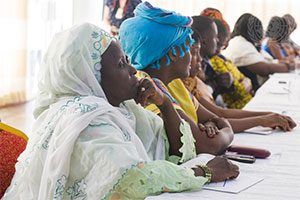 Representatives of Civil Society, Sierra Leone. Credit: UN Photo/Eskinder Debebe
Civil society faces mounting threats worldwide, even as it remains essential for democratic accountability, especially in countries struggling with economic instability and social inequality. However, at the same time, nations with weak democratic governance structures also systemically suppress the power of civil society. Human rights activists across the Global South frequently challenge issues such as political persecution and gender oppression, but in return face state-sanctioned punishment for their advocacy. Imprisonment and exile are common mechanisms of punishment that seek to erode the strength of civil society. The 2026 World Press Freedom Index has reached its lowest level in 25 years, with more than half of the world’s countries now falling into the "difficult" or “very serious” category for press freedom. IPS seeks to highlight the work of civil society across the Global South as well as the challenges that they face.
Updated by Yilan Batista and Shuli Wong August 2026

The Week with IPS

NEXT STOP - SDGs
Tracking global progress towards a sustainable world
Tracking global progress towards a sustainable world
