Languages
Friday, November 20, 2026



News and Views from the Global South
Civil Society

The U.S.’s 64-Square-Foot “Torture Chambers”
He has not had human contact or a good night’s sleep in nearly three decades. Every single day, he wakes to the sound of metal doors clanging open and a pair of disembodied hands pushing a tray of food through a slot into his 64-square-foot cell.
The Afghan Dead Find a List
“My relatives and I tried many times, again and again, to find out what happened to my father. I searched constantly for 35 years, without success. Just a few days ago, I found out from the ‘death list’ that my father had been executed.”
OP-ED: Women’s Empowerment Builds International Peace and Security
When war erupts, women are often the first to experience the harsh brutality and the last to be called to the peace table. A resolution adopted Friday by the U.N. Security Council moves us one step closer to the full participation of women as leaders for peace and security.
Skype Gets Dark in Karachi
First, it was Youtube. Now, if the government of Sindh has its way, it could well be goodbye to Skype, Whatsapp, Viber and Tango for the people of this province in southeastern Pakistan. At least for the next three months.
U.S. Reforms “Open Floodgates” on Arms Exports
On Tuesday, the largest deregulation in the history of U.S. arms exports took place as part of the Barack Obama administration’s export reform initiative.
Groups Target Food Waste to Eliminate Hunger
If all food loss and waste around the world could be recovered, half the world's population, or 3.5 billion people, could be fed. Yet people throw away a third of food produced globally, an issue that inspired the theme of these year's World Food Day, sustainable food systems for food security and nutrition.
Washington State Becomes Latest GMO Battleground
The northwestern state of Washington could become the first in the U.S. to require labeling of genetically modified organisms (GMOs) on foods and food packages, after a similar measure in California failed last year.
Afghan Families Want Accountability, Not Apologies
The dusty cemetery in Saracha village hosts three new graves: small hills of soil shielding the bodies of Sahebullah, Wasihullah and Amanullah, three of the five boys and young men killed by an ISAF-NATO airstrike on late Friday, Oct. 4.
When the Missing Don’t Return
Some call it ‘frozen loss,’ a point in time that families and relatives find almost impossible to extricate themselves out of, even years after their loved ones have disappeared.
Activists Struggle to Recover Human Rights Archives
Some 50,000 files on crimes against humanity are languishing in an undisclosed location in El Salvador, prey to damp and the ravages of time, while activists and lawyers frantically try to regain control over them.
Grief Veils Eid for Syrian Refugees
This week the Islamic world marks one of its holiest holidays, Eid al-Adha - honouring Ibrahim’s commitment to sacrifice his first-born son to Allah. The festival involves large family gatherings, bountiful lunches and generous gift giving.
Walking an Economic Tightrope with No Safety Net
With the richest one percent of the population now owning 40 percent of global assets, and the bottom half sharing just one percent, inequality is fast being recognised as a stubborn underlying obstacle to development.
Programme to Boost Small Farmers Fights for Continuity
When it launched in 2007, the FAO programme known as Food Security through Commercialisation of Agriculture (FSCA) tried to adopt an approach that differed from on-going efforts to achieve food security, which focused primarily on food production.Russia May Do Better Than its Nuclear Rhetoric
Despite a seemingly entrenched resistance to change on its nuclear disarmament policy, the Kremlin’s recent initiative to get Syria to destroy its chemical weapons provides hope that Russia could play a more positive role in reducing the world’s global nuclear stockpiles, experts say.Armenia’s Fight against Gender Equality Morphs into Fight Against EU
Europe is getting a surprise bashing in Armenia over a law on gender equality that many Armenians claim is designed to “promote” homosexuality as a “European value.”
Chevron Fights Amazon Pollution Verdict in U.S. Court
Two years after they were awarded 18 billion dollars by an Ecuadorian court for environmental damage caused by Chevron in the Amazonian rainforest, a group of indigenous villagers and their U.S. lawyer went on trial Tuesday in New York, accused by the oil company of bribery and racketeering.Giant Companies Pinpricked by ‘Direct Democracy’
A Swiss village has decided to reject tax money from the firm Glencore and to instead donate it to charities. Other towns may follow, sending a strong signal to the government to follow the U.S. and the EU and introduce transparency rules for the extractive industry.
Sicilian Town Opposes U.S. Transmitters
Niscemi, with its 30,000 local residents and its white houses, is a typical southern Sicilian town. But it stands out not only for its ancient cork forest, but also for the Naval Radio Transmitter Facility located within the protected forest itself.
Not Fukushima Again
Two and a half years ago, Ayako Oga, now 30, found herself helpless as an earthquake and the tsunami it triggered hit Japan and crippled four reactors at the Fukushima Daiichi nuclear plant. She and her husband were forced to abandon their village Ookuma Machi, barely five kilometres away.
U.S. Science Reporters Becoming an Endangered Species
The news for environmental journalism in the United States is grim and getting grimmer.
Kurds Build Bridges At Last
After fleeing the war three months ago, Gulnaz is headed back for Syria to bury her brother within the 24 hours Islam stipulates. But it is far from easy to take the coffin across the Syrian-Iraqi border.« Previous Page — Next Page »


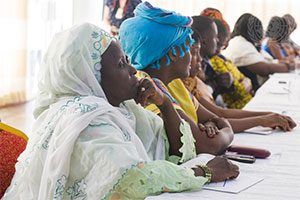 Representatives of Civil Society, Sierra Leone. Credit: UN Photo/Eskinder Debebe
Civil society faces mounting threats worldwide, even as it remains essential for democratic accountability, especially in countries struggling with economic instability and social inequality. However, at the same time, nations with weak democratic governance structures also systemically suppress the power of civil society. Human rights activists across the Global South frequently challenge issues such as political persecution and gender oppression, but in return face state-sanctioned punishment for their advocacy. Imprisonment and exile are common mechanisms of punishment that seek to erode the strength of civil society. The 2026 World Press Freedom Index has reached its lowest level in 25 years, with more than half of the world’s countries now falling into the "difficult" or “very serious” category for press freedom. IPS seeks to highlight the work of civil society across the Global South as well as the challenges that they face.
Updated by Yilan Batista and Shuli Wong August 2026

The Week with IPS

NEXT STOP - SDGs
Tracking global progress towards a sustainable world
Tracking global progress towards a sustainable world
