Languages
Friday, November 20, 2026



News and Views from the Global South
Civil Society
Gambia Media Crackdown Continues
Last July marked 19 years of Gambian President Yahya Jammeh’s inordinately long rule. His legacy during this time is to mark his country as one of the most unapologetically repressive states in Africa.Israel Silent on Chemical Weapons
“Does Israel have chemical weapons too?” is the question posed by the U.S. publication Foreign Policy, citing a newly uncovered CIA document from 1983 which alleged that Israel is likely to have developed such weapons.Philippines Struggles With Muslim Rebels
With the administration of Philippines President Benigno Aquino III devoting much of its political capital to resolving the conflict in the southern Philippine island of Mindanao, which has claimed around 150,000 lives over decades, many came to believe in the genuine possibility of a new era of stability and economic prosperity in the region.
Boats of Hope Head for Australian Rocks
It was a decision based on simple sums. Ananda, 28, from Weligama in the southern Sri Lankan district Matara decided to risk it all boarding a boat to Australia last year because he never had enough money.
Robin Hood Activists Take Aim at Wall Street
Five years after the 2008 world financial crisis and two years after the Occupy movement it triggered, U.S. critics of the financial sector are coalescing around the idea of a Robin Hood Tax on financial transactions.
It’s Afghanistan Again in a Turkish Town
People run back home at dusk, just when the shooting intensifies. To Sha Mehmed the experience is familiar. He was 11 when he left his native Afghan village to settle in this small Turkish town on the border with Syria.
Cuban Athletes Score against Violence
It is unusual to see Cuban sports legends in public service announcements. However, a handful of champions and rising young stars are wearing messages or appearing in TV spots against violence among men or toward women.
Q&A: Faith Groups as Partners in Development
The United Nations is considered one of the world's most secular institutions, with 193 member states representing peoples of different faiths and cultures and professing religious and agnostic beliefs.
It’s the Day to Buy Votes in Swaziland
As Swaziland goes to the polls for the second and final round of voting in its general elections on Sept. 20, giveaways have become the order of the day in this southern African nation.
Q&A: Congolese Wrongly Branded as “Pathological”
Western analysts all too often take a distorted and reductionist approach to the conflict in the Democratic Republic of Congo (DRC), says Kai Koddenbrock, who analysed more than 50 policy papers for a study published in the journal International Peacekeeping in November 2012.
Killers Roam Free in Nepal
When the police finally arrested a man this month in the Nepali capital for the murder of a teenager nine years ago, it became a matter of life and death for Nanda Prasad Adhikari and his wife Ganga Maya.
U.S. Urged to Curb Militarisation in Latin America
The United States needs to phase down its drug war and tighten the reins on its cooperation with local militaries and police in Latin America, according to a new report released here Wednesday by three influential think tanks.
U.S. to Require Disclosure of Worker-to-CEO Pay Gap
Regulators here are proposing that most U.S. corporations be required to provide annual public reporting on how the pay received by their chief executive compares to that of their average workers, a requirement proponents say could be a first step in reining in an unprecedented swelling in executive compensation.
Wanted for War Crimes, Sudan’s President Threatens U.N. Appearance
Sudanese President Omar Hassan al-Bashir, accused of war crimes and genocide in the politically-troubled Darfur region, is apparently planning to visit New York and address the U.N. General Assembly next week.
Trinidad Cracks Down on Destructive Shrimp Trawling
Dianne Christian Simmons recalls the days when she would head out with her husband on fishing expeditions in the Gulf of Paria, a 3,000-square-mile shallow inland sea between Trinidad and Tobago and the east coast of Venezuela.
Homosexuals Cornered in Russia
“It's okay to be gay in Russia if you live in a big city such as St. Petersburg or Moscow, study at university or work at a liberal company, but even here you can't feel absolutely safe,” says Nikita Mironov, describing the climate of fear that many homosexuals face in Russia.
Street Power Takes On Gold
Street protests are snowballing in Romania against a Canadian-led gold mining project in the Rosia Montana area in the Apuseni Mountains. More than 20,000 people joined a protest march in Bucharest on Sunday, and thousands in other Romanian cities took to the streets.Proposed Global Accord Called a Disaster for Public Services
Nearly 350 international civil society organisations are urging countries taking part in new negotiations towards an agreement on “trade in services” to abandon the effort, warning that the accord would negatively impact on universal access to and national regulation of public services.
Executions on Hold ‘for the Wrong Reasons’
The execution of three Taliban men ordered by the courts has been kept on hold - not because the Pakistani government opposes the death penalty but because it fears the Taliban, political leaders say.
Low Expectations for High-Level Nuke Meet
The upcoming event at the United Nations is being billed as something politically unique.
When Mexico Let Big Brother Spy
Non-governmental organisations are urging the United Nations Human Rights Council to demand explanations from the Mexican state for the weak protection it provided its citizens from large-scale spying by the United States.« Previous Page — Next Page »


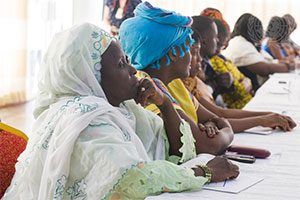 Representatives of Civil Society, Sierra Leone. Credit: UN Photo/Eskinder Debebe
Civil society faces mounting threats worldwide, even as it remains essential for democratic accountability, especially in countries struggling with economic instability and social inequality. However, at the same time, nations with weak democratic governance structures also systemically suppress the power of civil society. Human rights activists across the Global South frequently challenge issues such as political persecution and gender oppression, but in return face state-sanctioned punishment for their advocacy. Imprisonment and exile are common mechanisms of punishment that seek to erode the strength of civil society. The 2026 World Press Freedom Index has reached its lowest level in 25 years, with more than half of the world’s countries now falling into the "difficult" or “very serious” category for press freedom. IPS seeks to highlight the work of civil society across the Global South as well as the challenges that they face.
Updated by Yilan Batista and Shuli Wong August 2026

The Week with IPS

NEXT STOP - SDGs
Tracking global progress towards a sustainable world
Tracking global progress towards a sustainable world
