Languages
Friday, November 20, 2026



News and Views from the Global South
Civil Society
Hope and Pessimism as Israelis and Palestinians Resume Talks
Israeli and Palestinian negotiators returned to the negotiating table on Thursday, ready to put claims by the United States that it will engage more forcefully in the negotiating process to the test.
Banning Nukes Still a Political Fantasy
The General Assembly's first-ever high-level meeting on nuclear disarmament closed last week on a predictable note: the longstanding proposal for the elimination of nuclear weapons remains firmly in the realm of political fantasy.
After Persecution, Rohingyas Face Erasure
An exiled leader of the Rohingyas, a persecuted Muslim minority in Myanmar, is raising the alarm from his London office about the fate of his community. He fears “ethnocide to remove all references to the Rohingyas” if the first census in 30 years goes ahead in the Southeast Asian nation.
For the Disabled, Progress Unearths More Questions
When U.N. Secretary-General Ban Ki-moon opened a recent high-level meeting on disability and development that promised a place for the issue in the post-2015 agenda, he cited three examples of incapacity.Less Hunger, But Not Good Enough
Every year, we take a snapshot of world progress in the fight against chronic hunger. This year, the picture is looking better, but it’s still not good enough.
Relief Brings Its Own Disasters
In Uttarakhand, the small Indian state in the Himalayan foothills that was a victim of flash floods that killed at least a thousand people in June this year and uprooted thousands of families, the story is told of a child who went every day to the helipad, believing his father will return when, in fact, the father died in the floods.
100-Dollar Dream Teases Bangladesh Workers
On the industrial outskirts of Dhaka, which is dotted with big and small clothes factories, thousands of workers took to the streets demanding a minimum wage rise.People Pressure Piles up to Cleanse the Philippines
Under the reformist leadership of President Benigno Aquino III who has placed “good governance” initiatives at the heart of his administration’s agenda, the Philippines has enjoyed an unprecedented period of economic revival and political stability.
Ninja Citizen Journalists Don’t Claim to Be Impartial
The citizen journalists of Midia Ninja, who have covered the protests that broke out across Brazil in June right in the thick of things, are part of a new kind of reporting: one that is proud to be biased.
The Medicines Are Fake, the Illnesses Real
Reports of fraudulent medicines in the south-west Pacific island states of Solomon Islands and Papua New Guinea have drawn attention to the need for more public awareness of the lethal trade and its tragic consequences.
Push for Transparency in U.S.-Mexico Drilling Agreement
As lawmakers here prepare to take up legislation that would green-light a U.S.-Mexico agreement on oil-and-gas drilling in the Gulf of Mexico, development and rights groups are urging them to reject a proposal that would exempt involved companies from new disclosure requirements.
More Egyptian Unrest Rises in Social Media
Gory social media images that fueled the global Jihadist influx into Syria 18 months ago are back. But this time the outpouring is coming from Egypt.
Weakening Al-Shabaab Finds New Aggression
Strong action now expected against the al-Shabaab group may well end up strengthening the group rather than weakening it, local people fear. The extremist group is suspected of involvement in the attack on the Westgate mall in Nairobi.
Victims Memorial in Spain Awaits Names of the Dead
A pyramid is being built in the old San Rafael cemetery in the southern Spanish city of Málaga - a monument to thousands of people shot by firing squads here during the 1936-1939 Spanish Civil War and the 1939-1975 dictatorship of General Francisco Franco.
Sudan’s “Wanted” President Skips U.N. General Assembly
Sudan's beleaguered president, Omar Hassan al-Bashir, who threatened to visit the United Nations despite an arrest warrant for war crimes, has backed out at the 59th minute of the eleventh hour.Bloody Days in Sudan
Activists claim that more than one hundred people have been killed and thousands injured during demonstrations in Sudan following the removal of fuel subsidies.
Survivors Question U.N. Focus on Legalising Sex Work
The age-old debate over how to regulate sex work has led to a rift between the United Nations and anti-trafficking organisations, which are pressuring the world body to rethink its position following two reports that advocate decriminalising all aspects of prostitution.
Mideast and Africa Still Holdouts on Women’s Rights
Gender equality around the world has increased dramatically over the past half-century even though the vast majority of countries continue to restrict women’s economic development in at least one way, the World Bank reports this week.
Southern Libya Awaits Another Spring
“The government doesn’t care about us because we are from the south,” Mohamed Salah Lichekh, head of the Oubari local council in southern Libya, told IPS, expressing the majority sentiment in this part of the country.In Azerbaijan, a Presidential Campaign in Name Only?
There are three weeks to go before energy-rich Azerbaijan’s presidential vote on Oct. 9, but a race is nowhere to be seen. No political ads adorn the capital, Baku, and no candidate spots are running on private TV channels. The incumbent strongman, 51-year-old Ilham Aliyev, is not even bothering to run an active campaign.
Making Local People Stewards of the Earth
The lack of land rights is a crisis not just for local people but for all of humanity, warned organisers at an international conference here.« Previous Page — Next Page »


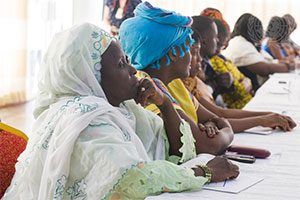 Representatives of Civil Society, Sierra Leone. Credit: UN Photo/Eskinder Debebe
Civil society faces mounting threats worldwide, even as it remains essential for democratic accountability, especially in countries struggling with economic instability and social inequality. However, at the same time, nations with weak democratic governance structures also systemically suppress the power of civil society. Human rights activists across the Global South frequently challenge issues such as political persecution and gender oppression, but in return face state-sanctioned punishment for their advocacy. Imprisonment and exile are common mechanisms of punishment that seek to erode the strength of civil society. The 2026 World Press Freedom Index has reached its lowest level in 25 years, with more than half of the world’s countries now falling into the "difficult" or “very serious” category for press freedom. IPS seeks to highlight the work of civil society across the Global South as well as the challenges that they face.
Updated by Yilan Batista and Shuli Wong August 2026

The Week with IPS

NEXT STOP - SDGs
Tracking global progress towards a sustainable world
Tracking global progress towards a sustainable world
