Languages
Friday, November 6, 2026



News and Views from the Global South
Education
Pakistani NGOs Fear New Year Constraints
A new policy by the Pakistani government to regulate foreign-funded non-governmental organisations (NGOs) has come in for sharp criticism from the social sector, with many saying it could stifle rights-based groups and affect crucial services provided to the needy.

Growing Number of Private Operators in Cuban Education
Cuba’s state education monopoly is increasingly sharing space with private operators, including churches and teachers working as tutors, which are filling in gaps and providing knowledge that has become necessary as a result of the country’s economic reforms, such as business management courses.
Baka Caught in the Maze of Modernism
Essomba Dominique, a Baka man from Mindourou in Cameroon’s East Region, sits dulled-eyed in front of his hut, known in the Baka language as the ‘mongoulou’.
Syrian Children Lose More Than Their Country
As refugees from Syria continue to pour into Lebanon, the majority of children are not going to school, spurring concern that they will become a ‘lost generation’.
Rebuilding Lives Skilfully
Farhat Bibi, 43, was left to fend for her three young sons after her husband was killed in a bomb attack in Pakistan’s Federally Administered Tribal Areas (FATA) three years ago. A few days later, she landed at a camp for people displaced by violence. “The camp proved to be a blessing in disguise,” she says.Women Advance in Distant Islands
Women’s political representation in the Pacific Islands region is globally the lowest at 3.65 percent, compared to the world average of 18 percent. Leadership is still widely perceived as ‘men’s business’ and voting is heavily influenced by nepotism and money politics. However, Rhoda Sikilabu, minister for community affairs in Isabel Province in the Solomon Islands is demonstrating that women leaders can drive development progress and win voter support.
U.N. Advice to Aid Worker: Write Last Will Before Leaving Home
When Anoja Wijeyesekera, an aid worker with the U.N. children's agency UNICEF, received her new assignment in Taliban-ruled Afghanistan back in 1997, her appointment letter arrived with a "survival manual" and chilling instructions: write your last will before leaving home.
OP-ED: Schools Bring Hope in Devastated Philippines
Last Sunday, I bought a bouquet of 45 small fresh yellow chrysanthemums. They cost me three dollars – not cheap for these parts. They were in a bucket in front of a tiny shop crammed with workers and customers in the heart of Tacloban City.
Indian Boys Get Lessons in Respect
In a shanty tucked inside Dharavi, described as Asia’s largest slum settlement, a little piece of theatre unfolds. Several young boys are heckled as they pretend to go vegetable shopping - and calling them names are young girls. The boys are embarrassed.
Skateboarding Can Be Empowering
An array of colourful quarter pipes, bank ramps and a fun box come to life as a clutch of Cambodian youngsters do balancing tricks, kick-flips and kick turns. The all-girl session at a skating facility near the Russian Market here is facilitated by 20-year-old Kov Chansangva, popularly known as Tin.
Spring Bursts Among the Toubou in Libya’s Desert
"Can there possibly be anything more satisfying than teaching your own language to your own people?" Abdel Salam Wahali remarked to IPS. He is a teacher of Tebu, an ancient language which is experiencing a boom in post-Gaddafi Libya.
Middle East Entrepreneurs Eye Education
The Middle East has some of the best and worst education systems in the world and they are attracting the attention of entrepreneurs keen to make a difference – and a buck.
Poor Paths Lead to Madrassas
Mustafa Khan, who sells cigarettes by the roadside in a Pakistani village, has a simple reason for sending two of his sons to a madrassa, an Islamic seminary, and not to a proper school. “We cannot afford it,” he says.
More Chileans Want the Benefits of Living in Latin America’s ‘Tiger’
Hugo Hurtado, 47, is a chef. Anyone would say that in his country, Chile, the Latin American “tiger”, his profession would be synonymous with success and even fame. But unfortunately that’s not true.
Breaking New Ground for Trans Children
Gabi was born six years ago biologically male, but dressed up as a princess and wore necklaces and long hair so that everyone saw a little girl instead.
Corruption Smothering Pacific Students
External interference in the awarding of tertiary scholarships in Pacific Island nations such as the Solomon Islands is denying some of the highest achievers among the young an opportunity to contribute to the future of their country and the region.
These ‘Ghost’ Schools Are Not for Children
Rahmatullah Balal has spent ten years counting the schools that aren’t. The particular kind of Pakistani schools that are called “ghost” schools.
For Kurdish Women, It’s a Double Revolution
"I got married when I was 14 and I already had four children at 20," recalls Nafia Brahim. In her fifties now, she is working hard so that no other woman loses control of her life.
Teen Pregnancy Rooted in Powerlessness
Before we begin, perhaps we can set aside the stereotypes: no, she didn’t "mess herself up by following boys around", and no, it is not in fact her fault that she became pregnant.
Mangroves Help Guyana Defend Against Changing Climate
Theola Fortune can recall how residents of Victoria would ridicule her and others every time they went into the east coast village to warn residents about the importance of mangroves and the need to protect them.
Walking an Economic Tightrope with No Safety Net
With the richest one percent of the population now owning 40 percent of global assets, and the bottom half sharing just one percent, inequality is fast being recognised as a stubborn underlying obstacle to development.« Previous Page — Next Page »





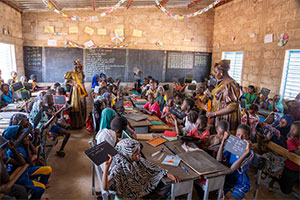 Two teachers work in a classroom in Forces Vives School in Dori, Burkina Faso. Credit: UNICEF/UNI978361
Safe and uninterrupted education is a fundamental right for all children. Education is paramount to global development, as it has been proven that investing in education – especially for girls and children – contributes significantly to economic growth and prosperity. Although more than 1 billion children go to school, many are subjected to conditions that are not conducive to a proper learning environment, including makeshift facilities, a lack of supplies, violence in classrooms, inadequate sanitation, untrained instructors, and widespread school closures. Since 2015, there have been immense gains in education with an increase of 109 million children in school. However, as of 2023, 272 million children are still out of school.
High poverty levels in developing countries also impede children’s access to a proper education. For example, from the early to mid 2000s, Sub-Saharan African nations witnessed a dramatic decline in trained teachers due to inadequate funding in the education sector. Furthermore, major cuts to United States international aid threaten an estimated 23 million additional children's access to education, as USAID‑funded school programmes across Africa and Asia face closure.
Various other factors contribute to the decline of education, notably hunger, which has increased as conflict and climate change interfere with global food production and dissemination. Meanwhile, certain social and cultural practices also impede children’s access to education, with gender inequality, discrimination, child labour, and child marriages preventing millions of children from attending school. Economic conditions such as the inaccessibility of higher education also affect disenfranchised communities across the world. In extreme situations, such as warfare where educational facilities are destroyed in their totality, notably in Gaza and Sudan, entire generations of children might grow up without access to education. Rebuilding educational infrastructure is a long and arduous process, especially when violence persists across generations, and this significantly stunts the development of societal prosperity and stability.
IPS is dedicated to telling the shocking truths about worldwide education through impassioned opinion pieces and comprehensive articles, highlighting global issues that impede worldwide education and the courses of action being taken by organizations such as UNICEF and Education Cannot Wait.

The Week with IPS

NEXT STOP - SDGs
Tracking global progress towards a sustainable world
Tracking global progress towards a sustainable world
