Languages
Friday, November 6, 2026



News and Views from the Global South
Education

Women On The Move, And In Danger
It was 8.45 pm, and a 22-year-old woman was looking for a cab to go home after a trip to a city mall in India’s Hyderabad city. A cab arrived, and the unsuspecting computer engineer got in, little knowing she was stepping into a trap.
Burned, Bombed, Beaten – Education Under Attack Worldwide
There was a time when images from war zones featured only battlefields and barracks. As warfare moved into the 20th century, pictures of embattled urban centres and rural guerilla outposts began to make the rounds.
Economic Reforms Needed for Peace in South Sudan
Gatmai Deng lost three family members in the violence that erupted in South Sudan on Dec. 15 and lasted until the end of January. And he blames their deaths on the government’s failure to use the country’s vast oil revenues to create a better life for its almost 11 million people.
Sun Smiles on a Cold Desert
Surendar Mohan, a catering assistant at the residential school Jawahar Navodiya Vidyalya, looks thankfully up at the sun from this cold high-altitude desert in northwest India.
Climate Change Triggers Disease Risk in Tanzania
Residents in low-lying areas in Tanzania’s largest city, Dar es Salaam, are potentially at risk of contracting waterborne diseases as heavy rains, which started last week, continue to pound the city.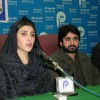
Students Take On the Army
Disturbed by civilian casualties and moved by the plight of people living like refugees in their own country, students from Pakistan’s Federally Administered Tribal Areas (FATA) are demanding an end to army operations against militants on their native soil.
Growing Inequality Mars 20 Years of Women’s Progress
As the world moves closer to the 2015 end mark of the Millennium Development Goals (MDGs), a new U.N. report illuminates how far global society has come, but also how far it still must travel to achieve its objectives.
USAID Unveils Five-Year Plan in Afghanistan
Even as most international military forces are slated to leave Afghanistan by the end of 2014, USAID, the foreign aid arm of the U.S. government, is emphasising its sustained commitment to developing Afghanistan’s economy after the withdrawal.
OP-ED: We Need Everyone to Build a More Sustainable World
Last week, I had the privilege of attending the Delhi Sustainable Development Summit, an annual event that deals with a subject that is very close to my heart. The summit gathered together amazing people: Nobel Prize winners, thought leaders, heads of state, corporate innovators, and academicians to deal with the paramount challenges of the 21st Century all focused on three pressing dimensions of sustainability: food, water and energy.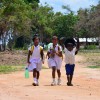
After War Comes Peace, Not Prosperity
Sri Lanka’s war-battered Northern Province had reason to celebrate when the results of a countrywide exam were announced last December. Of the 16,604 students from the province who sat for the exam, 63.8 percent secured the required marks for entry into prestigious national universities.
Moral Monday Protests Inspire Truthful Tuesdays
Moral Monday, the populist movement in North Carolina that saw a diverse coalition of thousands of progressive activists descend upon the state legislature, is now spreading throughout the U.S. South.
CELAC Summit Targets Inequality
Heads of state and government at the Second Summit of the Community of Latin American and Caribbean States (CELAC) made a joint commitment to reduce poverty, hunger and inequality, and declared their region a “zone of peace”.
Education Is Key to Bachelet’s Chile
For 14-year-old Isadora Riquelme and thousands of other Chilean teenagers, the chance of getting the university education they want depends on the reforms that Michelle Bachelet has promised to undertake when she takes office as president again in March.
U.S. Sanctions Closing Doors to Iranian Students
Even as the United States and European Union begin to lift some sanctions on Iran, U.S. law continues to prohibit some businesses that provide non-controversial services, such as online education, from operating in Iran and other countries.
New Writing on a School Wall
Welcome to Bridge Over the Wadi primary school, one of five bi-national schools under the "Hand-in-Hand" initiative of the Centre of Jewish-Arab Education in Israel. The centre strives to bring children from both communities to learn together in Hebrew and Arabic in the hope that they’ll bridge the divide between the two peoples.
Digital Age Demands Educational Transformation, World Forum Says
The challenges of the digital age call for schools to develop an alternative model of education, with teachers who incorporate new technology and employ a more critical pedagogy, participants said at the Fórum Mundial de Educaçao (World Education Forum) in this southern Brazilian city.
Educational Network Erases Borders
Hundreds of students from Spain’s Canary Islands, Senegal and the Sahrawi refugee camps outside of Tindouf in western Algeria are meeting each other and breaking down cultural barriers thanks to the Red Educativa Sin Fronteras.
OP-ED: Baka’s Struggle a Footnote to Story of Cameroon’s Growth
A recent article by IPS journalist Ngala Killian Chimtom described the struggle of the Baka of Cameroon to maintain their indigenous culture and livelihoods while coping with the rapidly-changing environment around them.
U.S. Moves to End “School-to-Prison Pipeline”
The U.S. government has released landmark new guidelines aimed at tackling overreliance on punitive disciplinary measures within the national school system, with students being expelled or even referred to law enforcement for minor infractions.

Women Farmers in Chile to Teach the Region Agroecology
An organisation that brings together some 10,000 peasant and indigenous women from Chile is launching an agroecology institute for women campesinos, or small farmers, in South America.
Keeping the Grass Greener for African Plant Breeders
For the few plant breeders in Africa like Vivian Oduro, working for an international research institution is an obvious choice, with prestige and benefits any agricultural scientist would find hard to decline.« Previous Page — Next Page »





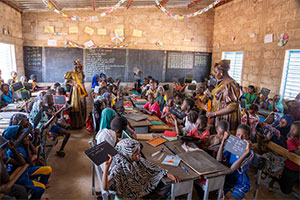 Two teachers work in a classroom in Forces Vives School in Dori, Burkina Faso. Credit: UNICEF/UNI978361
Safe and uninterrupted education is a fundamental right for all children. Education is paramount to global development, as it has been proven that investing in education – especially for girls and children – contributes significantly to economic growth and prosperity. Although more than 1 billion children go to school, many are subjected to conditions that are not conducive to a proper learning environment, including makeshift facilities, a lack of supplies, violence in classrooms, inadequate sanitation, untrained instructors, and widespread school closures. Since 2015, there have been immense gains in education with an increase of 109 million children in school. However, as of 2023, 272 million children are still out of school.
High poverty levels in developing countries also impede children’s access to a proper education. For example, from the early to mid 2000s, Sub-Saharan African nations witnessed a dramatic decline in trained teachers due to inadequate funding in the education sector. Furthermore, major cuts to United States international aid threaten an estimated 23 million additional children's access to education, as USAID‑funded school programmes across Africa and Asia face closure.
Various other factors contribute to the decline of education, notably hunger, which has increased as conflict and climate change interfere with global food production and dissemination. Meanwhile, certain social and cultural practices also impede children’s access to education, with gender inequality, discrimination, child labour, and child marriages preventing millions of children from attending school. Economic conditions such as the inaccessibility of higher education also affect disenfranchised communities across the world. In extreme situations, such as warfare where educational facilities are destroyed in their totality, notably in Gaza and Sudan, entire generations of children might grow up without access to education. Rebuilding educational infrastructure is a long and arduous process, especially when violence persists across generations, and this significantly stunts the development of societal prosperity and stability.
IPS is dedicated to telling the shocking truths about worldwide education through impassioned opinion pieces and comprehensive articles, highlighting global issues that impede worldwide education and the courses of action being taken by organizations such as UNICEF and Education Cannot Wait.

The Week with IPS

NEXT STOP - SDGs
Tracking global progress towards a sustainable world
Tracking global progress towards a sustainable world
