Languages
Sunday, November 8, 2026



News and Views from the Global South
Population
Report Exposes Holes in Taiwan’s Human Rights Record
Earlier this week a coalition of rights organisations issued a ‘shadow report’ on Taiwan’s compliance with two international human rights covenants, which it incorporated into domestic law in 2009, probing the country’s track record on human rights.Student Protests Energise Mexico’s Election Campaign
The "Occupy" movement has spread to Mexico, where thousands of university students have taken to the streets, bringing fresh air to a superficial and flat election campaign and forcing political parties to pay attention to a long-ignored segment of the population.
HAITI: Partners in Deforestation and “Slumification”
More than 100 Haitian families now have new housing, thanks to the support of two non-governmental organisations working on reconstruction following the country's devastating 2010 earthquake.Efforts to Build Caregiving Industry ‘Inadequate’
To meet the demands of a rapidly ageing population, Japan has loosened its notoriously strict immigration and nursing regulations to accept foreign caregivers. But new evidence indicates deep cracks in those piecemeal gestures.
India’s Economic Growth Leaves Human Development in the Dust
Ahead of the Universal Periodic Review (UPR) of India, a coalition of NGOs denounced the gap between the country’s growth rate and the rate of poverty, malnutrition and lack of health and sanitation.
Vaccination – Pakistan’s Missing Shots
The deaths of 20 children in an outbreak of measles in Pakistan’s Federally Administered Tribal Agency (FATA) are raising concerns over the state of immunisation in the conflict-ridden areas along the Afghanistan border.Prisoners’ Rights Still Absent in Argentina under Democracy
Nearly 29 years after the demise of the 1976-1983 dictatorship in Argentina, successive democratic governments have failed to find a humane way of running the prison system. Preventable deaths, torture and appalling conditions for inmates continue to be reported.Parliamentarians Track Progress on Reproductive Rights
Have women around the world become more empowered in their reproductive health and rights over the past 18 years? This is one of the questions that some 300 parliamentarians from around the world will be examining when they meet in Istanbul, Turkey, this week for the Fifth International Parliamentarians’ Conference on the Implementation of the International Conference on Population and Development (ICPD) programme of action.
G8 Turns to Private Sector for Food Crisis Solutions
On the eve of the Group of Eight (G8) summit near Washington, President Barack Obama on Friday unveiled a major new initiative aimed at shoring up food security and combating global hunger.
Funding Dries Up Even as Rains Worsen Cholera Deaths
As predicted, the beginning of the rainy season in Haiti brought exponential increases in the numbers of people sickened and killed by cholera.
Q&A: How Sex Education Programs Can Shape a Better Future
In Latin American countries and in the Caribbean, where income disparities are among the greatest in the world, too many people often lack access to comprehensive health services and information needed to live healthy lives.
SOUTH SUDAN: Bracing for a Massive Influx of Returnees
In the wake of border tensions, the United Nations is airlifting 12,000 southerners from a Sudanese frontier town into South Sudan. But they are returning home in the midst of an economic crisis that has the U.N. warning it may appeal for more funding to scale up humanitarian operations.
From Mubarak To Worse
More than 15 months after Egypt's Tahrir Square uprising and four months after free parliamentary polls, many Egyptians say that daily living conditions are worse now than they were in the Mubarak era.
Protection for Salvadoran Migrants En Route to U.S.
A law to protect Salvadoran migrants, who are frequently victims of attacks and abuses on their way to the United States, is nearing entry into force after having been approved over a year ago. All that remains is for a body made up of civil society organisations to be created to implement it.
Q&A: The Future of Agriculture May Well Be in Cities
In the coming decades, the world's population is expected to grow by at least another two billion people, 80 percent of whom will live in cities by the year 2050.
Maternal Deaths Drop By Nearly Half
The statistics have remained staggering: every two minutes, a woman dies of pregnancy and child birth-related complications caused primarily by severe bleeding, infections, high blood pressure and unsafe abortions.EU Feels Force of Israeli Demolitions
All 27 foreign ministers of the European Union have strongly spoken out against Israeli demolitions in Area C of the West Bank. Since the beginning of 2011 not less than 60 EU-funded projects have been demolished while 110 others are currently at risk. Several analysts claim the Israeli authorities are specifically targeting EU-funded projects.Public Funds Could Help Provide Water and Electricity, Researchers Say
For several decades, governments around the globe have turned to privatisation as the best option to help relieve the world's destitute by providing them with health care services, water and electricity. By and large, however, this effort has failed.
Remembering Is Now 64 Years Old
"There is the beginning of my life. My father would call for prayer, ‘Allahu Akbar’," says 72-year old Yacoub Odeh, pointing to a collapsed house perched high on the hill. "The whole village would hear him." Odeh was then eight years old: "I’m the son of yesterday."
Deserting Refugees in the Sahara
As dusk settles over the isolated Saharan town Kufra, young guards order a few hundred migrants lined up at a detention centre to chant "Libya free, Chadians out", before they kneel down for evening prayers.
Shedding Light on Inequality in World’s Most Unequal Region
A new report takes a close look at the territorial distribution of poverty and inequality in Latin America, which has long had a reputation of being the most unequal region in the world.« Previous Page — Next Page »





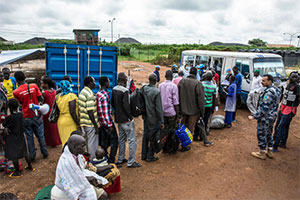 One Thousand Internally Displaced Persons (IDPs) Relocated from Tomping Camp in South Sudan. Credit: UN Photo/Isaac Billy
It took hundreds of thousands of years for the world’s human population to cross one billion in 1804. Approximately 200 years later, the population has multiplied sevenfold. In 2023, the global population crossed 8 billion, and is expected to reach 9 billion before 2050. With the planet more crowded than ever, it is essential to keep track of population trends, urbanization, migration, and reproduction across the world.
Life expectancy has seen significant strides in the past century, largely due to economic development and increased standards of living. On the contrary, trends in global fertility are shifting, with certain regions in Africa and Asia reporting higher rates, while parts of Europe and North America report stagnant or lower rates. This is in part due to differences in sexual and reproductive healthcare, as well as societal and economic conditions around the world. For example, child marriage is prevalent in certain societies, where childbearing is also considered a familial duty. Meanwhile, stagnating economies frequently experience lower marriage and childbearing rates.
The increase in migration and urban development around the world is also linked to global population trends. By 2050, it is expected that approximately 66 percent of all people will live in cities. Furthermore, global crises such as warfare and natural disasters also prompt transnational migration. Transnational migration is linked to a variety of socioeconomic issues in both host and receiving countries: migrants often leave developing countries with less access to educational and economic opportunities and arrive in developed countries where they are frequently the targets of ethnic, racial, and cultural discrimination, and economic exploitation. Recent crises in Europe and the United States demonstrate the importance of advocating for migrants worldwide. As migrants from the Global South are increasingly stripped of their legal and civic rights in unlawful deportations, or targeted in acts of identity-based violence, it is essential to keep track of population trends and protect the human rights of migrant populations. Climate-related disasters are now a major driver of displacement, with nearly half of all new internal displacements in 2025 being disaster-related.
IPS is devoted to covering issues surrounding population trends, migration, and reproduction through its compelling articles, which use both statistics and human stories to provide readers with robust and informative viewpoints.

The Week with IPS

NEXT STOP - SDGs
Tracking global progress towards a sustainable world
Tracking global progress towards a sustainable world
