Languages
Sunday, October 18, 2026



News and Views from the Global South
Trade & Investment

Falcons Love the Taliban
While the Taliban’s military activities continue to plague Pakistan’s northern Federally Administered Tribal Areas (FATA), the incessant violence has been a blessing in disguise for one creature: the falcon.Chinese Investment Tests Limits of Georgian Hospitality
A 150-million-dollar-plus Chinese real estate and tourism deal that is slated for a suburb of Georgia’s capital, Tbilisi, is creating a quandary for many Georgians.
U.N. Greenlights Long-Awaited Arms Trade Treaty
For many in the international community, the iconic sculpture outside the U.N. Visitors’ Centre appears more prominent today, as the majority of member states tightened its knot by adopting the first ever Arms Trade Treaty (ATT).
World Bank Aims to End Extreme Poverty by 2030
World Bank President Jim Kim has unveiled a series of new institutional goals aimed at ending extreme poverty by 2030 and focusing on the promotion of “shared prosperity” – increasing the incomes of the poorest 40 percent in each country while placing increased focus on dealing with climate change.
Mining Investment Won’t Switch from Chile to Peru
The Chilean government has warned of the potential flight of mining and energy investments to Peru because of court rulings that have paralysed large-scale mining projects in the north of the country. But this fear is unfounded, at least in the short term.Veto Returns to Haunt Big Powers in Arms Trade Treaty
When the United Nations set out to draft a politically-sensitive Arms Trade Treaty (ATT), ever since negotiations began in 2006, member states agreed to take the final decision by "consensus".U.S. Eyes Pension Funds to Renew Crumbling Infrastructure
President Barack Obama doubled down on a new push for infrastructure investment in a major speech Friday, highlighting roads, ports and bridges that many say have suffered from decades of insufficient upkeep.
“Crowdfunding” Gives Boost to Renewables in U.S.
A U.S. company called Mosaic has unveiled a new way for citizens to use the Internet to invest in specific solar energy projects around the country.
Zimbabwe Struggling to Pay Laid-Off Workers
As former Reserve Bank of Zimbabwe employees went to the Labour Court in Harare this week hoping for a ruling in favour of the finalisation of their retrenchment packages, the country’s public and private sectors continue to lay off workers without paying the promised compensation.
U.N. Accused of Opaque Selection Process for Top Officials
- The Geneva-based U.N. Conference on Trade and Development (UNCTAD), described as a key forum for developing nations on issues relating to trade, investment and development, will have a new secretary-general come September.
Not Yet Banking on BRICS
Although leaders of the Brazil, Russia, India, China and South Africa group agreed to launch a new development funding institution, giving the club a major infrastructure boost, some here are sceptical about the potential impact of the new bank.Argentina vs Holdouts Could Set Precedent for Future Debt Crises
The fate of countries with major debt problems is at stake in federal courts in New York, which are to decide in April whether or not they accept Argentina’s proposal to the bondholders who rejected two restructurings of sovereign debt.
The Two Faces of International Commodity Trade
For decades, commodity trade has been understood from the point of view of “commodity dependent” exporting countries, those whose revenues are largely generated by commodities exports. The trend of decreasing agricultural commodity prices was the focus of attention. However, from the beginning of the 2000s, there was an upward trend in agricultural commodity prices culminating in the price peak of 2007-08.
Now Gaza’s Ark Prepares to Dare Israel
“An ark is literally a large floating vessel designed to keep its passengers and cargo safe,” say the group preparing ‘Gaza’s Ark’. But their ark, they say, is “a vessel that embodies hope that the Palestinians of the Gaza Strip can soon live in peace without the threat of the Israeli blockade.”
Group Warns of “Natural Resources Giveaway” in Latin America
Researchers have unveiled new data warning that governments in Latin America are infringing on the rights of their indigenous populations in a bid to fuel development through the extraction of natural resources.Concerns Mount as U.S. Plans Major Natural Gas Exports
Environmentalists and others here are reacting with concern to a surprise announcement on Monday of a major deal that would see U.S. natural gas exported to the United Kingdom, marking the first time that such sales have been permitted.
Tug-of-War Over Nuclear Future
Pushed and pulled in opposite directions, the future of Japan’s energy plans in the wake of the accident at the Fukushima Daiichi nuclear power plant two years ago is emerging as a fight between national economic advancement and what anti-nuke activists call “the lives of the people”.
OP-ED: The BRICS and the Rising South
On Tuesday, leaders of five large emerging economies – Brazil, Russia, India, China, and South Africa, known as the BRICS – will gather in Durban, South Africa to discuss harnessing their formidable resources on behalf of faster development progress in Africa and elsewhere.USAID Makes Steady but Slow Gains on Transparency
The United States’ main foreign assistance agency is getting widespread plaudits for new data on a series of internal reforms aimed at aid improvement, but some development experts are pointing to a persistent opaqueness from the agency.Civil Society Seeks to Influence Mexican Mining Law Reform
Two separate bills to reform Mexico’s mining laws, one from the government and the other from academics and NGOs, agree on the urgent need for major changes in the rules governing the industry.China Muscles into Kyrgyzstan’s Energy Market, Fueling Suspicion
China is financing the construction of Kyrgyzstan’s first major oil refinery, and excitement is building in Bishkek that the facility could enable the Central Asian nation to break Russia’s fuel-supply monopoly.« Previous Page — Next Page »





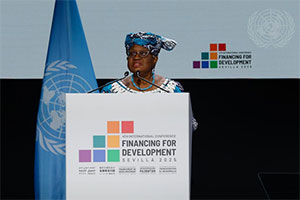 Opening of 4th International Conference on Financing for Development. Credit: UN Photo/Mariscal
International trade and investment are crucial elements of the world economy. While they can be powerful stimulators of development, they can also lead to global imbalances and dynamics of exploitation. In 2025, international trade entered a period of immense disruption, driven in part by a new wave of United States tariffs that reshaped global supply chains and investment flows. The increase in the US tariff rate, the highest since the 1930s, has forced bilateral renegotiations with global trading partners. Furthermore, the debt crisis in developing nations has accelerated while Official Development Assistance (ODA) has substantially dropped 7.3% in 2024.
In the 21st century, advancements in economic diversification in formerly colonized nations have propelled them into more central roles in the global economy. For example, both China and Mexico were able to develop their manufacturing sector and channel this development into booming export flows, thus advancing into the position of emerging economies. Foreign investment also plays an essential role in providing capital for developing countries, although they are oftentimes accompanied by social and environmental exploitation. For example, rising Chinese investments in natural resources in Latin America have often been met with tension as these investment projects fail to properly mitigate environmental risks and protect workers’ rights. In a more multifaceted vein, Sino-African relations have led to infrastructure development in Sub-Saharan Africa while also heightening the region’s economic dependency on China. IPS reports on global news in trade and investment, while shining a light on the nuanced nature of these endeavors.

The Week with IPS

NEXT STOP - SDGs
Tracking global progress towards a sustainable world
Tracking global progress towards a sustainable world
