Languages
Thursday, November 26, 2026



News and Views from the Global South
Food and Agriculture

Walking an Economic Tightrope with No Safety Net
With the richest one percent of the population now owning 40 percent of global assets, and the bottom half sharing just one percent, inequality is fast being recognised as a stubborn underlying obstacle to development.
Programme to Boost Small Farmers Fights for Continuity
When it launched in 2007, the FAO programme known as Food Security through Commercialisation of Agriculture (FSCA) tried to adopt an approach that differed from on-going efforts to achieve food security, which focused primarily on food production.
Finding Land for Cameroon’s Pastoralist Nomads
Adamou Harouna’s herd of cattle grazes leisurely on lush green vegetation in Ndop, a small village in Cameroon’s North West Region.
No Safe Havens in Increasingly Acid Oceans
Oil, gas and coal are contaminating the world's oceans from top to bottom, threatening the lives of more than 800 million people, a new study warns Tuesday.
The Hurricanes Didn’t Bring the Hunger
A month after Hurricanes Ingrid and Manuel caused the worst destruction from a natural catastrophe in Mexico in 30 years, another disaster has come to light: hunger in communities that are supposedly served by a rural food supply programme.
U.S. Science Reporters Becoming an Endangered Species
The news for environmental journalism in the United States is grim and getting grimmer.
Climate Change a Mixed Blessing for Coconut Farmers
Climbing up the coconut industry has been anything but easy for Rosamund Benn, who has dedicated the past 32 years of her life working on a 50-acre coconut farm in The Pomeroon, a farming region of Guyana.
400 Million Children Mired in Extreme Poverty
Four hundred million children under 13 years of age are living in extreme poverty worldwide, according to a new study released by the World Bank here Thursday.
Behind Haiti’s Hunger
Haiti has been receiving food aid for half a century - over 1.5 million tonnes from the U.S. alone during the past two decades.
The Coming Plague
A climate plague affecting every living thing will likely start in 2020 in southern Indonesia, scientists warned Wednesday in the journal Nature. A few years later the plague will have spread throughout the world's tropical regions.
Improved Seed Improves Ethiopian Farmers’ Lives
 Ethiopian farmers are learning that seed security is the basis of food security.

Small Island Economies Battered by Erratic Weather
Malcolm Wallace always knew on which side his bread would be buttered.
Seeding Ethiopia’s Future Food Security
Datta Dudettu and his seven children know what is like to go hungry. They live in Woliyta, a drought-prone area in southern Ethiopia that has experienced chronic food shortages. But hopefully, thanks to the successful use of hybrid seed, that is now firmly in the past.
How to Tell the Biggest Stories of Our Times
What does gorilla conservation have in common with the provision of contraceptives to women? How does rural-urban migration contribute to global warming? What does city planning in Kenya have to do with coastal erosion in the Philippines?
Some Rice, Served With Rainwater
The quiet Cambodian village of Chouk, set in the beautiful forests of the Cardamom Mountains near the Thai border, seems peaceful. But things are difficult in this largely empty village of simple wooden houses, populated mainly by children and the elderly.FAO: Modernisation or Irrelevance
The current international situation is characterised by financial and economic challenges that in one way or another affect most countries around the world. In this context there is an increasing call to modernise state institutions, private sector companies, and civil organizations, whatever their remit may be.
Q&A: The Eleventh Hour for Climate Justice
Climate justice – the nexus between human rights and climate change – must be a pillar of the post-2015 development agenda, says former Irish president Mary Robinson.Less Hunger, But Not Good Enough
Every year, we take a snapshot of world progress in the fight against chronic hunger. This year, the picture is looking better, but it’s still not good enough.
Hunger Decreases, but Unevenly, U.N. Reports
Some 842 million people still suffer from chronic hunger, according to the State of Food Insecurity in the World (SOFI 2013), published Tuesday by the three Rome-based U.N. food agencies.U.S. Government Shutdown Could Hit Foreign Aid
A deadlocked U.S. Congress proved unable to settle budgetary differences late Monday evening, leading to a federal government shutdown that could soon be felt by foreign aid programmes and their recipients.
WTO: Stingy with the Poor, Generous with the Rich
A fight taking place in the World Trade Organisation (WTO) negotiations towards the Bali Ministerial Conference shows how the rules on agriculture allow developed countries to continue to shell out huge subsidies while penalising farmers in developing countries.« Previous Page — Next Page »


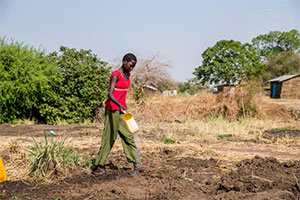 Farming on the Outskirts of Juba. Credit: UN Photo/JC McIlwaine
Promoting human and planetary health is a central focus of the United Nations, as laid out in the 2030 Sustainable Development Goals (SDGs). World hunger and unsustainable farming practices continue to be pressing concerns for the world. According to the 2025 State of Food Security and Nutrition in the World report by the Food and Agriculture Organization (FAO), 673 million people faced hunger in 2024. There are stark regional disparities, with the FAO projecting that 60% of the world population facing hunger will reside in Africa by 2030. Globally, the prevalence of food insecurity has remained consistently higher for women than men.
Sustainable and efficient national food systems are essential in preserving health, education, environmental well-being, peace, economy, and security. However, creating sustainable food systems can be a challenging endeavor, as food production takes a heavy toll on the environment. The agricultural sector accounts for a significant portion of greenhouse gases. Finding safe, sustainable, and ethical strategies to feed the world is crucial in ensuring planetary longevity. A recent initiative from 2023, the EU Regulation on Deforestation-free Products (EUDR), seeks to advocate for sustainable food systems. The main driver of deforestation is the expansion of agricultural land used to produce commodities like cattle, wood, cocoa, coffee, etc. The EUDR is part of the 2020 European Green New Deal and the EU Biodiversity Strategy for 2030 and aims to limit Europe’s consumption of products linked with deforestation by requiring that companies prove that their products are deforestation-free. Despite aiming to achieve major strides in sustainability, policies such as EUDR also raise socioeconomic concerns for targeted countries. Many emerging Latin American economies are impacted by the policy, and have raised the question of how developing countries can grapple with the tensions between economic development and advancing sustainability.
IPS has been at the forefront of providing compelling and insightful stories on communities facing hunger as well as the cost of food production. IPS uses statistics from FAO, the World Food Programme (WFP) and the International Fund for Agricultural Development (IFAD) to bring relevant and hard-hitting facts to readers. This gathering of information and data from such organizations helps bring the best stories from IPS journalists working in the different regions in consultation with experts on the ground.

The Week with IPS

NEXT STOP - SDGs
Tracking global progress towards a sustainable world