Languages
Thursday, November 26, 2026



News and Views from the Global South
Food and Agriculture

Q&A: Indonesia Still at High Risk for Catastrophic Fires
In June, Singapore, Malaysia and Indonesia were enveloped in haze as hundreds of forest fires burned across the island of Sumatra, in the worst pollution crisis to hit Southeast Asia in more than a decade.
Protecting Tanzania’s Farmers from Weather Extremes
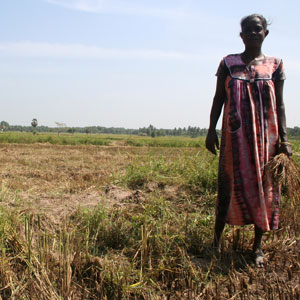
When Habiba Msoga from Kiroka village, in Tanzania’s Morogoro Region, first began applying a method of rice cultivation that was different from what her fellow farmers traditionally used, they laughed at her.
Oil Palm Expands on Deforested Land in Brazil’s Rainforest
The green of the oil palm plantations is unbroken along kilometre after kilometre of red soil, devastated in the past by loggers and ranchers. The oil palm, a sign of alarm for some and of hope for others, is here to stay in the Amazon rainforest state of Pará in the extreme north of this country.
OP-ED: A Global Green New Deal for Sustainable Development
Eight decades ago, during the Great Depression, newly elected U.S. President Franklin Delano Roosevelt introduced the New Deal consisting of a number of mutually supporting initiatives of which the most prominent were:
Opportunity Knocking
A sense of urgency brought on in recent years by food price volatility inspired collective action to reduce the likelihood of further price spikes and food supply shocks.
Ethiopia’s Indigenous Excluded from Rapid Growth
As the construction of a major transmission line to export electricity generated from one of Ethiopia’s major hydropower projects gets underway, there are growing concerns that pastoralist communities living in the region are under threat.
World Headed for a High-Speed Carbon Crash
If global carbon emissions continue to rise at their current rate, humanity will eventually be left with no other option than a costly, world war-like mobilisation, scientists warned this week.
Insuring Cows and Goats Improves Kenyan Lives
“That is the sound I love the most in the whole world,” Hussein Ahmed says as the bells tied to his cattle begin clinking as they return home. Ahmed, a pastoralist in Marsabit district in arid and semi-arid northern Kenya, lost all his animals in 2011 during one of the worst droughts in the region for over 60 years.
Less Food for More Hungry
Deep cuts in food aid for poor people in the United States are poised to bring higher demands on charities and food pantries across the country that provide food to families in need – and which are already overstretched.
Jordan’s Farmers Struggle to Weather Climate Change
Abu Waleed isn't quite sure where to begin his litany of grievances. Bugs that chomp their way through the mint he grows, or the dry well that forces him to pump water from a half kilometre away? Or perhaps the 160 dinars he spent on spinach seeds only to see scant growth after planting.
Women Find a Green Midas Touch
On a hot and humid day in northwestern Bangladesh, Anisa Begum sits with a group of 25 homemakers, explaining how to use natural fertilisers to increase grain yield.
Bangladesh Ailing After Aila
It has been four years since Cyclone Aila struck Bangladesh, triggering floods and widespread destruction. But the villagers of Koira subdistrict, among the worst affected of the 11 districts hit by the cyclone, are yet to recover from its impact.
Refugees Eating Dogs to Beat Starvation
Acute food shortages have reached desperate levels in the Yarmouk refugee camp in Damascus. Leading religious figures in the camps have issued a fatwa permitting the killing and consumption of cats, dogs, mice, rats and donkeys.
Power Struggle Rises Over Tanzania’s Pangani River
As farmers and herders fight over dwindling water levels in the Pangani River Basin in northeastern Tanzania, a new dispute is emerging between farmers and the state-run power utility firm over this precious resource.
Plantations Winnow Tigers Down to the Hundreds
The tiger population in the rainforests of Sumatra is vanishing at a staggering rate, reducing the number of the endangered species to as few as 400, warns Greenpeace International.
The United States of Drought
As the planet heats up and larger populations demand larger water supplies, the United States will be left high and dry if it fails to address a worsening water shortage.
Conflicts Over Water Rise in Tanzania
Conflicts over water are increasing in the sprawling Pangani River Basin in northeastern Tanzania as farmers and herders jostle for dwindling water resources in the face of climate change.
Groups Target Food Waste to Eliminate Hunger
If all food loss and waste around the world could be recovered, half the world's population, or 3.5 billion people, could be fed. Yet people throw away a third of food produced globally, an issue that inspired the theme of these year's World Food Day, sustainable food systems for food security and nutrition.
Washington State Becomes Latest GMO Battleground
The northwestern state of Washington could become the first in the U.S. to require labeling of genetically modified organisms (GMOs) on foods and food packages, after a similar measure in California failed last year.
Struggling U.S. Families Threatened by Food Stamp Cuts
Near the Martin Luther King Jr. Library in downtown Washington, just a few blocks away from the federal district, dozens of homeless men and women wait for the evening shuttles that will take them to their dinners at one of many food shelters around the city.
When Poverty Quietly Morphs into Catastrophe
Wambui Karunyu, 72, and her seven-year-old grandson are the only surviving members of their immediate family. Karunyu’s husband and five children all succumbed to the hardships of living in the semi-arid area of lower Mukurweini district in central Kenya.« Previous Page — Next Page »


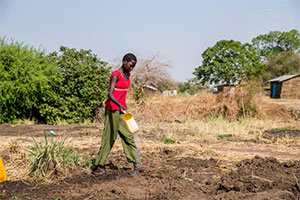 Farming on the Outskirts of Juba. Credit: UN Photo/JC McIlwaine
Promoting human and planetary health is a central focus of the United Nations, as laid out in the 2030 Sustainable Development Goals (SDGs). World hunger and unsustainable farming practices continue to be pressing concerns for the world. According to the 2025 State of Food Security and Nutrition in the World report by the Food and Agriculture Organization (FAO), 673 million people faced hunger in 2024. There are stark regional disparities, with the FAO projecting that 60% of the world population facing hunger will reside in Africa by 2030. Globally, the prevalence of food insecurity has remained consistently higher for women than men.
Sustainable and efficient national food systems are essential in preserving health, education, environmental well-being, peace, economy, and security. However, creating sustainable food systems can be a challenging endeavor, as food production takes a heavy toll on the environment. The agricultural sector accounts for a significant portion of greenhouse gases. Finding safe, sustainable, and ethical strategies to feed the world is crucial in ensuring planetary longevity. A recent initiative from 2023, the EU Regulation on Deforestation-free Products (EUDR), seeks to advocate for sustainable food systems. The main driver of deforestation is the expansion of agricultural land used to produce commodities like cattle, wood, cocoa, coffee, etc. The EUDR is part of the 2020 European Green New Deal and the EU Biodiversity Strategy for 2030 and aims to limit Europe’s consumption of products linked with deforestation by requiring that companies prove that their products are deforestation-free. Despite aiming to achieve major strides in sustainability, policies such as EUDR also raise socioeconomic concerns for targeted countries. Many emerging Latin American economies are impacted by the policy, and have raised the question of how developing countries can grapple with the tensions between economic development and advancing sustainability.
IPS has been at the forefront of providing compelling and insightful stories on communities facing hunger as well as the cost of food production. IPS uses statistics from FAO, the World Food Programme (WFP) and the International Fund for Agricultural Development (IFAD) to bring relevant and hard-hitting facts to readers. This gathering of information and data from such organizations helps bring the best stories from IPS journalists working in the different regions in consultation with experts on the ground.

The Week with IPS

NEXT STOP - SDGs
Tracking global progress towards a sustainable world