Languages
Monday, September 14, 2026



News and Views from the Global South
Food and Agriculture
Peru’s Agro-Export Boom Has not Boosted Human Development
Peru’s agro-export industry is growing steadily and reached record levels in 2022. But this has not had a favorable impact on human development in this South American country, where high levels of inequality, poverty, childhood anemia and malnutrition persist, as well as complaints about the poor quality of employment in the sector.
Kenyan Scientist’s Trend-Setting Research into Health Benefits of Snails
Snails and slime are usually followed by the thought ‘EEW!’ from most people … some might even scream at seeing a snail near them. For Dr Paul Kinoti, however, these slimy creatures could earn him international recognition because his research on snails landed his institution, Jomo Kenyatta University of Agriculture and Technology (JKUAT), a Ksh. 127 million (USD 1 million) grant.[related_articles]
How Farmer Producer Organisations Benefit Small Scale Farmers in India
Until a decade ago, marginal farmers Gangotri Chandrol and Sunitabai lacked livelihood options in the post-monsoon season.
World Hunger Day: Renewing Our Commitment to Elevating Women as Change Agents for Ending Hunger
This upcoming weekend, on May 28, we are commemorating World Hunger Day. The day serves as a reminder that more than 800 million people around the world are living with hunger and malnutrition. That number is staggering, but there is hope.
Nothing Beats Bushmeat, Not Even the Risk of Disease
Meat from wild animals is relished across Africa and widely traded, but scientists are warning that eating bush meat is a potential health risk, especially in the wake of pandemics like COVID-19.
Why Quality Seeds Are among the Most Valuable Currency in Climate Finance for Africa
At long last, momentum is growing for an overdue rethink of climate finance and development assistance to support countries on the frontlines of the climate crisis.
Acute Hunger an ‘Immediate Threat’ To Over a Quarter of a Billion People
While King Charles III’s coronation in Britain was hogging much of the international media’s attention at the start of this month, it was easy not to notice another story that deserved at least as many headlines.
A Short Tale of a Tree and a Moroccan Wedding Party
A much needed break amidst so many alarming news, with a brief story of a tree, a bottle of liquid gold, and a wedding gift.
Finding Ways to Feed South Africa’s Vast Hungry Population
In the deep rural village of Jekezi in South Africa's Eastern Cape, most young and able-bodied people have fled the area, leaving behind people with disabilities, the elderly, and children.
Unceasing Human Attacks on the Source of 80% of Food, 98% of Oxygen
Two big facts are impressive enough: plants are the source of 80% of all food, and as much as 98% of all oxygen. Logically, it would be taken for granted that human beings would do whatever is needed to protect this essential source of life. But do they?
Can African Farmers Still Feed the World?
Less than a decade ago, Africa was home to 60-65% of the world’s uncultivated arable land and 10% of renewable freshwater resources, as reported by the African Union in 2016, while concluding that African farmers could feed the world.
Livestock Producers Seek to Integrate Biogas and Animal Protein Market in Brazil
It is the “best energy,” according to its producers, but biogas from livestock waste still lacks an organized market that would allow it to take off and realize its potential in Brazil, the world's largest meat exporter.
Of Africa and The Magic Formula of The Italian Taxi Driver
Some days ago in Rome, the Italian taxi driver switched on the radio during a longish ride through the usual traffic jam. Music, gossip, and the hourly news bulletin. All of a sudden, the man strongly hit the steering wheel. “They are stupid, those bastards…,” he shouted.
To Confront Our Current Crises, It’s Time to Put Our Money Where Our Mouth Is
The finance sector’s role in the current global crises – notably climate, biodiversity, and food security – is significant. Polluting activities and environmentally-destructive practices for short-term economic gains have catapulted us to our current untenable situation. We're ‘sawing off the branch we’re sitting on’ by sacrificing life-giving ecosystem services for profit, and that branch is sagging and splitting under our weight.
Rural Women’s Constant Struggle for Water in Central America
“This is a very difficult place to live, because of the lack of water,” said Salvadoran farmer Marlene Carballo, as she cooked corn tortillas for lunch for her family, on a scorching day.
Empowering Women is Key to Breaking the Devastating Cycle of Poverty & Food Insecurity in sub-Saharan Africa
Studies consistently show that women have lower rates of agricultural productivity compared to men in the region, but it’s not because they’re less efficient farmers.
UNDP Assistance Helps Farmers to Meet New EU Deforestation Rules

The UNDP has assisted cocoa farmers from the Peruvian Amazon to ensure the commodities meet European Parliament regulations. The regulation prohibits the placing of products on the market if their production has led to deforestation.
What Local Food Challenges and Choices Across Vietnam Reveal About a Global Push for Food Systems Transformation
Last month, Nature spotlighted three insightful new studies chronicling food-related challenges from a global perspective. One presented worrisome new data on the global rise in the prevalence of diabetes, high blood pressure and liver disease, all linked to obesity. Another presented a new assessment revealing that half of the greenhouse emissions generated by food systems globally are caused by food waste. Finally, the third study found that food consumption could add “nearly 1 degree Celsius to warming by 2100,” with most of that attributed to global methane emissions from meat, dairy and rice production.
Biogas and Biomethane Will Fuel Development in Cuban Municipality
The first five biomethane-fuelled buses in the Cuban municipality of Martí will not only be a milestone in the country but will also represent a solution to the serious problem of transportation, while reducing emissions of greenhouse gases and bolstering local development.
Chile’s Water Vulnerability Requires Watershed and Water Management
Good management of the 101 hydrographic basins which run from the Andes mountain range to the Pacific Ocean is key to solving the severe water crisis that threatens the people of Chile and their main productive activities.
El Salvador Still Lacks Policies to Bolster Food Security
Sitting under the shade of a tree, Salvadoran farmer Martín Pineda looked desperate, and perhaps angry, as he said that governments of different stripes have come and gone in El Salvador while agriculture remains in the dumps.« Previous Page — Next Page »


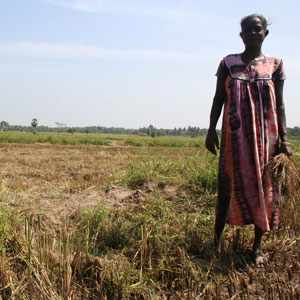
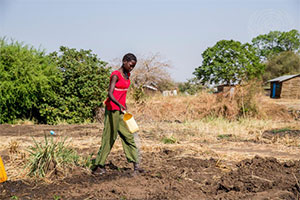 Farming on the Outskirts of Juba. Credit: UN Photo/JC McIlwaine
Promoting human and planetary health is a central focus of the United Nations, as laid out in the 2030 Sustainable Development Goals (SDGs). World hunger and unsustainable farming practices continue to be pressing concerns for the world. According to the 2025 State of Food Security and Nutrition in the World report by the Food and Agriculture Organization (FAO), 673 million people faced hunger in 2024. There are stark regional disparities, with the FAO projecting that 60% of the world population facing hunger will reside in Africa by 2030. Globally, the prevalence of food insecurity has remained consistently higher for women than men.
Sustainable and efficient national food systems are essential in preserving health, education, environmental well-being, peace, economy, and security. However, creating sustainable food systems can be a challenging endeavor, as food production takes a heavy toll on the environment. The agricultural sector accounts for a significant portion of greenhouse gases. Finding safe, sustainable, and ethical strategies to feed the world is crucial in ensuring planetary longevity. A recent initiative from 2023, the EU Regulation on Deforestation-free Products (EUDR), seeks to advocate for sustainable food systems. The main driver of deforestation is the expansion of agricultural land used to produce commodities like cattle, wood, cocoa, coffee, etc. The EUDR is part of the 2020 European Green New Deal and the EU Biodiversity Strategy for 2030 and aims to limit Europe’s consumption of products linked with deforestation by requiring that companies prove that their products are deforestation-free. Despite aiming to achieve major strides in sustainability, policies such as EUDR also raise socioeconomic concerns for targeted countries. Many emerging Latin American economies are impacted by the policy, and have raised the question of how developing countries can grapple with the tensions between economic development and advancing sustainability.
IPS has been at the forefront of providing compelling and insightful stories on communities facing hunger as well as the cost of food production. IPS uses statistics from FAO, the World Food Programme (WFP) and the International Fund for Agricultural Development (IFAD) to bring relevant and hard-hitting facts to readers. This gathering of information and data from such organizations helps bring the best stories from IPS journalists working in the different regions in consultation with experts on the ground.

The Week with IPS

NEXT STOP - SDGs
Tracking global progress towards a sustainable world
Tracking global progress towards a sustainable world