Languages
Tuesday, November 10, 2026



News and Views from the Global South
Labour

OPINION: Africans’ Land Rights at Risk as New Agricultural Trend Sweeps Continent
Agriculture in Africa is in urgent need of investment. Nearly 550 million people there are dependent on agriculture for their livelihoods, while half of the total population on the continent live in rural areas.
Growing Calls for Reforms of El Salvador’s Privatised Pension System
Two of the promises made 16 years ago when El Salvador’s pension system was privatised have failed to materialise: There was no expansion of social security coverage and no improvement in pensions. Now pressure is growing for a reform of the system.
OPINION: Building a Sustainable Future – The Compact Between Business and Society
Can we envision a day when a critical mass of companies is investing in a better world? Where business is delivering value for the long-term – not just financially, but also socially, environmentally and ethically? Over a decade ago, it was hard to imagine, but we can now say with confidence that a global movement is underway.
Amid Crisis, Puerto Rico’s Retirees Face Uncertain Future
A feeling of insecurity has overtaken broad sectors of Puerto Rican society as the economy worsens, public sector debt spirals out of control, and the island's creditworthiness is put in doubt.
World Bank Urged to Rethink Reforms to Business-Friendliness Report
Civil society groups from several continents are stepping up a campaign urging the World Bank to strengthen a series of changes currently being made to a major annual report on countries’ business-friendliness.
Bangladeshi Girls Seek Equal Opportunity
Until five years ago, Shima Aktar, a student in Gajaghanta village in the Rangpur district of Bangladesh, about 370 km northwest of the capital Dhaka, was leading a normal life. But when her father decided that it was time for her to conform to purdah, a religious practice of female seclusion, things changed.
When Land Restoration Works Hand in Hand with Poverty Eradication
Tugging at the root of a thorny shrub known as ‘juliflora’, which now dots the village of Chirmiyala in the Medak District of southern India’s Telangana state, a 28-year-old farmer named Ailamma Arutta tells IPS, “This is a curse that destroyed my land.”
Innovation Offers Hope in Sri Lanka’s Poverty-Stricken North
In this dust bowl of a village deep inside Sri Lanka’s former conflict zone, locals will sometimes ask visitors to rub their palms on the ground and watch their skin immediately take on a dark bronze hue, proof of the fertility of the soil.
Caregiving Exacerbates the Burden for Women in Cuba
Hortensia Ramírez feels like she needs more hands to care for her 78-year-old mother, who suffers from arteriosclerosis, do the housework, and make homemade baked goods which she sells to support her family.
Karachi Residents Trapped Between Armed Assassins and Private Bodyguards
With a rise in sectarian killings, extortion, drug peddling, kidnappings and land grabbing, Pakistan’s sprawling port city of Karachi, home to some 20 million people, has become a hotbed of crime.
U.S. Urged to Put Development Aid over Border Security
When U.S lawmakers departed Washington for a month-long recess, they left behind a simmering debate over what to do about the tens of thousands of Central American children and adults that continue to cross the U.S. southern border.
Tajikistan Struggles to Stem Rise of Jihadi Recruits
Before he became a jihadist, Odiljon Pulatov would travel each year from Tajikistan to Moscow to earn money as a construction worker.
Gender Equality Gains Traction with Pacific Island Leaders
A pledge by political leaders two years ago to accelerate efforts toward closing the gender gap in the Pacific Islands has been boosted with the announcement that three women will take the helm of the regional intergovernmental organisation, the Pacific Islands Forum Secretariat, headquartered in Suva, Fiji.IFC Warned of Systemic Safeguards Failures in Honduras
For the second time this year, an internal auditor has criticised the World Bank’s private sector investment agency over dealings in Honduras, and is warning that similar problems are likely being experienced elsewhere.
Youth Suicides Sound Alarm Across the Pacific
Suicide rates in the Pacific Islands are some of the highest in the world and have reached up to 30 per 100,000 in countries such as Samoa, Guam and Micronesia, double the global average, with youth rates even higher.
Zimbabwe’s ‘Casualisation of Labour’ Leads to a New Form of Exploitation
Ethel Maziriri, 27, holds an Honours Degree in Social Work from the University of Zimbabwe, but instead of working in her chosen profession, she works as a cashier in one of the country’s leading clothing retail company. And it’s not by choice.
Minimum Wage, Minimum Cost
In 1958, when New York State was considering raising its minimum wage, merchants complained that their profit margins were so small that they would have to cut their work forces or go out of business. In 2014 in Seattle at hearings on a proposed minimum wage increase, some businesses voiced the same fears.
For Disenfranchised Haitian Islanders, Tourism Signals a Paradise Lost
Calm waters lap the shore beneath stately coconut palms. Mango trees display their bounty alongside mangrove forests. Goats graze peacefully on hillsides.
Zimbabwean Women Breathe New Life into Private Transport Sector
Mavis Gotora from Mabvuku high-density suburb, in Zimbabwe’s capital, Harare, walks up and down, as she persuades one passer-by after another to board the private taxi cab she drives.
Going Back to the Farm in Cuba
Scattered houses amidst small fields of vegetables and other crops line the road to the La China farm on the outskirts of the Cuban capital. This is where Hortensia Martínez works – a mechanical engineer who has been called crazy by many for deciding to become a small farmer.
Will Obama’s “New Africa” Deliver on Its Promises?
As the three-day U.S- Africa Leaders Summit here drew to a close Wednesday, experts across the private, public and non-profit sectors continued to debate the opportunities and obstacles posed by the U.S’ expanding business partnership with Africa.« Previous Page — Next Page »





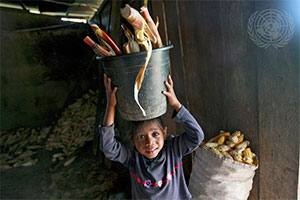 Timorese Girl with Fresh-Picked Corn. Credit: UN Photo/Martine Perret
A global common denominator is the need for a decent job. The economic realities of each country determine just how difficult it is to find one. Despite the labour movement's achievements, serious challenges persist: gender discrimination, child labour, worker migration, the digital divide and AI automation, evaporating pensions, unsafe workplaces, corporate pressure against union organising, negative impacts of trade agreements, and the precariousness of informal employment. The 2025 UN SDG Report identifies jobs and social protections as one of the six priority areas requiring urgent action, with progress either stalled or reversing in many developing nations.
In recent years, the fight to protect labour equality has taken on new dimensions with the rise of Environmental, Social and Governance standards. With the Social aspect aiming to promote equality and human rights, ESG principles have strengthened labour advocacy within corporate and governmental regulatory landscapes. In particular, ESG has become much more institutionalized in emerging economies such as Brazil and China. IPS follows the world’s workers as they confront these challenges - their setbacks and their successes.

The Week with IPS

NEXT STOP - SDGs
Tracking global progress towards a sustainable world
Tracking global progress towards a sustainable world
