Languages
Monday, October 26, 2026



News and Views from the Global South
Trade & Investment

Russians Stand Strong Against Sanctions
As the West imposes what have been called the most comprehensive sanctions on Russia since the end of the Cold War, many ordinary Russians say they have no fear of any economic measures the United States or the European Union may take against their country.
Monk Sparks Row Between Spain and China
Thubten Wangchen, a Tibetan Buddhist monk with Spanish nationality, has become a thorn in Spain-China relations since Spanish High Court judge Ismael Moreno sought international arrest orders for top Chinese leaders last month following a petition by the monk.
Swiss Step Up Arms Exports, Peacefully
Switzerland has eased its restrictions on arms exports - in order to save a few thousand workplaces. Critics fear that Switzerland's credibility as an international peace broker will now suffer.
Koreans Embrace Some Old Ways
Old family bonds still seem to run deep in the South Korea of today. For evidence, one need only look at the yearning of the elderly to meet their long separated kin in North Korea during last month’s historic family reunions.
Russian Arms to Egypt Threaten to Undermine U.S. in Mideast
Russia, which is at loggerheads with Washington over the spreading political crisis in Ukraine, is threatening to undermine a longstanding military relationship between the United States and one of its traditional allies in the Middle East: Egypt.A Matter of Life and Death
If you or some family members or friends suffer from cancer, hepatitis, AIDS, asthma or other serious ailments, it’s worth your while to follow the negotiations on the Trans Pacific Partnership Agreement and other similar bilateral trade agreements.Congress Pressured on Multinational Corporate Accountability
Advocacy and accountability groups are urging the U.S. Congress to enact new mechanisms that would allow it to hold multinational corporations accountable for rights infringements abroad.
Tahrir Square Finds a GrEEK Neighbour
The group of buildings near Tahrir Square could be modern campus-style office space anywhere. It’s hard to believe that just outside the heavy steel gates lies downtown Cairo, the noisy, polluted and now troubled heart of Egypt.
North Korea Doing Fine Without the South
If the North Korea of the 1990s was seen as a starving nation that produced an exodus of hungry people, then the picture should be even gloomier now – six years after it stopped receiving South Korea’s generous aid. But it’s not. The nation of 24 million people, widely said to be the most secretive in the world and a nuclear threat, appears to have weathered the years well.
Smuggled Medicines Save Lives
They are contraband, yet a large number of Pakistanis have come to depend on drugs made in India and smuggled into Pakistan. Patients as well as doctors say these are cheap and effective, even as law enforcers look the other way.
‘Humanitarian Crisis’ for Ogaden Living Near Ethiopia’s Oil Fields
New allegations of scorched earth evictions of the Ogaden people have raised concerns that a lack of benefit sharing could escalate instability in the region and reinforce separatist tensions as foreign energy companies prepare to extract oil and gas from troubled southeastern Ethiopia.
Poverty Rises Amidst Gold
Natural reserves such as gold, copper, nickel, gas and timber are being extracted in the western Pacific island states of Papua New Guinea and Solomon Islands to feed the soaring economies of East and South East Asia. But despite these Pacific nations recording economic growth rates of 6-11 percent over the past seven years, opportunities for human development have not been grasped.
South-South Cooperation Takes Off in Arab World
As the concept of South-South cooperation (SSC) continues to strengthen worldwide, some of the richest countries in the Arab world have been reaching out to the poor and the needy in the developing world.
Conflict on DRC, Zambia Border Threatens Regional Trade
Truck driver Alfred Ndlovu transports cobalt from the Democratic Republic of Congo’s (DRC) mineral rich Katanga Province to South Africa twice a month. He has been doing this for the last five years but now he is considering giving it up because he fears for his life every time he crosses the border.
Half of U.S. Farmland Being Eyed by Private Equity
An estimated 400 million acres of farmland in the United States will likely change hands over the coming two decades as older farmers retire, even as new evidence indicates this land is being strongly pursued by private equity investors.OECD in “Game-Changing” Move to Halt Tax Evasion
A major grouping of rich countries has unveiled a new model for the automatic exchange of certain individual financial information between countries, aimed at significantly cutting down on offshore tax evasion.
Website Welcomes Wildlife Trafficking Whistleblowers
A group of international organisations fighting illicit wildlife trafficking has unveiled a new website aimed at assisting whistleblowers who want to aid in the fight against wildlife crimes.Philippines Makes Tentative Truce With Islamists
After two years of intensive negotiations, the Philippine government and the country’s largest rebel group, the Moro Islamic Liberation Front (MILF), have signed a final peace agreement, which paves the way for a lasting resolution of one of the world’s longest-running intra-state conflicts.
Poverty Wages Unraveling Cambodia’s Garment Industry
Cambodia’s garment industry is regularly plagued with strikes and protests. But when armed security forces opened fire on striking workers in the capital city of Phnom Penh on Jan. 3, killing five and injuring dozens, it suddenly became clear that this was not just another protest.
Economic Crisis in Mali’s North as the South Recovers
Under the harsh Sunday afternoon sun, Daouda Dicko washes his client’s clothes on the shore of the Niger River, which runs through Mali’s capital, Bamako. “I started doing this to survive two years ago. Now, I am used to it and I don’t mind the extra money it brings,” Dicko, who also works as a gardener, tells IPS.
Chileans, Peruvians Unperturbed by State Conflicts
Juan González and Luis Monsalve come from different backgrounds, but have much in common. González, a 40-year-old Peruvian migrant who has lived for the past eight years in Santiago, and Monsalve, a 63-year-old Chilean, agree that border conflicts never benefit ordinary people.« Previous Page — Next Page »





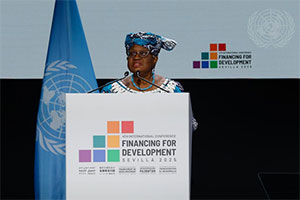 Opening of 4th International Conference on Financing for Development. Credit: UN Photo/Mariscal
International trade and investment are crucial elements of the world economy. While they can be powerful stimulators of development, they can also lead to global imbalances and dynamics of exploitation. In 2025, international trade entered a period of immense disruption, driven in part by a new wave of United States tariffs that reshaped global supply chains and investment flows. The increase in the US tariff rate, the highest since the 1930s, has forced bilateral renegotiations with global trading partners. Furthermore, the debt crisis in developing nations has accelerated while Official Development Assistance (ODA) has substantially dropped 7.3% in 2024.
In the 21st century, advancements in economic diversification in formerly colonized nations have propelled them into more central roles in the global economy. For example, both China and Mexico were able to develop their manufacturing sector and channel this development into booming export flows, thus advancing into the position of emerging economies. Foreign investment also plays an essential role in providing capital for developing countries, although they are oftentimes accompanied by social and environmental exploitation. For example, rising Chinese investments in natural resources in Latin America have often been met with tension as these investment projects fail to properly mitigate environmental risks and protect workers’ rights. In a more multifaceted vein, Sino-African relations have led to infrastructure development in Sub-Saharan Africa while also heightening the region’s economic dependency on China. IPS reports on global news in trade and investment, while shining a light on the nuanced nature of these endeavors.

The Week with IPS

NEXT STOP - SDGs
Tracking global progress towards a sustainable world
Tracking global progress towards a sustainable world
