
Friday, October 23, 2026



News and Views from the Global South
Reframing Rio

Rio+20: Creating a Future Girls Want
On a wall in the Rio conference centre is an unusual, brightly coloured tree. It is made of sticky notes, arranged so that the tree's branches extend down and out. On these notes, delegates passing by the World Association of Girl Guides and Girls Scouts (WAGGGS) have been asked to write down the futures they envision.‘Armed Youth’ to Rock Rio
Environmental and community activists from Taiwan will enliven the United Nations Sustainable Development Conference, dubbed Rio+20, and the parallel People’s Summit, with one of the island’s most prominent social protest music groups, the Village Armed Youth Band.
World Bank: Latin America Has the Green Antidote Within Reach
The natural resources of currently buoyant Latin America could be significantly depleted in less than a generation. Combined with the fact that this is the region with the greatest income inequality between the rich and the poor, the outlook might appear disastrous. But the warning, voiced by the World Bank, is not meant as cause for despair.
Q&A: Planting the Seeds for Sustainable Development
By now, the dilemma is well recognised but hardly solved: as the global population grows, resources become increasingly scarce. Indeed, food production will have to increase by a whopping 60 percent by 2050 in order to meet the future demand for food and agricultural products.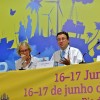
RIO+20: Ignoring Science, Negotiations Become Political Battle
The science is crystal clear: humans are threatening Earth's ability to support mankind, and a new world economy is urgently needed to prevent irreversible decline, said scientists and other experts at an event on the sidelines of the Rio+20 Earth Summit.
Youth Farmers Have Great Needs and Low Expectations from Rio+20
Ulvia Abdullayeva, from Ganja in western Azerbaijan, has come to Rio to deliver a simple but critical message to world leaders and her national authorities: small farmers need protection and financing.
RIO+20: The Two Faces of BRICS Development Aid
The BRICS countries (Brazil, Russia, India, China and South Africa) face a key choice: to opt for "good" development aid, based on sustainable development, or for the "bad" old traditional model, which they criticised when they were its recipients.
UN, People’s Summit Clash over Green Economy
U.N. Environment Programme Executive Director Achim Steiner believes that he and the Rio+20 People’s Summit agree that the global economic model has caused the current environmental destruction. But the discussion on what to replace it with turned into an acrid debate.Rio+20 and beyond: together for a sustainable future
As stated in the 1972 United Nations Conference on the Human Environment and the 1992 Earth Summit, human beings are at the centre of sustainable development. However, even today, over 900 million people still suffer from hunger. Poor populations worldwide, especially in rural areas, are among those most vulnerable to the food, climate, financial, economic, social and energy crises and threats the world faces today.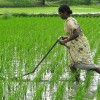
New Set of Sustainable Development Goals Looks Beyond 2015*
When world leaders from over 100 countries wind up their three-day Rio+20 summit in Brazil next week, they will leave behind the shattered remains of a slew of proposals that never got off the ground.
RIO+20: Developing Countries Accept Green Economy*
It’s not true that developing countries conditioned the inclusion of the green economy in the final document at Rio+20 on clearly defined provisions for financing, the head of the Venezuelan delegation, Claudia Salerno, told TerraViva.
Green Turns Trendy in Indonesia
JAKARTA, Jun 17 (IPS) 2012 - Studies on carbon emissions conducted in the Bogor Agricultural University (BAU) in West Java confirm that the worst culprits are students with their trendy lifestyles.
Rio+20: Concrete Goals the Only Recipe for Success
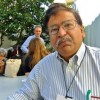
Goals drive action, and that's why establishing a set of Sustainable Development Goals is so important to put the world on a sustainable pathway, experts said Saturday under the tropical fig and palm forest that covers much of the ground at the Pontifical Catholic University of Rio de Janeiro.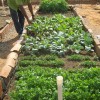
Cilantro Spices Up Coexistence with Drought in Brazil
Many grow lettuce, tomatoes, carrots, beets and other vegetables. But cilantro is ever-present in the gardens that are helping rural families weather the lengthy drought that is once again wracking Brazil’s impoverished Northeast.
Back to the Future With Local Rice Seeds
By coaxing a bumper 3.2 tonnes of rice out of each acre on his organic farm in this district famed for its ancient Buddhist monasteries, Charitha Wijeratne has convincingly proved that using indigenous seeds does not affect productivity.
Europe and Former Colonies Urge Action at Rio+20
Europe and 79 of its former colonies have sent a strong message to the U.N. Conference on Sustainable Development in Brazil next week that it should use the opportunity to both fulfill past promises and deal with "new and emerging challenges".
Earth’s Future Not for Sale, Activists Say
Just ahead of the start of the United Nations Conference on Sustainable Development (Rio+20), many are worried about the influence that corporations will have on the summit's agenda.
Liberia Looking for a Sustainable Economic Future at Rio+20
Deep in the forest in Gbarpolu County, northwest Liberia, a group of men working a surface gold mine are asked what will happen to the land when they are finished with it.
Nepal’s Female Farmers Fear Climate Change
When Arati Chaudhary’s husband left for India to find work as a migrant labourer, the job of managing farm and family fell on her slender shoulders.
Activists Aren’t Mourning Obama’s Absence at Rio Summit
When a reluctant George H.W. Bush, Sr., then U.S. president, changed his mind and decided at the eleventh hour to address the 1992 Earth Summit in Rio, he sounded defensive in his strong response to charges that the United States was one of the major powers responsible for the some of the world's worst environmental ills - from greenhouse gases to conspicuous consumption.
King of Fruit Reaps Few Rewards for Pakistani Farmers
In the summer heat, fresh mangos are the fruit of choice for politicians seeking to exchange favours with foreign dignitaries. But when it comes to global trade, the prospects of the so-called king of fruit are limited.« Previous Page — Next Page »





The Rio Plus 20 United Nations conference on sustainable development in June 2012 raised hopes over ushering in an new development paradigm through scaled-up international commitment to equitable, climate-conscious growth. Its outcome was less sweeping, leaving the development, NGO and private sector to search for alternatives to address current and impeding crises caused by resource depletion, pollution and climate change, exacerbating endemic global inequality. This special section of our site covers the full spectrum of the Earth Summit, from the lead up to the height of the conference, while continuing to track post-Rio implementation and emerging initiatives for sustainable development.

Donors & Partners


International Institute for Environment and Development

This content has been produced with the financial assistance of the European Union. The content is the sole responsibility of IPS, and can under no circumstances be regarded as reflecting the position of the European Union.

Connect for Climate

Alliance of Communicators for Sustainable Development

This website is funded through the support of the International Fund for Agricultural Development (IFAD).
