Languages
Tuesday, October 13, 2026



News and Views from the Global South
South-South
Beating Rural Poverty in South America
The development of agriculture through the adoption of technological innovations will help Latin America leave behind its status as the most unequal region in the world, and will especially benefit the Southern Cone, one of the planet’s largest food reserves.Women Using ICTs to Change the World
New technologies can transform society, and the role of women in using these tools to promote change was clearly seen at the first ICT Congress for Peace in this city in northern Spain.
Regional Trade Key to African Food Security, World Bank Says
The World Bank is urging African countries to strengthen regional food trade, suggesting that food security could be greatly enhanced simply by allowing farmers to trade more easily across the continent.
Q&A: “Developing Countries Are Doing Their Part for Biodiversity”
Developing countries are investing enormously in preserving biological diversity, and it is unimaginable that the wealthy nations will not fulfill their obligations to provide funding for these efforts, Brazilian environmental negotiator André Aranha Corrêa do Lago told Tierramérica*.
Q&A: “There Is No National Boundary for Medical Care”
For millions of people in developing countries, having cataracts means permanently impaired vision or even blindness. While treatment can fix the problem, the cost is well beyond most sufferers' reach.
Gang Truce Can Break Down, Prevention Should Be Priority
El Salvador has managed to bring down one of the world’s highest murder rates thanks to a truce between gangs that was lauded by the United Nations as an example to be followed in other countries of Central America.
The Face of Food Security Is Female
In a major endorsement for investment in women - the bulk of food growers in the developing world - United Nations Secretary General Ban Ki-moon said food security could not be achieved without women, and that the world's hungry also needed leaders to prioritise actions.
Amid Food Crisis, Caribbean Agriculture Going to Seed
With the average age of a farmer in the Caribbean now 62 years old, there is growing concern that commercial agriculture is on a path to extinction – a dire scenario for a region already shouldering a massive food import bill.
Brazil Frustrated with European “Backtracking” on IMF Reforms
In the aftermath of last week’s elections to the International Monetary Fund (IMF)’s executive board, Brazil and others are expressing frustration that a reforms process aimed at increasing the representation of developing countries is being stymied by European countries.
Shadow Over Aichi Biodiversity Targets
With negotiations to mobilise resources for preservation of biodiversity at a major United Nations conference going nowhere, the Group of 77 and China have hinted at possible suspension of the ‘Aichi targets’ under the Nagoya Protocol.
India to Conserve Biodiversity at Grassroots
India’s National Biodiversity Authority (NBA) is actively promoting decentralised grassroots livelihoods as the best way to conserve biodiversity as mandated by the Nagoya Protocol on access and benefit sharing (ABS).
Rich Nations Fall Short of Development Potential
The United States is lagging far behind other developed countries in its policies aimed at improving global prosperity, according to new research.

Africa’s Claims for Security Council Seats Still in Limbo
After 20 long years of negotiations on a proposed expansion of the Security Council, African countries continue to be left out in the cold - even as African leaders complain that the international community has failed to respond to their demands for two permanent seats in the most powerful body at the United Nations.Fiji’s Leadership of G77 a ‘Rare Opportunity’ for the Pacific
For the first time in 48 years, a Pacific Small Island Developing State (PSIDS) is gearing up to assume chairmanship of the Group of 77 developing nations plus China.
Asia: Saving Grace of Global Economy?
Developing countries – relegated to the sidelines of the West-led postwar expansion – have emerged as the saving grace of the global economy against a backdrop of calls for a new economic model that can ease the ravages of globalisation and address the lack of confidence in market-based systems.
India Ignoring Coastal Biodiversity – NGOs
Indian civil society organisations see in the 11th United Nations Conference of the Parties (COP11) to the Convention on Biodiversity (CBD), underway in this south Indian city, a rare opportunity to highlight alleged neglect of biodiversity along the country’s extensive coastal and marine areas.
South-South Cooperation Transcends Sharing Technical Knowhow
When the United Nations commemorated the Day of South-South Cooperation last month, Secretary-General Ban Ki-moon singled out a new development that transcends sharing technical know-how: coordination of government policy among developing nations.
The Brasilia Consensus, a Model for Latin America
Following the extreme neoliberalism of the Washington Consensus, which gave rise to a lost decade in social terms, Latin America is experimenting more successfully with a home-grown formula: the Brasilia Consensus, which combines the market economy and social inclusion.Venezuela Votes…and Latin America Catches a Cold
Sunday’s elections in Venezuela will determine whether the era of President Hugo Chávez's Bolivarian revolution will continue or come to an end. The result will have an impact not only on this country but on the rest of Latin America.
Q&A: “The Children Take on an Artist’s Lovely Identity, from a Young Age”
Venezuela’s youth symphony orchestras that have enamoured audiences on several continents are a social programme aimed at fighting poverty and marginalisation, more than an artistic endeavour, says the founder of the initiative, José Antonio Abreu.
Brazil Shores Up Industry to Keep Its Place as Emerging Power
The recovery of industry in Brazil, in the face of the global economic crisis that has accentuated the loss of competitiveness against manufactured products from abroad, is a high-priority task for the government in its attempt to keep the economy on a growth path.« Previous Page — Next Page »





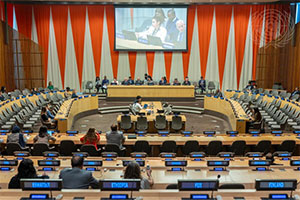 Panel Discussion on International Day for South-South Cooperation 2023. Credit: UN Photo/Cia Pak
South-South cooperation – collaboration between developing countries – is a growing and dynamic phenomenon, an important process that is vital in confronting shared challenges. Led by emerging giants, India, Brazil and South Africa (IBSA), the Global South is a tremendous source of tested solutions to development challenges, including the Millennium Development Goals (MDGs). China’s Belt and Road Initiative (BRI), launched in 2013, has further transformed South-South cooperation by enhancing infrastructure, trade, and investment linkages across Asia, Africa, and Latin America. Meanwhile, new platforms like the expansion of BRICS to include other countries such as Thailand, Nigeria, and Cuba are reshaping global economic governance and offering alternatives to traditional Western-led institutions. The Nairobi Outcome of the 2009 High-Level United Nations Conference on South-South Cooperation in Nairobi, Kenya highlights growing political and economic ties within the developing world, as countries from the Global South assume leading roles in decision-making on hot global issues ranging from economic recovery to food security, energy transitions, debt relief, and climate change. Today, the African Continental Free Trade Area and India’s “Voice of the Global South” summits have advanced frameworks for regional self-reliance, while G77 has reaffirmed commitments to resilient and inclusive economies ahead of the 16th UN Conference on Trade and Development.
Updated by Yilan Batista and Shuli Wong August 2026

The Week with IPS

NEXT STOP - SDGs
Tracking global progress towards a sustainable world
Tracking global progress towards a sustainable world
