Languages
Sunday, November 8, 2026



News and Views from the Global South
Active Citizens

Native Seeds Help Weather Climate Change in El Salvador
Knife in hand, Domitila Reyes deftly cuts open the leaves covering the cob of corn, which she carefully removes from the plant – a process she carries out over and over all morning long, standing in the middle of a sea of corn, a staple in the diet of El Salvador.
Private Nature Reserves in Latin America Seek a Bigger Role
Private voluntary nature reserves in Latin America should be seen as allies in policies on the environment, climate change mitigation and the preservation of biological diversity in rainforests, say experts.
Latin American Legislators Find New Paths to Fight Hunger
With eight specific commitments aimed at pushing through laws and policies on food security and sovereignty, family farming and school feeding programmes, legislators from 17 countries closed the Sixth Forum of the Parliamentary Front Against Hunger in Latin America and the Caribbean.
Gay Cruising Spots a Challenge for HIV/AIDS Prevention in Cuba
When night falls, young men can be seen sitting on a dismantled bus stop on a remote hill far from the centre of the Cuban capital. Later they climb uphill to have sex with other men in the thick forest.
School Meals Bolster Family Farming in Brazil
“That law should have existed since the end of slavery, which threw slaves into the street without offering them adequate conditions for working and producing, turning them into semi-slaves,” said Brazilian farmer Idevan Correa.
Open Data – Still Closed to Latin American Communities
Open data policies in Latin America have not yet enabled communities to exercise their right to access to information, consultation and participation with regard to mining or infrastructure projects that affect their surroundings and way of life.
Central America Seeks Recognition of Its Vulnerability to Climate Change
For decades, the countries of Central America have borne the heavy impact of extreme climate phenomena like hurricanes and severe drought. Now, six of them are demanding that the entire planet recognise their climate vulnerability.
Medicinal Plants Popular and Unprotected in Mexico
“This plant heals 150 ailments, like diabetes, high blood pressure and gastritis. It's prepared as an infusion or blended with water, and you take it every day," says Clemente Calixto, a traditional indigenous healer in Mexico, holding up a green leafy branch.
Native Women Green the Outskirts of the City, Feed Their Families
The hands of women who have migrated from rural areas carefully tend to their ecological vegetable gardens in the yards of their humble homes on the outskirts of Sucre, the official capital of Bolivia, in an effort to improve their families’ diets and incomes.
Youngster Uses Technology to Fight Teen Pregnancy in Honduran Village
Four years ago, Cinthia Padilla, who is now 16, learned how to use a computer in order to teach children, adolescents and adults in this isolated fishing village in northern Honduras how to use technology to better their lives.
Minorities Speak Out in Latin American Population Conference
“The countries of Latin America have not fully committed themselves to the international conventions and have not given indigenous peoples access. Nor have their contents been widely disseminated,” to help people demand compliance and enforcement, said Guatemalan activist Ángela Suc.
Healthy Oceans Key to Fighting Hunger
Seafood offers a large amount of animal protein in diets around the world, and the livelihoods of 12 percent of the global population depend directly or indirectly on fisheries and aquaculture.
The Global South Will Make Its Contribution to Fighting Climate Change
Seen for years as passive actors in the fight against global warming, more than 100 countries of the Global South have submitted their national contributions to reducing greenhouse gas emissions and decarbonising their economies.
Honduran Fishing Village Says Adios to Candles and Dirty Energy
A small fishing village on the Caribbean coast of Honduras has become an example to be followed in renewable energies, after replacing candles and dirty costly energy based on fossil fuels with hydropower from a mini-dam, while reforesting the river basin.
Men Start to Make Women’s Struggles Their Own in Argentina
The meeting was about gender equality, but for once there were more men than women. It marked a watershed in the struggle in Argentina to make the commitment to equality more than just “a women’s thing.”
Forced Disappearance, a Cancer Eating Away at Mexico
The soup kitchen of the San Gerardo parish in the southwestern Mexican state of Guerrero has become a memorial to horror. Long rows of photos have been hung on the walls of the large hall – the faces of dozens of people who were “disappeared”, abducted, extracted from their lives without a trace.
How to Fix Environmental Woes in Buenos Aires Shantytown
Children have been poisoned by lead in Villa Inflamable, a shantytown on the south side of the capital of Argentina. Resettling their families involves a socioenvironmental process as complex as the sanitation works in one of the most polluted river basins in the world.
Activists Say Fracking Fails to ‘Keep Pennsylvania Beautiful’
U.S. activist Vera Scroggins has been sued five times by the oil industry, and since October 2013 she has faced a restraining order banning her from any properties owned or leased by one of the biggest players in Pennsylvania’s natural gas rush, Cabot Oil & Gas Corporation.
Western Double Standards on Deadly Cluster Bombs
The 2008 Convention on Cluster Munitions (CCM) banned the use of these deadly weapons for two primary reasons: they release small bomblets over a wide area, posing extended risks beyond war zones, and they leave behind unexploded ordnance which have killed civilians, including women and children, long after conflicts have ended.Opinion: A Call for Public Participation in National Budget Processes
After forming governments, authorising them to tax us and to spend on our collective needs, do we remain watchful about our money? No, we don’t. Not even when we know governments borrow from money markets on the strength of the tax fund created, often beyond our means to repay. Why?
Mental Health Another Casualty of Changing Climate
Jun* is in chains, tied to a post in the small house that resembles a fragile nipa hut. His brother did this to prevent him from hurting their neighbours or other strangers he meets when he’s in a ballistic mood. Jun has been like this for three years now, but since Typhoon Haiyan hit the Philippines two years ago, his symptoms have worsened.« Previous Page — Next Page »





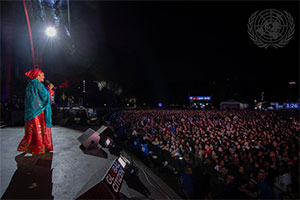 Global Citizen Festival in New York. Credit: UN Photo/Eskinder Debebe
Active citizens are committed to social change because they know that it is achievable. However, major political challenges face active citizens across the world. For example, in authoritarian regimes in Latin America where the hegemonic party has been in power for decades on end, protestors and human rights activists face enormous repression and struggle to materialize their advocacy into concrete results. The same can be said for Africans, where a shift towards elected government in recent decades has yet to translate into an effective voice in decision-making. Now, the Strengthening Citizen Demand for Good Governance, which uses evidence-based approaches – funded by DFID's Governance and Transparency Fund – seeks to raise their voices.
In 2025, the CIVICUS Monitor’s People Power Under Attack report revealed that civic freedoms are severely limited in 122 of 198 countries and territories, and only 7.2% of the global population now lives in countries where civic space is open. Through partnership with the Overseas Development Institute (ODI) and CIVICUS, IPS reporters across the continent will seek to define the extent and limits of state capability, government accountability and the responsiveness of leaders to the needs of citizens.

The Week with IPS

NEXT STOP - SDGs
Tracking global progress towards a sustainable world
Tracking global progress towards a sustainable world
