Languages
Sunday, November 15, 2026



News and Views from the Global South
Civil Society

Student Struggle in South Africa Gains Momentum
When #FeesMustFall began to trend on social media platforms in South Africa in October 2015, government shrugged it off as an example of isolated hotheads, while political pundits predicted the student campaign wouldn’t last.
U.N. Urban Summit Gives Rise to a Mixture of Optimism and Criticism
Experts and activists greeted with a mixture of hope and skepticism the Third United Nations Conference on Housing and Sustainable Urban Development (Habitat III), which opened Monday Oct. 17 in the capital of Ecuador, and which seeks to produce a new urban agenda for cities and their inhabitants.
Unexpected Eritrean Journalistic Voice Rises in Ethiopia
It took Eritrean journalist Estifo* seven years to save up enough money to pay a fixer to get him and his family from the capital, Asmara, to the shared border with Ethiopia. After they crossed the border by foot, they turned themselves in to the Ethiopian authorities and claimed asylum as refugees.
Murders, Crackdown Create Lingering Climate of Fear in Bangladesh
Like the living room of any proud family, the one in Ajoy Roy’s house boasts photos of the eldest son, Avijit.The Right to Development at 30 Years
It’s had a very useful if sometimes controversial past and it will have great relevance for many more years ahead. That’s the sense one has about the Declaration on the Right to Development as it is commemorated 30 years after its adoption by the United Nations General Assembly in 1986.
Mexico City’s Expansion Creates Tension between Residents and Authorities
People living in neighborhoods affected by the expansion of urban construction suffer a “double displacement”, with changes in their habitat and the driving up of prices in the area, in a process in which “we are not taken into account,” said Natalia Lara, a member of an assembly of local residents in the south of Mexico City.
Argentina at Risk of an Educational System Serving the Market
In Argentina, teachers, students and trade unionists are protesting against mass redundancies in education, which they say are part of a process of undermining public education and a move towards a new model based on market needs.
The Public Benefit Organisations Act Will Help Kenya’s March Towards the Sustainable Development Goals
The Sustainable Development Goals (SDGs) in Kenya was launched on 14 September 2016, Representing President Uhuru Kenyatta, the Cabinet Secretary of the Ministry of Devolution and planning Mr Mwangi Kiunjuri, said Kenya was way ahead of implementing the SDGs through its Vision 2030, and the devolved system of Governance
New Government Inherits Conflict over Peru’s Biggest Mine
Of the 150 socioeconomic conflicts related to the extractive industries that Peru’s new government inherited, one of the highest-profile is the protest by the people living near the biggest mining project in the history of the country: Las Bambas.
Economic Growth in Bangladesh: Challenge and Change for Women
A recent research study “Bangladesh: Looking Beyond Garments” conducted by the Asian Development Bank ADB has revealed that the positive economic turnaround in Bangladesh is largely due the rising presence of women in the workplace.
Global Citizenship Education Aims to Break Down Artificial Barriers
The importance of education in the promotion of peace, sustainable development and human dignity, and the prevention of violent extremism, was the focus of a Global Citizenship Education Seminar at UN headquarters in New York on Friday September 9.
Making African Palm Oil Production Sustainable
“In San Lorenzo they cut down the jungle to plant African oil palms. The only reason they didn’t expand more was that indigenous people managed to curb the spread,” Ecuadorean activist Santiago Levy said during the World Conservation Congress.
When It Comes to Conservation, Size Matters
When the communities living in the Tatamá y Serranía de los Paraguas Natural National Park in the west of Colombia organised in 1996 to defend their land and preserve the ecosystem, they were fighting deforestation, soil degradation and poaching.
Without Indigenous People, Conservation Is a Halfway Measure
“You don't convert your own house in a tourist site,” said Oussou Lio Appolinaire, an activist from Benin, wearing a traditional outfit in vivid yellows and greens. He was referring to opening up to tourists places that are sacred to indigenous people.
Big Oil and Activists Unite to Protect Endangered Whales
A rare case of intensive and decade-long collaboration between Big Oil, scientists and environmental activists has been hailed as a success story in protecting an endangered species of whale from extinction.
Yemen’s Children Deserve Better
In Yemen, conflict, violence, and bloodshed are now a daily occurrence. In spite of ongoing human rights violations global media outlets have chosen to take a back seat and remain silent. Why has the grave severity of Yemen’s rising conflict been kept in the shadows rather than exposed as a recurrent headline?
Rich Countries Should Take Development Goals Seriously Too
The UN’s new Sustainable Development Goals apply to all 193 UN member states, yet one year in some say that rich countries aren’t taking their critical role quite as seriously as they should be.
Honduras Still a Death Trap for Environmental Activists Six Months after Berta Cáceres’ Slaying
Chills ran down Tomás Gómez Membreño’s spine when he first heard about the brutal murder of his renowned friend and ally, the Honduran Indigenous leader Berta Cáceres, six months ago this week.
Obama Stresses Climate Change Urgency Ahead of IUCN Congress
U.S. President Barack Obama has stressed the urgency of tackling climate change in a speech to Pacific leaders in his home state of Hawaii.
Indigenous People Demand Shared Benefits from Forest Conservation
"Why don’t the authorities put themselves in our shoes?” asked Cándido Mezúa, an indigenous man from Panama, with respect to native peoples’ participation in conservation policies and the sharing of benefits from the protection of forests.
Mexico, a Democracy Where People Disappear at the Hands of the State
“Go and tell my dad that they’re holding me here,” Maximiliano Gordillo Martínez told his travelling companion on May 7 at the migration station in Chablé, in the southern Mexican state of Tabasco. It was the last time he was ever seen, and his parents have had no news of him since.« Previous Page — Next Page »


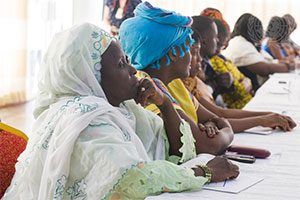 Representatives of Civil Society, Sierra Leone. Credit: UN Photo/Eskinder Debebe
Civil society faces mounting threats worldwide, even as it remains essential for democratic accountability, especially in countries struggling with economic instability and social inequality. However, at the same time, nations with weak democratic governance structures also systemically suppress the power of civil society. Human rights activists across the Global South frequently challenge issues such as political persecution and gender oppression, but in return face state-sanctioned punishment for their advocacy. Imprisonment and exile are common mechanisms of punishment that seek to erode the strength of civil society. The 2026 World Press Freedom Index has reached its lowest level in 25 years, with more than half of the world’s countries now falling into the "difficult" or “very serious” category for press freedom. IPS seeks to highlight the work of civil society across the Global South as well as the challenges that they face.
Updated by Yilan Batista and Shuli Wong August 2026

The Week with IPS

NEXT STOP - SDGs
Tracking global progress towards a sustainable world
Tracking global progress towards a sustainable world
