Languages
Sunday, November 22, 2026



News and Views from the Global South
Civil Society

Ceasefire Means ‘Nothing’ to Gaza Fishers
Shortly after Israel and Hamas signed a ceasefire agreement on Nov. 21, the Israeli navy abducted 30 Palestinian fishers from Gaza's waters, destroyed and sank a Palestinian fishing vessel, and confiscated nine fishing boats in the space of four days.
Occupation Can’t Stifle Innovation
Afnan Hamad stands proudly in front of a booth at the Ramallah Cultural Palace exhibition hall, three plastic bottles filled with discoloured liquid on the table in front of her.
Kashmiri Separatists Scrabble for Political Relevance
Amid growing scepticism among Kashmiri people that the separatist leadership has lost relevance in the region’s fast-changing political landscape, the All Parties Hurriyat (Freedom) Conference – an alliance of separatist political parties and religious and social groups - is making a Herculean effort to reclaim some relevance in this disputed region.
Some Take Cannabis Illicitly, Israelis Take it Seriously
With his shaky hands, eighty-year-old Moshe Roth can barely pour the green powder into his pipe. Seated in a wheelchair, he murmurs in a trembling voice, “Even the scent’s good.”
Washington Struggles for Relevance as Assad’s Fall Approaches
This week, the United States officially recognised the newly-formed National Coalition for Opposition and Revolutionary Forces as the legitimate representatives of the Syrian people, culminating a two-year process of legitimising the Syrian opposition with the U.S. government.
Unregulated Drug Market Has Deadly Impact in Pakistan
When 26-year-old Muhammad Qasim, a rickshaw driver from Lahore’s low-income Shahadra settlement, died last month, his family was shocked to learn that the cause of death was an overdose – of cough syrup.Civil War on the Egyptian Horizon
Egypt is facing its worst political crisis since the January 2011 revolution ousted former dictator Hosni Mubarak, with analysts warning of a possible civil war. Furthermore, unlike during the revolution, opposition to the current regime is bitterly divided between Islamists and more secular Egyptians.
Case to Abolish Gambian Death Penalty Falls on Toothless Court
The court of justice for the West African economic community is expected to hear a civil society case calling for the abolition of the death penalty in the Gambia this December, four months after the execution of nine prisoners shocked the world.
Brazil’s Economic Model Offers Ray of Hope
As governments struggle to find ways out of the persistent global financial crisis, Brazil’s development model offers an alternative path to recovery and growth, according to some economists and politicians.
Cambodian Activists Challenge ASEAN Policies
For a brief moment last month, mainstream international media turned the spotlight on Cambodia, one of the world’s 48 least developed countries (LDCs), as a high-level visit from U.S. President Barack Obama and the annual summit of the Association of Southeast Asian Nations (ASEAN) gave this country of 14.3 million people a glamorous edge.
First Muslim Human Rights Commission to Launch End December
Gathering for the first time here in Washington, representatives of the newly established human rights commission of the Organisation of Islamic Cooperation (OIC) stated Thursday that they plan to start their substantive work by the end of the month.
Q&A: For Day Labourers, Life Is a Game of Russian Roulette
They wait in parking lots, hoping for someone to come and offer them a few days of work. This work could entail anything from cleaning to construction, and though they may not be trained or equipped for these types of jobs, they have little choice, for they are day labourers, undocumented immigrants with no legal or moral support and subject at the mercy of their employers.
Constitutional Poll Polarises Egypt
This Saturday, Egyptians will head to the polls to vote on a controversial draft constitution. The referendum has divided this nation – still pulsing with the revolutionary fervour that toppled former dictator Hosni Mubarak in early 2011 - with most Islamist parties and groups supporting the proposed national charter, while liberal, leftist and 'revolutionary' groups, in addition to Egypt's sizable pro-Mubarak demographic, are opposed to it.
War Widows Struggle in a ‘Man’s World’
Sita Tamang’s husband went missing sometime in 2004, two years before Nepal’s civil war came to an end. A native of Dharan, a town about 600 kilometres southeast of Kathmandu, Tamang waited seven years after his disappearance before she tried to claim compensation offered by the government after a 2006 peace deal ended this country’s bloodshed.
Major Study Suggests Crimes Against Humanity in Sudan
Reporting on the results of a two-year investigation, on Wednesday the U.S.-based Human Rights Watch presented findings that suggest that the Sudanese government’s aerial bombardment of civilians in the country’s south could amount to crimes against humanity.
Favelas – the Football in the Run-Up to Brazil’s World Cup
Opinions are divided in Morro da Providência, Brazil's oldest favela, over construction works for the 2014 FIFA World Cup and the 2016 Olympics. While some residents are optimistic about the improvements that lie ahead, others point out that hundreds of dwellings will be demolished.
Outrage Over Acquittal in Argentine Sex Trafficking Case
The courtroom broke out in angry shouts and cries when judges in Argentina unexpectedly acquitted 13 defendants accused of kidnapping a young woman and forcing her into prostitution in 2002.
Dreams of a ‘Green Utopia’ Wither in the Maghreb
When the Desertec Industrial Initiative (DII), an alliance of 21 major European corporations, first unveiled plans to install a network of solar thermal, photovoltaic, and wind plants across the North African Maghreb region to generate electricity, the project was greeted as a ‘green utopia’.
Native Communities in Peru Take Charge of Environmental Monitoring
At the end of every month, with the skill of an environmental engineer, Wilson Sandi prepares a work plan that will be used by Achuar indigenous people, like him, to document the scars left by 40 years of oil drilling in the Peruvian Amazon region of Loreto.
Changing the Game to Achieve Nuclear Disarmament
Twenty-five years ago, on Dec. 8, presidents Mikhail Gorbachev and Ronald Reagan signed the Intermediate-Range Nuclear Forces (INF) Treaty. This historic agreement eliminated a modern class of land-based “theatre” weapons - the SS20s, cruise and Pershing missiles - that had been brought into Europe in the early 1980s.
U.S. Defends Low-Key Stance on Rwanda, Congo
President Barack Obama’s top diplomat on African affairs on Tuesday defended the U.S. administration’s response to the continued crisis in the Democratic Republic of Congo (DRC), in the face of stepped up criticism from both civil society and U.S. lawmakers.« Previous Page — Next Page »


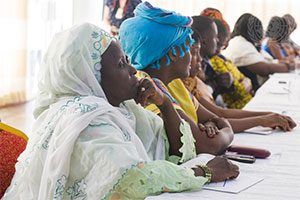 Representatives of Civil Society, Sierra Leone. Credit: UN Photo/Eskinder Debebe
Civil society faces mounting threats worldwide, even as it remains essential for democratic accountability, especially in countries struggling with economic instability and social inequality. However, at the same time, nations with weak democratic governance structures also systemically suppress the power of civil society. Human rights activists across the Global South frequently challenge issues such as political persecution and gender oppression, but in return face state-sanctioned punishment for their advocacy. Imprisonment and exile are common mechanisms of punishment that seek to erode the strength of civil society. The 2026 World Press Freedom Index has reached its lowest level in 25 years, with more than half of the world’s countries now falling into the "difficult" or “very serious” category for press freedom. IPS seeks to highlight the work of civil society across the Global South as well as the challenges that they face.
Updated by Yilan Batista and Shuli Wong August 2026

The Week with IPS

NEXT STOP - SDGs
Tracking global progress towards a sustainable world
Tracking global progress towards a sustainable world
