Languages
Monday, October 26, 2026



News and Views from the Global South
Aid
Giving Villages the Technology They Want
Mobile broadband services are seen as a key tool of development communication the world over, but people in rural Asia and Africa say telecom companies should cater to their needs and not simply impose technology on them.
Rebuilding Lives Skilfully
Farhat Bibi, 43, was left to fend for her three young sons after her husband was killed in a bomb attack in Pakistan’s Federally Administered Tribal Areas (FATA) three years ago. A few days later, she landed at a camp for people displaced by violence. “The camp proved to be a blessing in disguise,” she says.
When Home Becomes a Firing Zone
Jinba is in the crosshair of ‘Firing Zone 918’ - and ‘Firing Zone 918’ is a microcosm of the Israeli occupation. Together with seven other communities, Jinba is slated for demolition to make way for an Israeli training ground. Forced eviction hangs over a thousand Palestinians.
In the Philippines, a Vortex of Climate Change and Debt
Since Typhoon Yolanda made landfall in the Philippines on Nov. 8, the country has sent holders of its debt close to one billion dollars, surpassing, in less than two months, the 800 million dollars the U.N. has asked of international donors to help rebuild the ravaged central region of the archipelago.Women Advance in Distant Islands
Women’s political representation in the Pacific Islands region is globally the lowest at 3.65 percent, compared to the world average of 18 percent. Leadership is still widely perceived as ‘men’s business’ and voting is heavily influenced by nepotism and money politics. However, Rhoda Sikilabu, minister for community affairs in Isabel Province in the Solomon Islands is demonstrating that women leaders can drive development progress and win voter support.
And Now This Filthy Flood
Wearing tattered shoes and hopping between dirty puddles, 14-year-old Sabeh manages to find his way to the market at the Al Shati refugee camp, one of Gaza’s most heavily populated and poor areas.
World Bank Raises 52b Dollars for Poorest Countries
The World Bank has raised some 52 billion dollars, a record amount, for its fund for development in the world’s poorest countries, though some are expressing concerns over the terms under which some of this money is being offered by donor governments.
U.N. Advice to Aid Worker: Write Last Will Before Leaving Home
When Anoja Wijeyesekera, an aid worker with the U.N. children's agency UNICEF, received her new assignment in Taliban-ruled Afghanistan back in 1997, her appointment letter arrived with a "survival manual" and chilling instructions: write your last will before leaving home.
When NATO Leaves Afghanistan
Afghanistan’s 30 million people are deeply divided over whether President Hamid Karzai should sign the Bilateral Security Agreement (BSA) with Washington that will allow U.S. military operations to continue in the conflict-ravaged country after NATO forces leave in 2014.
Drug-Shunning Patients Could Derail Zimbabwe’s AIDS Plan
Each month, scores of people living with HIV gather at Mpilo's Opportunistic Infections Clinic in Bulawayo for free antiretroviral medication that has improved their lives.
Dam the Fish
“I prefer the dam to the fish,” says middle-aged farmer Ton Noun, when asked his opinion on a proposed 400 megawatt dam on Sesan river near his home in northeastern Cambodia. Then he chuckles and asks, “What fish?”
Sexual Minorities Fight for Health Services In Uganda
At an unremarkable office on Bukoto Street in the Ugandan capital, Kampala, health workers and civil society activists attend a regular meeting to offer information and advice on living with HIV and AIDS. What is unusual is that these information sessions cater to a group of around 50 transgender women.
Refugees Struggle in Ruined Camp
As the Syrian war intensifies sectarian clashes in Lebanon’s northern coastal city Tripoli, Palestinians in the area worriedly watch the violence from the sidelines.Illicit Capital Leaving Developing Countries Up by 14 Percent
Developing countries are likely losing more than a trillion dollars a year in "illicit financial flows" stemming from crime and corruption, according to new estimates. This fast-rising figure is already 10 times the total amount of foreign aid these countries are receiving.
In Home Gardens, Income and Food for Urban Poor
Flowers burst out of old tires and rows of pepper plants fill recycled plastic tubs as herbs pop out of old pipes. As utilitarian as it is cheery, this rooftop array is one of several urban agriculture projects that are significantly improving livelihoods for the urban poor in this sprawling city.
Reaching Quietly for the ‘Solidarity Basket’
In the early morning hours, as hundreds of people grab their breakfast at a busy bakery in Beogradska Street in the Serbian capital, a very special basket quickly fills up with croissants, rolls and breads. It is the ‘solidarity basket’.
Politicians’ Delay Means Climate Catastrophe for Malawi’s Poor
Delays in finalising Malawi’s climate change policy, which has been in the making for the last three years, are affecting millions of families living in disaster-prone areas across this southern African nation, says the country’s minister of environment and climate change management Halima Daudi.
Developing Countries Still Waiting for a Global Response to Climate Change
As president of the Council of Ministers of the African, Caribbean and Pacific states, Samoa's Prime Minister Tuilaepa Lupesoliai Sailele Malielegaoi had the perfect forum to voice his concerns about the effects climate change has had on his island nation.
WHO Celebrates Major Progress in Fighting Malaria
Enhanced efforts to fight malaria have saved an estimated 3.3 million lives and nearly halved the disease's global mortality rate since 2000, according to the latest edition of the World Health Organisation's (WHO) annual "World Malaria Report", released Wednesday.
Throwing the Tanzania-Zambia Railway a Lifeline
Some say it's the journey, not the destination that matters. Hop aboard the Tanzania-Zambia Railway Authority (TAZARA) line at Tanzania's Dar es Salaam port and begin the 1,860-kilometre journey to Kapiri Mposhi, a small town in Zambia's Central Province, and you may find yourself pondering this adage.
Africa Urged to Use Multilateral Approach to Achieve Sustainable Development
Africa can achieve sustainable development by scaling up "green economy" initiatives. What is needed is increased allocations from within national budgets supplemented by donor funding, claim experts.« Previous Page — Next Page »





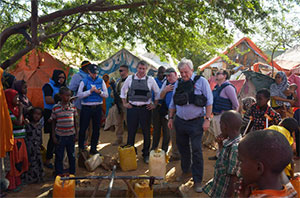 UN Emergency Relief Coordinator Visits Somalia. Credit: UN Photo/Tobin Jones
In recent years, conflicts have broken out across the world with no sign of slowing down or stopping. In times like this, millions of people globally are in dire need of humanitarian aid. Famine, warfare, natural disasters, and economic decline plague a host of nations, including Palestine, Sudan, Chad, Lebanon, and Haiti, to name a few. Humanitarian aid provides millions of people with critical services including healthcare, food, clean drinking water, psychosocial support, housing, and access to education. UN agencies such as the UNDP, UNICEF, the World Food Programme (WFP), UNHCR, UNRWA, and UNEP work with the UN Office for the Coordination of Humanitarian Aid (OCHA) and local organizations to come up with the best possible strategies to support affected communities. At the same time, humanitarian aid and those working on the frontlines are consistently threatened by both actors directly involved in conflict as well as those who are meant to contribute to the international humanitarian regime at large. The near-collapse of United States international aid structures in 2025, including the termination of 83% of USAID’s 6,300 global initiatives, has left millions of people without access to vital humanitarian assistance. 98 million people in 2025, only 65% of people targeted for humanitarian assistance, received the help they needed. In contrast, 123 million people received some form of humanitarian assistance in 2024, and OCHA’s 2026 Global Humanitarian Overview estimates that 239 million people are in need of assistance in 2026. IPS is well-positioned to discuss current initiatives to provide aid and relief through in-depth reporting and opinion content.

The Week with IPS

NEXT STOP - SDGs
Tracking global progress towards a sustainable world
Tracking global progress towards a sustainable world
