Languages
Thursday, October 22, 2026



News and Views from the Global South
Aid

OP-ED: Avoiding Another Crisis in the Central African Republic
The European Union and the United Nations will co-chair a high-level meeting in Brussels on Monday, aiming to mobilise funding to provide immediate life-saving assistance for the Central African Republic.
Africa’s Billions that the Poor Won’t Touch
With its two-trillion-dollar economy, recent discoveries of billions of dollars worth of minerals and oil, and the number of investment opportunities it has to offer global players, Africa is slowly shedding its image as a development burden.
The Road to Myanmar Is Inviting but Potholed
Myanmar is flinging open the gates to foreign investment, seen as key to the southeast Asian country's future after decades of stagnation under military rule. From Coca-Cola and Unilever to Samsung and Fujitsu, the key brands of international companies can be seen hogging billboards.
Syrian Crisis Threatens Development in Arab World
The widespread sectarian violence and ongoing military conflicts in several political hotspots, including Syria, Iraq and Lebanon, have not only claimed thousands of human lives and devastated fragile economies but also undermined the U.N.’s longstanding plans to eradicate hunger and extreme poverty worldwide.
Kuwait Tops Humanitarian Aid to Syria at Pledging Conference
As Secretary-General Ban Ki-moon grimly predicted a worsening of the monumental humanitarian disaster in war-torn Syria, the international community Wednesday pledged over 2.4 billion dollars in new funds to help the displaced and devastated in the politically-troubled Arab nation.
2014: Solutions to Ten Conflicts
There are conflicts old and new crying for solution and reconciliation, not violence, with reasonable, realistic ways out.
Natural Disasters Add to Myanmar’s Troubles
As Myanmar nurses a fragile democracy after long years of military rule, a new danger has reared its head. Climate change, say experts, has the potential to spur migration and exacerbate conflict in the country.
U.N. to Seek Billions for Syria at Kuwait Conference
When Secretary-General Ban Ki-moon chairs a U.N. pledging conference next week for urgently needed aid to Syria, he is expected to warn the donor community that the humanitarian crisis in the politically-troubled Arab nation is threatening to reach biblical proportions.
Four Years Later, USAID Funds in Haiti Still Unaccounted For
As the fourth anniversary of the devastating earthquake in Haiti approaches on Jan. 12, development analysts are decrying an ongoing lack of transparency in U.S. foreign aid to the country, even as those assistance streams are drying up.
Gaza Loses an Underground Lifeline
The border between Egypt and the Gaza Strip used to buzz with activity until a few months back as traders brought in an array of Egyptian goods – from food supplies to raw material - through hundreds of tunnels.
Christmas Storm Underlines Caribbean’s Vulnerability
Guyanese President Donald Ramotar says the death and destruction caused by intense rainfall in three Caribbean Community (CARICOM) countries over the Christmas holidays is a sign that the region has no time to lose in fortifying its resiliance to climate change.
Afghans Want Justice Before Elections
Will we get justice? That is the question many Afghans are asking as their war-ravaged country heads for presidential polls in April. For, the list of candidates includes several warlords who have been accused of heinous crimes and who are yet to be brought to justice.
Best Wishes for a Less Destitute New Year
Over the past year more than 50,000 Palestinian refugees have fled violence, chaos and destitution in Syria to seek sanctuary in Lebanon. The vast majority have found themselves living in dire poverty, and trapped in chronically insecure existence.
Pakistan’s Polio Campaign Runs Into Taliban Wall
The Taliban are proving to be a huge stumbling block for Pakistan as the South Asian nation - one of only three remaining polio endemic countries in the world – tries to fight the crippling disease.
Pakistani NGOs Fear New Year Constraints
A new policy by the Pakistani government to regulate foreign-funded non-governmental organisations (NGOs) has come in for sharp criticism from the social sector, with many saying it could stifle rights-based groups and affect crucial services provided to the needy.

Tallying Losses, St. Vincent Begins Repairs After Deadly Flood
Ralph Gonsalves fought to hold back tears as he shared how his cousin was killed the night before Christmas.Waiting for the Rains, Zambia Grapples With Climate Change
It is seven in the morning and Georgina Musende, 56, of Kamanga Township, which just lies east of the Zambian capital Lusaka, is already sweating as she digs into the dry earth. Every time the hoe hits the ground, the dust engulfs her.
West Papua Searches Far for Rights
The indigenous struggle for liberation in West Papua on the western half of the island of New Guinea in the south-west Pacific, with the loss of thousands of lives, is far from ending. But, despite political uncertainties, a united coalition of pro-independence leaders has reignited hope of freedom by galvanising the support of a Pacific Islands inter-governmental organisation.
Syrian Children Lose More Than Their Country
As refugees from Syria continue to pour into Lebanon, the majority of children are not going to school, spurring concern that they will become a ‘lost generation’.Giving Villages the Technology They Want
Mobile broadband services are seen as a key tool of development communication the world over, but people in rural Asia and Africa say telecom companies should cater to their needs and not simply impose technology on them.
Rebuilding Lives Skilfully
Farhat Bibi, 43, was left to fend for her three young sons after her husband was killed in a bomb attack in Pakistan’s Federally Administered Tribal Areas (FATA) three years ago. A few days later, she landed at a camp for people displaced by violence. “The camp proved to be a blessing in disguise,” she says.« Previous Page — Next Page »





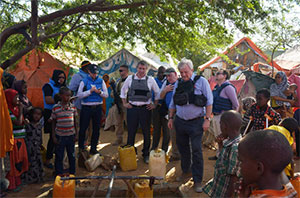 UN Emergency Relief Coordinator Visits Somalia. Credit: UN Photo/Tobin Jones
In recent years, conflicts have broken out across the world with no sign of slowing down or stopping. In times like this, millions of people globally are in dire need of humanitarian aid. Famine, warfare, natural disasters, and economic decline plague a host of nations, including Palestine, Sudan, Chad, Lebanon, and Haiti, to name a few. Humanitarian aid provides millions of people with critical services including healthcare, food, clean drinking water, psychosocial support, housing, and access to education. UN agencies such as the UNDP, UNICEF, the World Food Programme (WFP), UNHCR, UNRWA, and UNEP work with the UN Office for the Coordination of Humanitarian Aid (OCHA) and local organizations to come up with the best possible strategies to support affected communities. At the same time, humanitarian aid and those working on the frontlines are consistently threatened by both actors directly involved in conflict as well as those who are meant to contribute to the international humanitarian regime at large. The near-collapse of United States international aid structures in 2025, including the termination of 83% of USAID’s 6,300 global initiatives, has left millions of people without access to vital humanitarian assistance. 98 million people in 2025, only 65% of people targeted for humanitarian assistance, received the help they needed. In contrast, 123 million people received some form of humanitarian assistance in 2024, and OCHA’s 2026 Global Humanitarian Overview estimates that 239 million people are in need of assistance in 2026. IPS is well-positioned to discuss current initiatives to provide aid and relief through in-depth reporting and opinion content.

The Week with IPS

NEXT STOP - SDGs
Tracking global progress towards a sustainable world
Tracking global progress towards a sustainable world
