Languages
Thursday, October 22, 2026



News and Views from the Global South
Aid

Egypt’s Generals Face a Watery Battle
Heavy reliance on water intensive crops, a major upstream dam project for the Nile basin, and rising groundwater levels pushing at pharaoh-era monuments will be pressing issues for the next Egyptian president - whether military or civilian.
Saving the Tiny Island of Petite Martinique
Sanchez is a small central business district in Petite Martinique, the tiny island that forms part of the tri-nation state of Grenada, Carriacou and Petite Martinique.
Not Enough Money to Bring Peace to CAR
There are growing concerns that the massive funding crisis for peacekeeping operations in the Central African Republic (CAR) will jeopardise any prospect of restoring stability to the country.
The Longer Peace Takes, the Worse it Gets for South Sudanese
South Sudan is taking the first steps in what promises to be a long process of healing the fractures that prompted more than five weeks of fighting, potentially leaving thousands of people dead and wounded and displacing 863,000 others.
Mali’s Displaced Still Have Nothing To Return To
In her traditional orange headdress, Agaichetou Toure sits quietly in a waiting room in Kalaban-Koura, a popular neighbourhood on the outskirts of Mali’s capital Bamako.
U.S. Reforming “Outdated” Overseas Food Aid
U.S. lawmakers are in the final stages of approving reforms to a half-century-old system of providing overseas food assistance that critics say is outdated, inefficient and sometimes harmful to local economies in developing countries.
Nowhere to Come In From the Cold
As the temperature dips to zero degrees Celsius, a chill has set into the lives of people like 44-year-old Rasool Khan at the Jalozai camp for internally displaced persons (IDPs) in Pakistan. Huddled in tiny tents, with just a plastic sheet over their heads and no heat, they pass sleepless nights in the bitter cold.USAID Vows Inclusion in Fight Against Extreme Poverty
The United States' main foreign aid funder, USAID, released a mission statement Wednesday that includes new focus on ending extreme poverty while also promising to be more inclusive in incorporating civil society and other input in its decision-making.Pacific Nations Need Help Away From Aid
Long-term dependence on development aid in Pacific Island nations, many of which have been independent for 30-40 years, continues to cause concern.
Nile Delta Disappearing Beneath the Sea
It only takes a light covering of seawater to render land infertile, so Mohamed Saeed keeps a close watch on the sea as it advances year after year towards his two-hectare plot of land. The young farmer, whose clover field lies just 400 metres from Egypt's northern coast, reckons he has less than a decade before his field – and livelihood – submerges beneath the sea.
U.S. Tightens Development Safeguards
Development activists and rights watchdogs are applauding a surprise strengthening of environmental and human rights policies governing U.S. development funding and overseas financial assistance.
Ukraine Crackdown Hits Fight Against AIDS
Groups battling one of the world’s worst HIV/AIDS epidemics say their task may get “catastrophically” harder following the introduction of controversial laws in Ukraine in response to months of anti-government protests.
Swiss Spring for Syrian Refugees Passes
Switzerland facilitated family reunification for Syrians in September. So far, more than 1,100 Syrian refugees have benefited from the programme, while thousands are waiting at Swiss embassies in the region, hoping for a similar chance. Surprised by these numbers, Switzerland put an end to the programme.
OP-ED: The Arab World Has Changed, So Should Washington
As the Egyptian revolution against Hosni Mubarak celebrates its third anniversary, the military junta under General Abdel Fattah al-Sisi is resurrecting dictatorship under the veneer of “constitutional” legitimacy and on the pretense of fighting “terrorism.”
South Sudan’s Ceasefire Brings Hope For Half a Million Displaced
The overwhelming job of providing relief to the more than half a million displaced and wounded in South Sudan may have gotten a little easier with the signing of a ceasefire agreement last night in Addis Ababa, which is set to go into effect today.
As Afghan Pullout Looms, U.S. Urged to Rethink Pakistan Ties
With the 2014 deadline for a U.S. withdrawal from Afghanistan in sight, analysts here are urging Washington policymakers to drop the term ‘Af-Pak’ and recognise the importance of Pakistan beyond its implications for Afghanistan.
The Missing Faces of Ethiopia’s Poor
It’s hard to tell if Gelegay Tsegaye is smiling, since a flap of skin covers half his mouth, but his eyes crinkle when he talks and his muffled voice rings with an upbeat cadence. He’s sitting in a special ward of the Korean Hospital in Addis Ababa, Ethiopia’s most modern healthcare facility.
Elites Will ‘Consider Inequality’
With no acute crisis on the radar, this year's Annual Meeting of the World Economic Forum (WEF) will move away from the response mode of the past years and “look for solutions for the really fundamental issues,” its founder Klaus Schwab said at the pre-meeting press conference.
Questions Linger over Haiti Housing Projects
Four years after the Jan. 12, 2010 earthquake, questions continue to haunt the four main post-disaster housing projects built by the Haitian government.
Four Years After Haiti’s Earthquake, Still Waiting for a Roof
Mimose Gérard sits in her tent at Gaston Margron camp, surrounded by large bags filled with plastic bottles. She earns just pennies for each, but that’s better than nothing.Bali Package – Trade Multilateralism in the 21st Century
At the Ninth Ministerial Conference of the World Trade Organisation (WTO), held in Bali Dec. 3-7, a series of decisions was adopted aimed at streamlining trade, allowing developing countries more options for providing food security, boosting least developed countries' trade, and bolstering development in general.« Previous Page — Next Page »





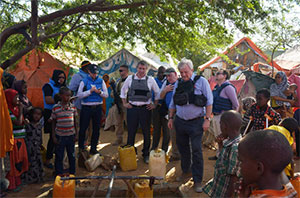 UN Emergency Relief Coordinator Visits Somalia. Credit: UN Photo/Tobin Jones
In recent years, conflicts have broken out across the world with no sign of slowing down or stopping. In times like this, millions of people globally are in dire need of humanitarian aid. Famine, warfare, natural disasters, and economic decline plague a host of nations, including Palestine, Sudan, Chad, Lebanon, and Haiti, to name a few. Humanitarian aid provides millions of people with critical services including healthcare, food, clean drinking water, psychosocial support, housing, and access to education. UN agencies such as the UNDP, UNICEF, the World Food Programme (WFP), UNHCR, UNRWA, and UNEP work with the UN Office for the Coordination of Humanitarian Aid (OCHA) and local organizations to come up with the best possible strategies to support affected communities. At the same time, humanitarian aid and those working on the frontlines are consistently threatened by both actors directly involved in conflict as well as those who are meant to contribute to the international humanitarian regime at large. The near-collapse of United States international aid structures in 2025, including the termination of 83% of USAID’s 6,300 global initiatives, has left millions of people without access to vital humanitarian assistance. 98 million people in 2025, only 65% of people targeted for humanitarian assistance, received the help they needed. In contrast, 123 million people received some form of humanitarian assistance in 2024, and OCHA’s 2026 Global Humanitarian Overview estimates that 239 million people are in need of assistance in 2026. IPS is well-positioned to discuss current initiatives to provide aid and relief through in-depth reporting and opinion content.

The Week with IPS

NEXT STOP - SDGs
Tracking global progress towards a sustainable world
Tracking global progress towards a sustainable world
