Languages
Friday, November 20, 2026



News and Views from the Global South
Food and Agriculture
ENERGY: Brazilian Biofuels Run into EU Obstacles
Brazil has begun a counterattack on the European Union's measures for certifying crop-based fuels, which could lead to import barriers for this energy source coming from the South American giant.COLOMBIA: The Violent “Agrarian Counter-Reform” Conspiracy
An unknown number of agribusiness owners and public employees at all levels, as well as far-right paramilitaries, have a common link with rural people who have been forced off their farms or killed in Colombia: the land stolen from the latter group in the armed conflict.
ENVIRONMENT: Uruguay Tries to Solve Its Forestry Puzzle
"A Uruguayan consumes 40 kilos of paper per year, compared to 400 kilos consumed by someone in Finland. We produce wood pulp to feed foreign consumption," says sociologist María Selva Ortiz, representative of the environmental group Redes-Friends of the Earth Uruguay.
Niger Facing Growing Food Crisis
In April, the United Nations World Food Programme estimated it would need 190 million dollars to respond to a food crisis threatening more than 7 million people in Niger. By July, the WFP had revised the amount needed upwards to $371 million: a month later, the U.N. agency has been forced to scale back aid for lack of funds.
RWANDA: Improving the Lives of Small-Scale Farmers
Joelle Nsamira Kajuga, a female agricultural researcher has a ready answer to describe which modified crop will produce a higher yield, which will be resistant to bacteria, and which will ensure food security and generate a higher turnover for poor small-scale farmers in different regions in Rwanda.
CHILE: Salmon Industry Won’t Give Up
The once booming salmon industry in Chile is trying to get back on its feet after the devastating health crisis that cut production in half. But its long-term viability has been called into question.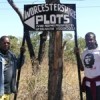
SOUTHERN AFRICA: Land Reform Underfinanced and Failing
Mavis Muchena sits on the veranda of her mud hut, a middle-aged single mother of four with a face worn beyond her years and hands creased from working the soil. She should represent the future of a renewed farming boom in Zimbabwe, but instead she represents its failure.Americas Social Forum Calls for Agriculture Based on Solidarity
Small-scale agriculture based on the principles of solidarity and cooperation is the only way to guarantee food sovereignty in Latin America, said peasant and indigenous activists meeting in the Paraguayan capital this week.GUATEMALA: Multi-Pronged Effort to Boost Food Security Still Falling Short
"I used to work on the south coast, cutting sugar cane, and I would go all the way to Belize to pick oranges during the harvest. I went through a lot so we could get by," Héctor Pan, a Q'eqchi Indian in Guatemala who has now abandoned farming to become a river rafting guide, told IPS.
SOUTH SUDAN: Children Too Hungry to Return to Civilian Life
When Timothy was forced into the southern Sudan People’s Liberation Army (SPLA) at age 11, the first thing they did was beat him. Then they took him to a military base where his tasks were to carry other soldiers’ bags, wash their clothes, collect firewood for them, and cook their food.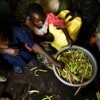
DRC Farmers Welcome Support
Farmers in the southwestern Democratic Republic of Congo are looking forward to increased production after 16 tractors and 200 ox-drawn carts were distributed across three regions in the province of Bandundu.MALAWI: A Cellphone, a Bicycle and Sound Agricultural Advice
It is 11 am and Mary Jusa seems unconcerned by the sun beating hard on her back. Humming a traditional tune, she carries on uprooting weeds in her maize field between two water canals.ECUADOR: All-Out Offensive Against Child Malnutrition
The Ecuadorean government aims over the next five years to eradicate chronic malnutrition among children under one -- 10 percent of whom are now undernourished -- and reduce the rate among children under five from the current 22 percent to seven percent.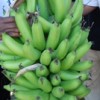
AFRICA: Modified Banana Could Cure Deadly Disease
An innovation by researchers in Nigeria could be a cure for the devastating Banana Xanthomonas Wilt (BXW) - responsible for annual losses in excess of 500 million dollars of crop across East and Central Africa. But it has also fuelled debate on the genetic engineering of crops in Africa.
Russia’s Agony a “Wake-Up Call” to the World
A wind turbine on an acre of northern Iowa farmland could generate 300,000 dollars worth of greenhouse-gas-free electricity a year. Instead, the U.S. government pays out billions of dollars to subsidise grain for ethanol fuel that has little if any impact on global warming, according to Lester Brown.ARGENTINA: Limits to Economic Growth Loom
The Argentine economy is making a rapid recovery after the impact of the global financial crisis last year, but experts warn about the limits to growth, which will reach a ceiling shortly unless investments increase.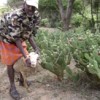
EAST AFRICA: Deadly Cactus Good for Animal Feed
Joseph Ole Morijo is baffled by research findings that cactus plants can be used as animal fodder during drought. Not after he lost his entire herd of 152 goats and sheep to the said plant.Haitians in DR Reap Far Less than They Sow
Luis Miguel, a soft-spoken and serious 21-year-old from Haiti's Artibonnite Valley, stands on a ridge overlooking the small farm in the Dominican Cibao where he works as the owner's overseer. He adopted his Dominican moniker in order to fit in.
WORLD: Cooking Up a Climate Deal
Another round of negotiations towards a global treaty on climate change concluded in Bonn on Aug. 6, with activists calling on parties to rediscover a spirit of compromise and make offers rather than demands.AFRICA: Bring Water Into Climate Change Negotiations
Longer periods of drought, decreased river flow, higher rainfall variability and lower soil moisture content: water is at the heart of the impacts of climate change. Yet the precious commodity scarcely features in climate negotiations.
Wanted: Pied Piper for Swazi Village Under Siege
When good rains finally fell, Catherine Mngomezulu was so hopeful that this year she would reap a bumper harvest. Then the rats appeared.« Previous Page — Next Page »


 Farming on the Outskirts of Juba. Credit: UN Photo/JC McIlwaine
Promoting human and planetary health is a central focus of the United Nations, as laid out in the 2030 Sustainable Development Goals (SDGs). World hunger and unsustainable farming practices continue to be pressing concerns for the world. According to the 2025 State of Food Security and Nutrition in the World report by the Food and Agriculture Organization (FAO), 673 million people faced hunger in 2024. There are stark regional disparities, with the FAO projecting that 60% of the world population facing hunger will reside in Africa by 2030. Globally, the prevalence of food insecurity has remained consistently higher for women than men.
Sustainable and efficient national food systems are essential in preserving health, education, environmental well-being, peace, economy, and security. However, creating sustainable food systems can be a challenging endeavor, as food production takes a heavy toll on the environment. The agricultural sector accounts for a significant portion of greenhouse gases. Finding safe, sustainable, and ethical strategies to feed the world is crucial in ensuring planetary longevity. A recent initiative from 2023, the EU Regulation on Deforestation-free Products (EUDR), seeks to advocate for sustainable food systems. The main driver of deforestation is the expansion of agricultural land used to produce commodities like cattle, wood, cocoa, coffee, etc. The EUDR is part of the 2020 European Green New Deal and the EU Biodiversity Strategy for 2030 and aims to limit Europe’s consumption of products linked with deforestation by requiring that companies prove that their products are deforestation-free. Despite aiming to achieve major strides in sustainability, policies such as EUDR also raise socioeconomic concerns for targeted countries. Many emerging Latin American economies are impacted by the policy, and have raised the question of how developing countries can grapple with the tensions between economic development and advancing sustainability.
IPS has been at the forefront of providing compelling and insightful stories on communities facing hunger as well as the cost of food production. IPS uses statistics from FAO, the World Food Programme (WFP) and the International Fund for Agricultural Development (IFAD) to bring relevant and hard-hitting facts to readers. This gathering of information and data from such organizations helps bring the best stories from IPS journalists working in the different regions in consultation with experts on the ground.

The Week with IPS

NEXT STOP - SDGs
Tracking global progress towards a sustainable world
Tracking global progress towards a sustainable world

