Languages
Monday, October 19, 2026



News and Views from the Global South
Population

U.N. Favours Changeover from Landlocked to ‘Land-linked’
Some 440 million people are living in 32 countries that are among the world’s poorest, most of them least developed, and geographically isolated from world markets not only because they have very few commodities to export, but also because they have no direct territorial access to the sea.
Uganda Still Grapples with Inadequate Funds to Tackle Climate Change
Until last month, Allen Nambozo's only source of income was the cabbages, carrots and bananas she grew along the slopes of Uganda’s Mount Elgon in the eastern district of Bulambuli.
Lacklustre Early Warning System Brings Tragedy to a Languid Mountainside
When early warning systems fail, death comes quickly to unsuspecting victims of natural disasters. It is a reality that millions of Sri Lankans have experienced repeatedly in the last decade, and yet those responsible for preventing human fatalities continue to make the same mistakes.
Child Poverty in Spain Seen Through the Eyes of Encarni
“I would like to have a big house, and I wish my family didn’t have to go out and ask for food or clothes,” Encarni, who just turned 12, tells IPS in the small apartment she shares with five other family members in a poor neighbourhood in the southern Spanish city of Málaga.
Another Women’s Treaty? Implement Existing One, Say NGOs
Can violence against women be prevented or eliminated with a new international treaty signed and ratified by the 193 member states of the United Nations?
Iraqi Christians Seek Shelter in Jordan after IS Threats
Watching videos and pictures on social media of the advance of the Islamic State (IS) inside Syria made it all seem far from reality to Iraqi Marvin Nafee.
Mozambique Tackles its Twin Burden of Cervical Cancer and HIV
The woman on bed 27 in Maputo Central Hospital’s oncology ward has no idea how lucky she is. In January, when abdominal pains racked her, a pharmacist suggested pain killers. For months, “the pain would go and return,” she told IPS.
Fighting the “Neighbour’s Disease” in Mozambique
 Mozambique is reeling under the twin burden of HIV and cervical cancer. Eleven women die of cervical cancer every day, or 4,000 a year. Yet this cancer is preventable and treatable, if caught early.

Better Water Management Needed to Eradicate Poverty
It demands repetition: water is a precondition for all life. It keeps us alive – literally – while being a prerequisite for or integral part of most of our daily activities. Think hospitals without water, think farms, energy producers, industries, schools and homes without our most needed resource. All sectors, without exception, are dependent on water.
Crisis Fuelled Resurgence of Horse-Drawn Carriages in Cuba
Up and down the streets of towns and cities in Cuba go horse-drawn carriages with black leather tops and large back wheels, alongside more simple carts, operating as public transportation.
Decline Before Fall of Berlin Wall
As the world marks the 25th anniversary of the fall of the famous Berlin Wall leading to the reunification of the country and the end of the cold war, a little noted event occurred nearly two decades before the fall that ushered in a trend having profound consequences for the future of Germany as well as for Europe: German births declined below deaths.
Bangladeshi ‘Char Dwellers’ in Search of Higher Ground
Jahanara Begum, a 35-year-old housewife, is surrounded by thatched-roof homes, all of which are partially submerged by floodwater.
OPINION: Keeping All Girls in School is One Way to Curb Child Marriage in Tanzania
“You cannot continue with your education. You have to get married because this man has already paid dowry for you,” Matilda H’s father told her. Matilda, from Tanzania, was 14 and had just passed her primary school exams and had been admitted to secondary school. She pleaded with her father to allow her to continue her education, but he refused.
The Invisible Reality of Spain’s Homeless
“It’s easy to end up on the street. It’s not because you led a bad life; you lose your job and you can’t afford to pay rent,” says David Cerezo while he waits for lunch to be served by a humanitarian organisation in this city in southern Spain.
Bougainville Voices Say ‘No’ to Mining
The viability of reopening the controversial Panguna copper mine in the remote mountains of Central Bougainville, an autonomous region in the east of Papua New Guinea, has been the focus of discussions led by local political leaders and foreign mining interests over the past four years.
OPINION: Ebola, Human Rights and Poverty – Making the Links
The catastrophic Ebola crisis unfolding in West Africa offers many lessons, not least for global anti-poverty efforts. These will culminate in a set of targets, to be agreed by the United Nations in 2015, known as the Sustainable Development Goals (SDGs).
Zimbabwe’s Rich Fuel Inequality Through Illicit Financial Flows
Zimbabwe has lost 12 billion dollars in illicit financial flows over the last three decades and experts say this illegal practice is perpetuating social inequalities and poverty in this southern African nation.
OPINION: Water Shutoffs and Unintended Consequences – Lessons from Detroit
United Nations Special Rapporteur on the Human Right to Safe Drinking Water and Sanitation Catarina de Albuquerque and Special Rapporteur on Adequate Housing Leilani Farha were in Detroit, Michigan Oct. 17-20.
Asia: So Close and Yet So Far From Polio Eradication
The goal is an ambitious one – to deliver a polio-free world by 2018. Towards this end, the multi-sector Global Polio Eradication Initiative (GPEI) is bringing out the big guns, sparing no expense to ensure that “every last child” is immunised against the crippling disease.
Kashmir Flood Carries Away Humble Dreams
Rafiqa Kazim and her husband Kazim Ali had a simple dream – to live a modest life, educate their four children and repay the bank-loan that the couple took out to sustain their small business.
Añelo, from Forgotten Town to Capital of Argentina’s Shale Fuel Boom
This small town in southern Argentina is nearly a century old, but the unconventional fossil fuel boom is forcing it to basically start over, from scratch. The wave of outsiders drawn by the shale fuel fever has pushed the town to its limits, while the plan to turn it into a “sustainable city of the future” is still only on paper.« Previous Page — Next Page »





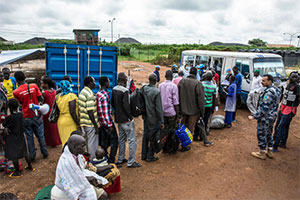 One Thousand Internally Displaced Persons (IDPs) Relocated from Tomping Camp in South Sudan. Credit: UN Photo/Isaac Billy
It took hundreds of thousands of years for the world’s human population to cross one billion in 1804. Approximately 200 years later, the population has multiplied sevenfold. In 2023, the global population crossed 8 billion, and is expected to reach 9 billion before 2050. With the planet more crowded than ever, it is essential to keep track of population trends, urbanization, migration, and reproduction across the world.
Life expectancy has seen significant strides in the past century, largely due to economic development and increased standards of living. On the contrary, trends in global fertility are shifting, with certain regions in Africa and Asia reporting higher rates, while parts of Europe and North America report stagnant or lower rates. This is in part due to differences in sexual and reproductive healthcare, as well as societal and economic conditions around the world. For example, child marriage is prevalent in certain societies, where childbearing is also considered a familial duty. Meanwhile, stagnating economies frequently experience lower marriage and childbearing rates.
The increase in migration and urban development around the world is also linked to global population trends. By 2050, it is expected that approximately 66 percent of all people will live in cities. Furthermore, global crises such as warfare and natural disasters also prompt transnational migration. Transnational migration is linked to a variety of socioeconomic issues in both host and receiving countries: migrants often leave developing countries with less access to educational and economic opportunities and arrive in developed countries where they are frequently the targets of ethnic, racial, and cultural discrimination, and economic exploitation. Recent crises in Europe and the United States demonstrate the importance of advocating for migrants worldwide. As migrants from the Global South are increasingly stripped of their legal and civic rights in unlawful deportations, or targeted in acts of identity-based violence, it is essential to keep track of population trends and protect the human rights of migrant populations. Climate-related disasters are now a major driver of displacement, with nearly half of all new internal displacements in 2025 being disaster-related.
IPS is devoted to covering issues surrounding population trends, migration, and reproduction through its compelling articles, which use both statistics and human stories to provide readers with robust and informative viewpoints.

The Week with IPS

NEXT STOP - SDGs
Tracking global progress towards a sustainable world
Tracking global progress towards a sustainable world
